Mathematics
164, 160, 156, 152, ….. are in Arithmetic Progression (A.P.). Find :
(a) which term is equal to 0.
(b) the sum of its first 20 terms.
A.P.
19 Likes
Answer
Given,
First term (a) = 164
Common difference (d) = 160 - 164 = -4
(a) Let nth term be zero.
⇒ an = 0
⇒ a + (n - 1)d = 0
⇒ 164 + (n - 1)(-4) = 0
⇒ 164 - 4n + 4 = 0
⇒ 168 - 4n = 0
⇒ 4n = 168
⇒ n =
⇒ n = 42.
Hence, 42nd term is equal to 0.
(b) By formula,
Substituting values we get :
Hence, sum of first 20 terms = 2520.
Answered By
10 Likes
Related Questions
A right circular cone of radius 20 cm has its volume 8800 cm3. Find its:
(a) height
(b) curved surface area.
Give your answer to the nearest whole number.
Construct a regular hexagon of side 4.5 cm. Hence, construct a circle circumscribing the regular hexagon. Use ruler and compass for the construction. Measure and write down the radius of the circle.
Solve the following quadratic equation:
3x2 + 6x - 4 = 0
Give your answer correct to two places of decimals.
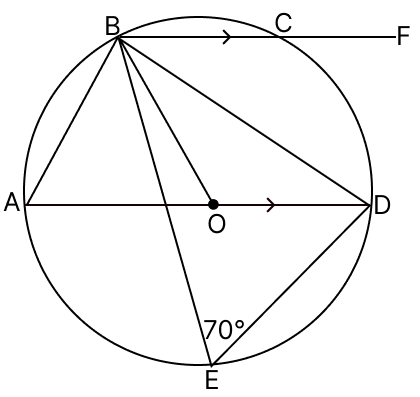
In the adjoining figure of a circle with centre O and diameter AD, ∠BED = 70° and BC is parallel to AD. Find:
(a) ∠BAD
(b) ∠BOD
(c) ∠DBC
(d) ∠DCF