
Chemistry
40 cm3 of methane (CH4) is reacted with 60 cm3 of oxygen. The equation for the reaction is given below:
CH4 + 2O2 ⟶ CO2 + 2H2O
All volumes are measured at room temperature. What is the total volume of the gases remaining at the end of the reaction?
- 60 cm3
- 40 cm3
- 45 cm3
- 50 cm3
Mole Concept
29 Likes
Answer
40 cm3
Reason — From the equation :
CH4 + 2O2 ⟶ CO2 + 2H2O
1 volume of CH4 reacts with 2 volumes of O2
For 40 cm3 of CH4 the required O2 is 40 cm3 x 2 = 80 cm3
Since only 60 cm3 of O2 is available.
The amount of CH4 that reacts with 60 cm3 of O2 is = = 30 cm3
∴ The excess CH4 remaining is 40 cm3 - 30 cm3 = 10 cm3
From the balanced equation, 2 volumes of O2 produce 1 volume of CO2.
∴ The volume of CO2 produced from 60 cm of O2 is = 30 cm3
The remaining gases are excess CH4 and produced CO2.
∴ Total volume = 10 cm3 (excess CH4) + 30 cm3 (CO2) = 40 cm3
Answered By
18 Likes
Related Questions
Aqueous copper (II) sulphate is electrolysed using copper electrodes. Which statement about the electrolysis is not correct?
- An oxidation reaction occurs at the positive electrode.
- The current is carried through the electrolyte by ions.
- The positive electrode loses mass.
- The number of copper (II) ions in the electrolyte decreases.
X, Y & Z are three metallic atoms in successive order belonging to the same group such that atomic radii of ‘X’ is the smallest. Which of the three atoms is the best reducing agent?
- X
- Y
- Z
- All three have the same reducing power.
A student was instructed by the teacher to prepare and collect ammonia gas in the laboratory by using aluminium nitride. The student had set up the apparatus as shown in the diagram below. Study the given diagram and answer the following questions:
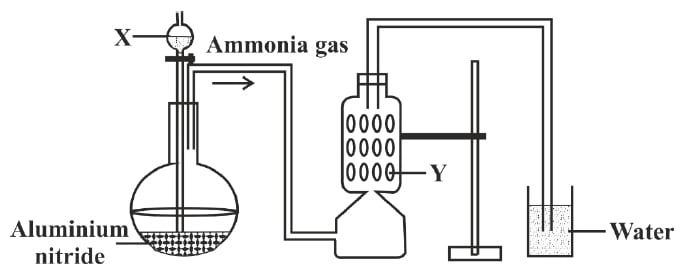
(a) Name the substance X added through the thistle funnel by the student.
(b) Write a balanced equation for the reaction occurring between Aluminium nitride and substance X.
(c) Identify the substance Y.
(d) State the function of Y.
(e) Why could the student not collect ammonia gas at the end of the experiment?
State the terms for the following:
(a) Undistilled alcohol containing a large amount of methanol.
(b) A salt formed by the partial replacement of the hydroxyl group of a di-acidic or a tri-acidic base by an acid radical.
(c) Organic compounds having the same molecular formula but different structural formula.
(d) The tendency of an atom to attract the shared pair of electrons towards itself when combined in a compound.
(e) The type of covalent bond in which electrons are shared unequally between the combining atoms.