
Mathematics
A man bought a certain number of chairs for ₹ 10000. He kept one for his own use and sold the rest at the rate ₹ 50 more than he gave for one chair. Besides getting his own chair for nothing, he made a profit of ₹ 450. How many chairs did he buy ?
Quadratic Equations
39 Likes
Answer
Given,
Man bought a certain number of chairs for ₹ 10000.
Let no. of chairs bought be x.
∴ Cost of one chair = ₹
S.P. of each chair = ₹
Since, he kept one chair for himself so he sold (x - 1) chairs.
Given,
⇒ Profit = ₹ 450
⇒ S.P. - C.P. = ₹ 450
Since no. of chairs cannot be negative.
∴ x = 20.
Hence, no. of chairs bought = 20.
Answered By
21 Likes
Related Questions
The time taken by a person to cover 150 km was 2.5 hours more than the time taken in return journey. If he returned at a speed of 10 km/hour more than the speed of going, what was the speed per hour in each direction ?
A takes 9 days more than B to do a certain piece of work. Together they can do the work in 6 days. How many days will A alone take to do the work ?
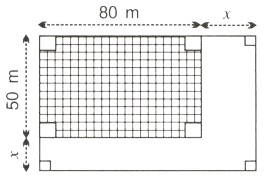
In the given figure; the area of unshaded portion is 75% of the area of the shaded portion. Find the value of x.
Solve for x : .