
Physics
A ray of light is incident normally on a plane glass slab. What will be (i) the angle of refraction and (ii) the angle of deviation for the ray?
Refraction Plane Surfaces
288 Likes
Answer
(i) The ray of light incident normally on a plane glass slab passes undeviated, ( i.e. such a ray suffers no bending at the surface). Thus, if angle of incidence ∠i = 0°, then the angle of refraction ∠r = 0°.
(ii) In the case when ray of light is incident normally on a plane glass slab, it passes undeviated. Hence, the angle of deviation is 0°.
Answered By
170 Likes
Related Questions
The optical density of turpentine is higher than that of water, while its mass density is lower than water. The figure given below shows a layer of turpentine floating over water taken in a container. For which one of the four rays incident on turpentine in the path shown in the figure is correct?
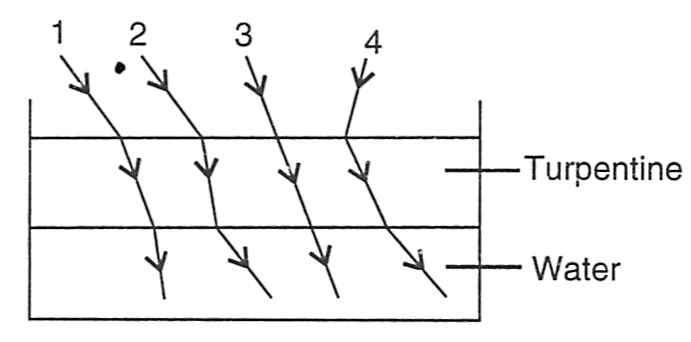
- Ray 1
- Ray 2
- Ray 3
- Ray 4
With respect to light passing from air into water, which of the following statements is correct?
- Angle of incidence is equal to the angle of refraction.
- Angle of incidence is always greater than the angle of refraction
- Angle of incidence is always less than the angle of refraction
- Angle of incidence has no effect on the angle of refraction.
For the same angle of incidence, the angles of refraction in three different media A, B and C are 15°, 25°, and 35° respectively. In which medium will the velocity of light be minimum?
Can relative refractive index of a medium with respect to another medium be less than unity? If yes, give example.