Mathematics
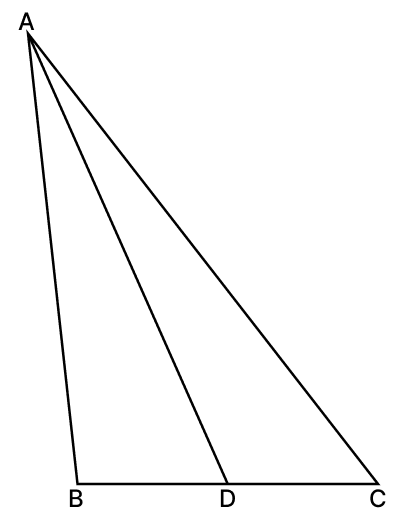
In a ΔABC, AB = 10 cm, AC = 14 cm and BC = 6 cm. If AD is the internal bisector of ∠A, then CD is equal to:
3.5 cm
4.8 cm
7 cm
10.5 cm
Similarity
2 Likes
Answer
Construction: Draw a line through C parallel to AD, meeting BA produced at E.
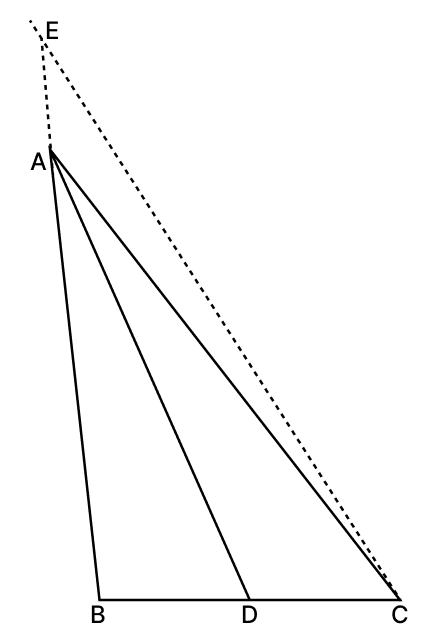
Since AD ∥ EC and BE is the transversal:
∠BAD = ∠AEC [Corresponding angles are equal]
Since AD ∥ EC and AC is the transversal:
∠DAC = ∠ACE [Alternate interior angles]
Given AD is the bisector of ∠A:
∠BAD = ∠DAC
∴ ∠AEC = ∠ACE
In ΔACE, sides opposite to equal angles are equal.
∴ AE = AC = 14 cm
Let DC be x,
Now, in ΔBCE, we have AD ∥ EC. By Basic Proportionality Theorem,
Let CD = x.
Then BD = BC - CD = 6 - x.
Substituting these values into the ratio:
Thus, CD = 3.5 cm.
Hence, option 1 is the correct option.
Answered By
1 Like
Related Questions
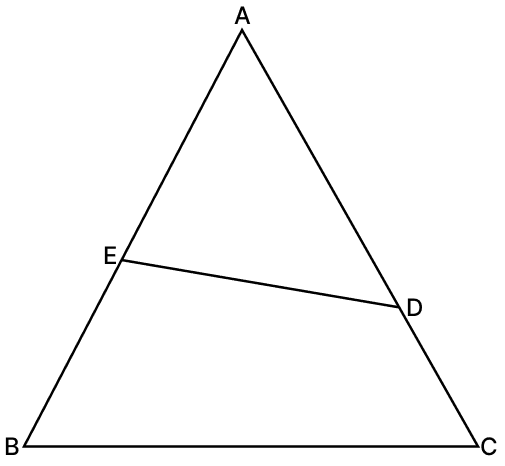
In the adjoining figure, ∠ADE = ∠ABC, AE = 8 cm, EB = 7 cm, BC = 9 cm, AD = 10 cm and DC = 2 cm. Then the length of DE is:
6 cm
6.75 cm
7.8 cm
13.5 cm
In ΔABC, it is given that AB = 9 cm, BC = 6 cm and CA = 7.5 cm. Also ΔDEF is given such that EF = 8 cm and ΔDEF ∼ ΔABC. Then the perimeter of ΔDEF is:
22.5 cm
25 cm
27 cm
30 cm
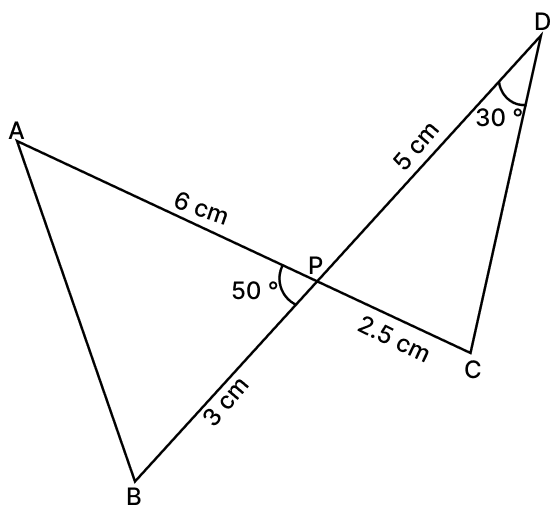
In the given figure, two line segments AC and BD intersect each other at point P such that PA = 6 cm, PB = 3 cm, PC = 2.5 cm, PD = 5 cm, ∠APB = 50° and ∠CDP = 30°. Then ∠PBA = ?
30°
50°
60°
100°
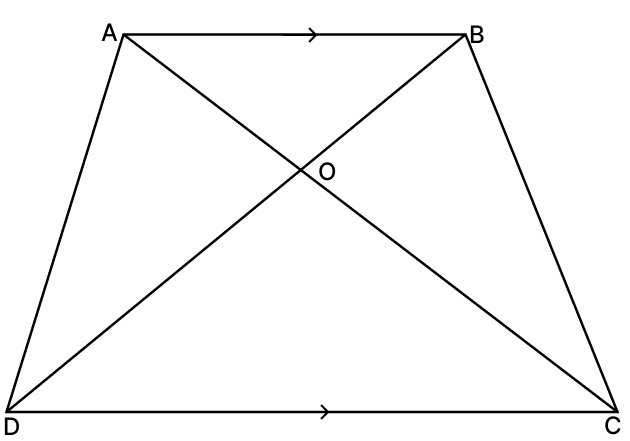
ABCD is a trapezium with AB parallel to DC. Then the triangle similar to ΔAOB is:
ΔACB
ΔADB
ΔCOB
ΔCOD