
Mathematics
In ΔABC, ∠ABC = 90°, AB = 20 cm, AC = 25 cm, DE is perpendicular to AC such that ∠DEA = 90° and DE = 3 cm as shown in the given figure.
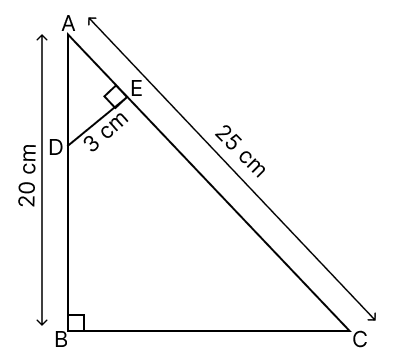
(a) Prove that ΔABC ~ ΔAED.
(b) Find the lengths of BC, AD and AE.
(c) If BCED represents a plot of land on a map whose actual area on ground is 576 m2, then find the scale factor of the map.
Similarity
46 Likes
Answer
(a) In ΔABC and ΔAED,
⇒ ∠ABC = ∠AED [Both = 90°]
⇒ ∠BAC = ∠DAE [Common angles]
∴ ΔABC ~ ΔAED (By AA similarity postulate)
Hence, proved that ΔABC ~ ΔAED.
(b) Given,
AB = 20 cm, AC = 25 cm, DE = 3 cm
In ΔABC,
By pythagoras theorem,
⇒ AB2 + BC2 = AC2
⇒ (20)2 + BC2 = (25)2
⇒ 400 + BC2 = 625
⇒ BC2 = 625 - 400
⇒ BC2 = 225
⇒ BC =
⇒ BC = 15 cm.
We know that,
Since, corresponding sides of similar triangles are proportional we have :
Solving,
Substituting values in we get :
Hence, BC = 15 cm, AE = 4 cm, AD = 5 cm.
(c) Given,
Area on ground = 576 m2
By formula,
Area of triangle = × base × height
Area of ΔABC = × AB × BC
=
= 150 cm2.
Area of ΔAED = × AE × DE
= 6 cm2.
From figure,
⇒ Area of Quadrilateral (BCED) = Area of ΔABC - Area of ΔAED
= 150 - 6 = 144 cm2.
⇒ Actual ground area = 576 m2
= 576 × 10000 cm2 = 5760000 cm2
Let scale factor be k.
By formula,
k2 =
Substituting values we get :
Hence, scale factor equals 1 : 200.
Answered By
29 Likes
Related Questions
Solve the following quadratic equation 2x2 − 5x − 4 = 0. Give your answer correct to three significant figures.
Mrs. Rao deposited ₹ 250 per month in a recurring deposit account for a period of 3 years. She received ₹ 10,110 at the time of maturity. Find:
(a) the rate of interest.
(b) how much more interest Mrs. Rao will receive if she had deposited ₹50 more per month at the same rate of interest and for the same time.
Use ruler and compass for the following construction. Construct a ΔABC, where AB = 6 cm, AC = 4.5 cm and ∠BAC = 120°. Construct a circle circumscribing the ΔABC. Measure and write down the length of the radius of the circle.
Find:
(a) A + C
(b) B(A + C)
(c) 5B
(d) B(A + C) − 5B