
Mathematics
ABCD is a parallelogram. P and Q are the mid-points of sides AB and AD respectively. Prove that area of triangle APQ = of the area of parallelogram ABCD.
Theorems on Area
13 Likes
Answer
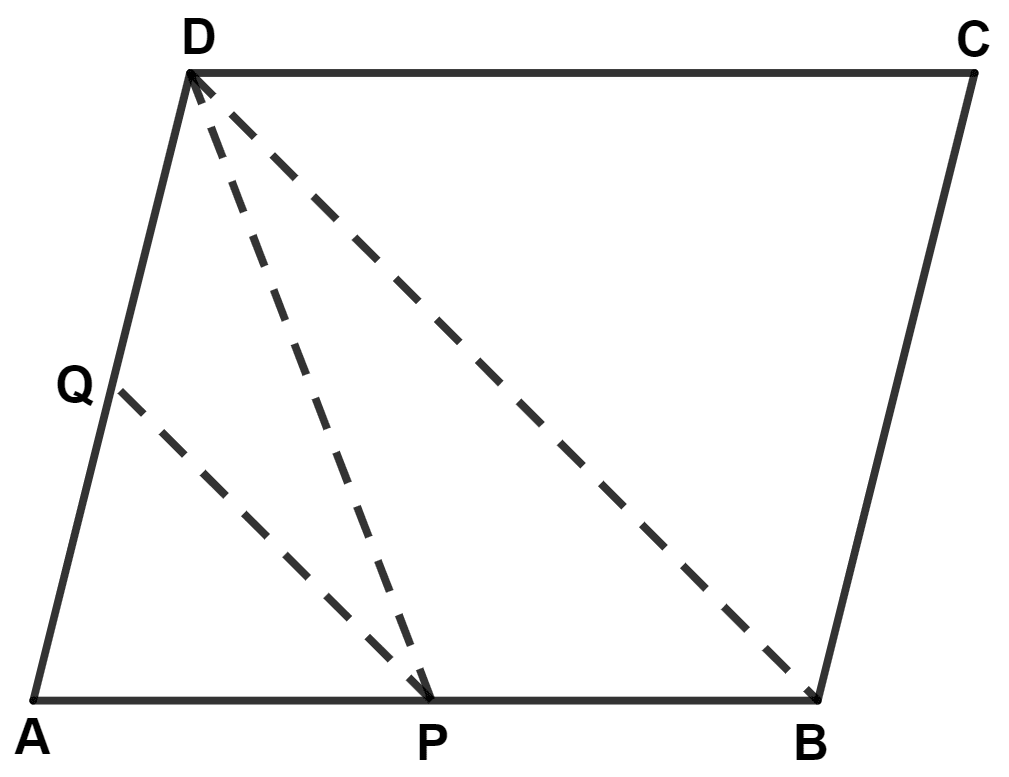
From figure,
ABCD is the parallelogram and BD is the diagonal of the parallelogram.
∴ BD divides || gm ABCD into two triangles of equal area.
∴ Area of Δ ABD = Area of Δ DBC = Area of || gm ABCD ……….(1)
Since, P is the mid-point of AB,
∴ DP is the median of Δ ABD.
∴ Area of Δ APD = Area of Δ DPB = Area of Δ ABD (Median divides triangle into two triangles of equal area)
⇒ Area of Δ APD = Area of Δ ABD
⇒ Area of Δ APD = Area of || gm ABCD [From equation (1)]
⇒ Area of Δ APD = Area of || gm ABCD …….(2)
In Δ APD,
Q is the mid-point of AD.
∴ PQ is the median.
∴ Area of Δ APQ = Area of Δ DPQ = Area of Δ APD
⇒ Area of Δ APQ = Area of Δ APD
⇒ Area of Δ APQ = Area of || gm ABCD [From equation (2)]
⇒ Area of Δ APQ = Area of || gm ABCD.
Hence, proved that area of Δ APQ = area of || gm ABCD.
Answered By
8 Likes
Related Questions
In the given figure; AD is median of △ ABC and E is any point on median AD. Prove that Area (△ ABE) = Area (△ ACE).
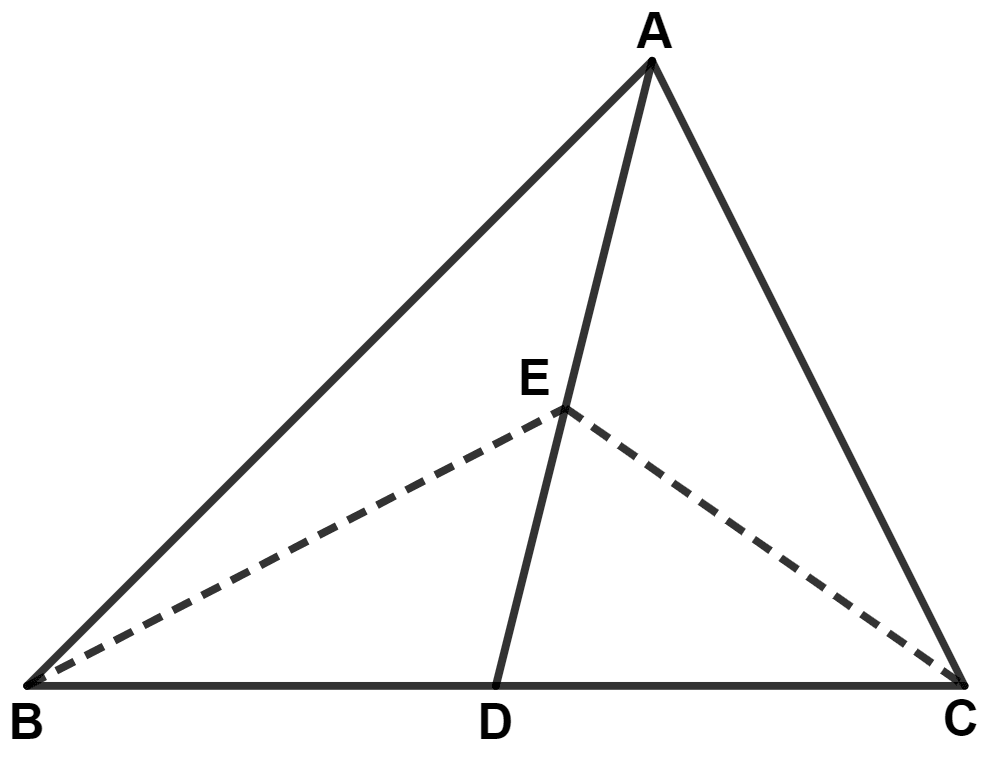
In the figure of question 14, if E is the mid point of median AD, then prove that :
Area (△ ABE) = Area (△ ABC).
The base BC of triangle ABC is divided at D so that BD = DC.
Prove that the area of Δ ABD = of the area of Δ ABC.
In a parallelogram ABCD, point P lies in DC such that DP : PC = 3 : 2. If area of Δ DPB = 30 sq.cm, find the area of the parallelogram ABCD.