
Mathematics
AD is altitude of an isosceles triangle ABC in which AB = AC = 30 cm and BC = 36 cm. A point O is marked on AD in such a way that ∠BOC = 90°. Find the area of quadrilateral ABOC.
Mensuration
8 Likes
Answer
ΔABC is shown in the figure below:
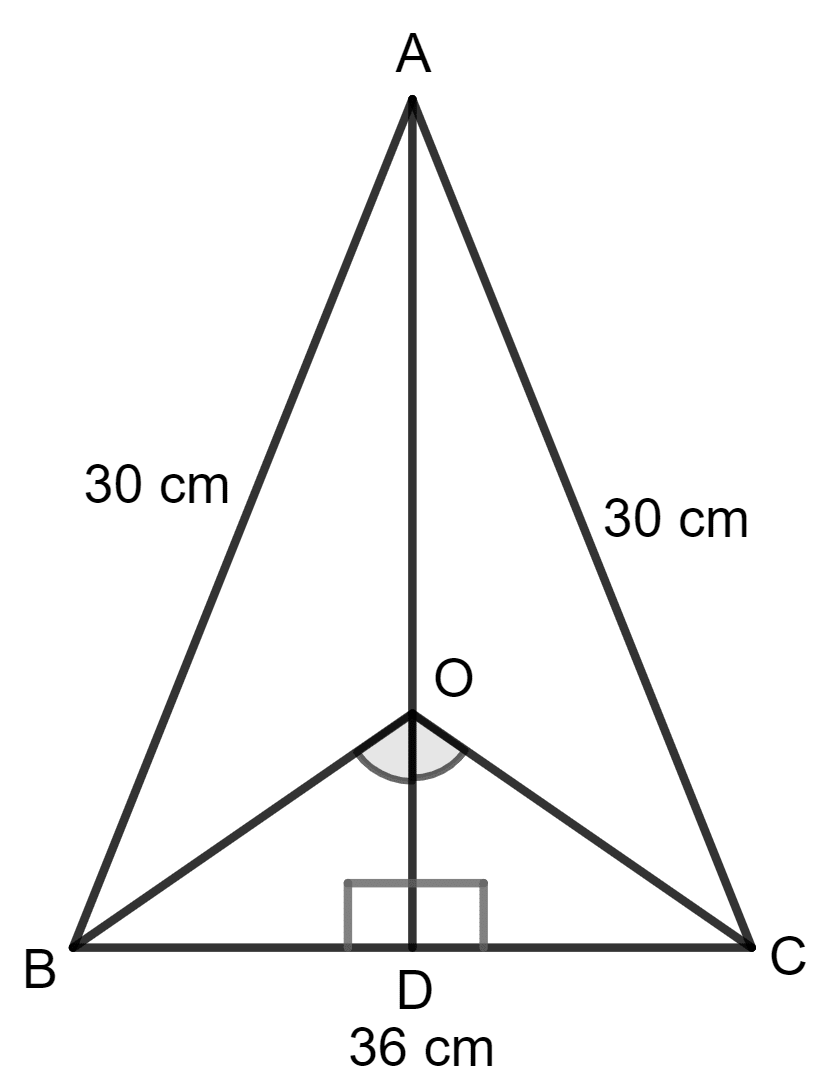
Area of isosceles triangle ABC =
∠ BOC = ∠ COD = 45° (∵ AD divide ∠ BOC in 2 equal halves)
Let OB = OC = x.
In Δ BOC, by using the Pythagoras theorem,
OB2 + OC2 = BC2
⇒ x2 + x2 = (36)2
⇒ 2x2 = 1,296
⇒ x2 =
⇒ x2 = 648
⇒ x =
⇒ x = 18
Now the area of triangle BOC = x base x height
Area of quadrilateral ABOC = Area of Δ ABC - Area of Δ BOC
= 432 - 324 cm2
= 108 cm2
Hence, the area of quadrilateral ABOC is 108 cm2.
Answered By
5 Likes
Related Questions
Assertion (A): The perimeter of the adjoining figure is (32 + x) cm.
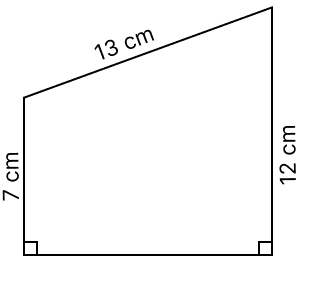
Reason (R): x2 = 132 - 52 = 144 and x = 12 cm.
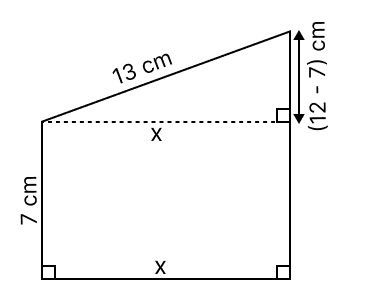
Perimeter = (32 + 12) cm
A is true, but R is false.
A is false, but R is true.
Both A and R are true, and R is the correct reason for A.
Both A and R are true, and R is the incorrect reason for A.
Assertion (A): If BC = 14 cm, AB = 14 x 4 cm
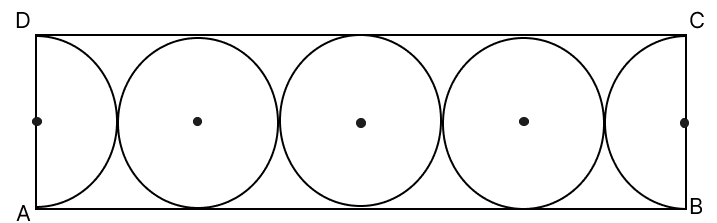
Reason (R): AB = 4 x 2r = 4 x 14 cm
A is true, but R is false.
A is false, but R is true.
Both A and R are true, and R is the correct reason for A.
Both A and R are true, and R is the incorrect reason for A.
A footpath of uniform width runs all around the outside of a rectangular field 30 m long and 24 m wide. If the path occupies an area of 360 m2, find its width.
A wire when bent in the form of a square encloses an area of 484 m2. Find the largest area enclosed by the same wire when bent to form :
(i) an equilateral triangle.
(ii) a rectangle of breadth 16 m.