
Mathematics
Adjacent sides of a parallelogram are equal and one of diagonals is equal to any one of the sides of this parallelogram. Show that its diagonals are in the ratio .
Mid-point Theorem
8 Likes
Answer
Let ABCD be the required parallelogram.
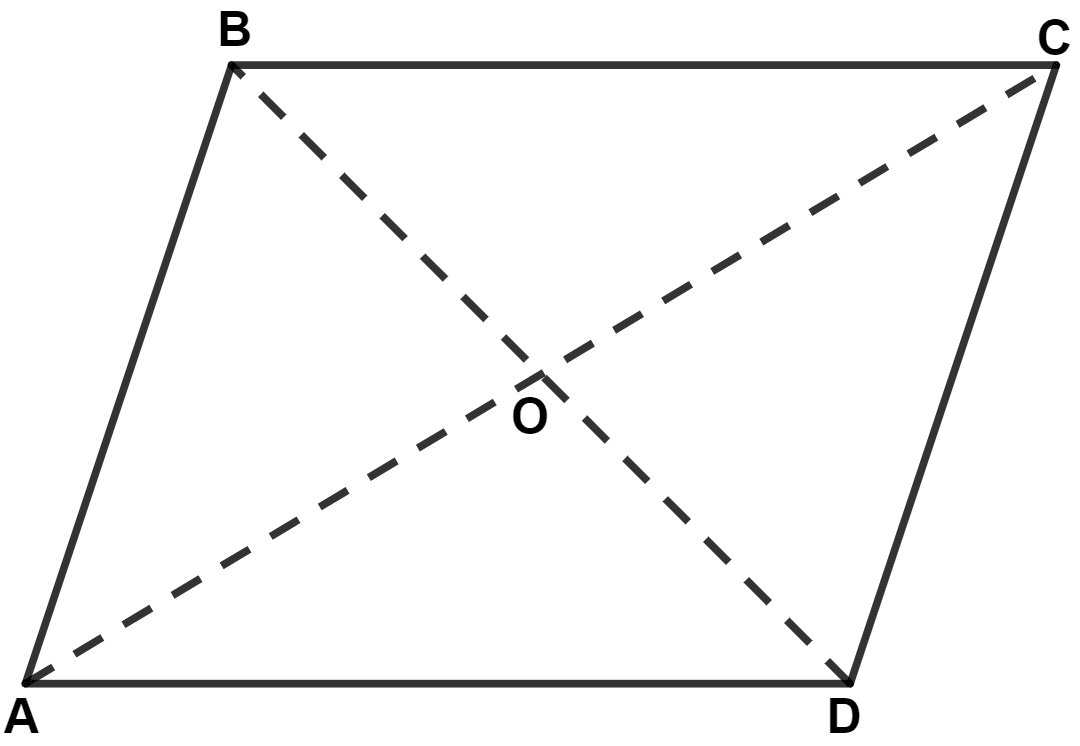
∴ AB = CD and BC = AD. (Opposite sides of parallelogram are equal)
Given,
Adjacent sides of a parallelogram are equal.
∴ AB = BC.
∴ AB = BC = CD = AD
Since, all sides of parallelogram are equal.
∴ ABCD is a rhombus.
Given, one of the diagonals is equal to its sides. Let diagonal BD be equal to sides.
∴ AB = BC = CD = AD = BD = a (let).
From figure,
⇒ BO = (Since, in a rhombus diagonals bisect each other at right angle).
Hence, △ AOB is right-angled at O.
In △ AOB,
By pythagoras theorem,
⇒ AB2 = BO2 + AO2
⇒ a2 = + AO2
⇒ AO2 =
⇒ AO2 =
⇒ AO2 =
⇒ AO = ,
⇒ AC = 2AO = units.
The ratio of the diagonals is:
∴ AC : BD = : 1.
Hence, proved that diagonals are in the ratio : 1.
Answered By
5 Likes
Related Questions
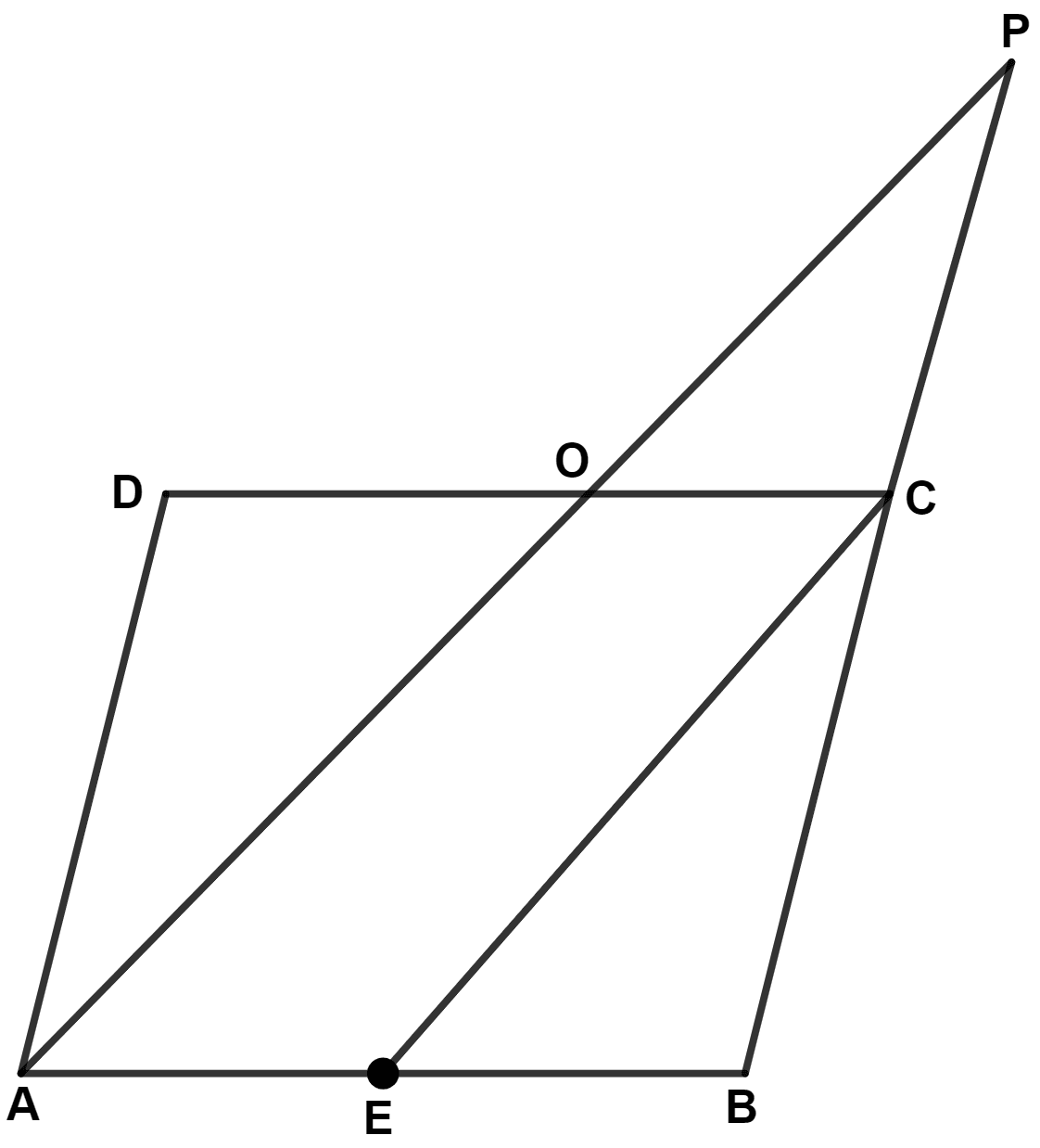
In parallelogram ABCD, E is the mid-point of AB and AP is parallel to EC which meets DC at point O and BC produced at P. Prove that :
(i) BP = 2AD
(ii) O is mid-point of AP.
In a trapezium ABCD, sides AB and DC are parallel to each other. E is mid-point of AD and F is mid-point of BC.
Prove that :
AB + DC = 2EF.
In △ ABC, AD is the median and DE is parallel to BA, where E is a point in AC. Prove that BE is also a median.
A school designing a triangular garden △ABC. To construct a walking path inside the garden, the gardener marks the mid-points of two sides: point D is the mid-point of side AB and point E is the midpoint of side AC. The path DE is drawn to connect these mid-points. The length of side BC of the triangular garden is 12 m, AB = 10 m and AC = 10 m.
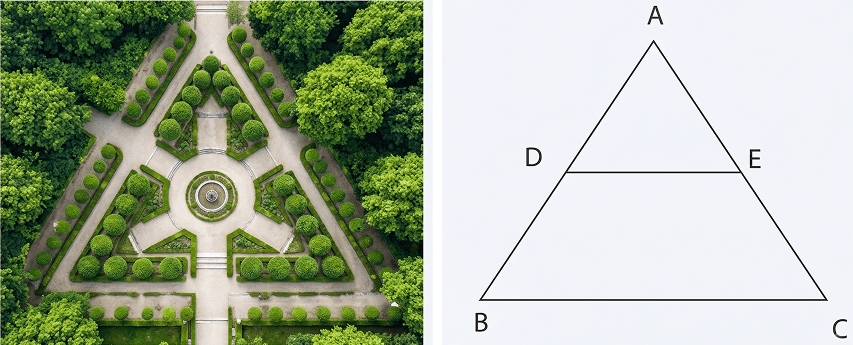
Based on the above information answer the following:
(i) What is the length of path DE?
(ii) Assign a special name to Quadrilateral BCED and find its perimeter.