Mathematics
Answer
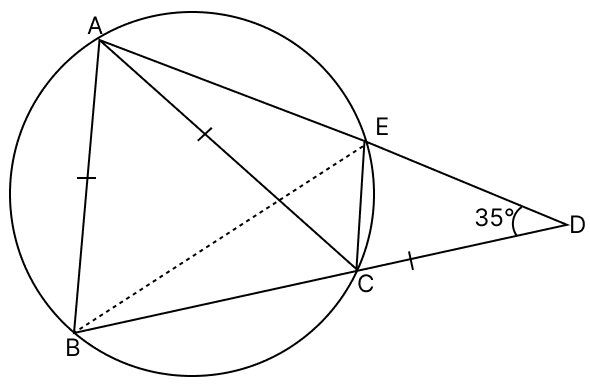
(i) Given,
AC = CD
In triangle ACD,
∠DAC = ∠ADC = 35° [Angles opposite to equal sides in a triangle are equal]
In △ACD,
⇒ ∠DAC + ∠ADC + ∠ACD = 180°
⇒ 35° + 35° + ∠ACD = 180°
⇒ 70° + ∠ACD = 180°
⇒ ∠ACD = 180° - 70° = 110°.
From figure,
⇒ ∠ACB + ∠ACD = 180° [Linear pair]
⇒ ∠ACB + 110° = 180°
⇒ ∠ACB = 180° - 110° = 70°.
Given,
AB = AC
∴ ∠ABC = ∠ACB = 70°. [As angles opposite to equal sides are equal]
Hence, ∠ABC = 70°.
(ii) In △ABC,
⇒ ∠BAC + ∠ACB + ∠ABC = 180° [Angle sum property of triangle]
⇒ ∠BAC + 70° + 70° = 180°
⇒ ∠BAC + 140° = 180°
⇒ ∠BAC = 180° - 140° = 40°.
We know that,
Angles in same segment are equal.
⇒ ∠BEC = ∠BAC = 40°.
Hence, ∠BEC = 40°.
Related Questions
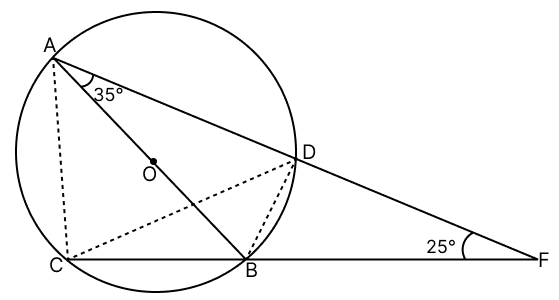
In the given figure, AB is a diameter of a circle with centre O. If ADF and CBF are straight lines, meeting at F such that ∠BAD = 35° and ∠BFD = 25°, find :
(i) ∠DCB
(ii) ∠DBC
(iii) ∠BDC
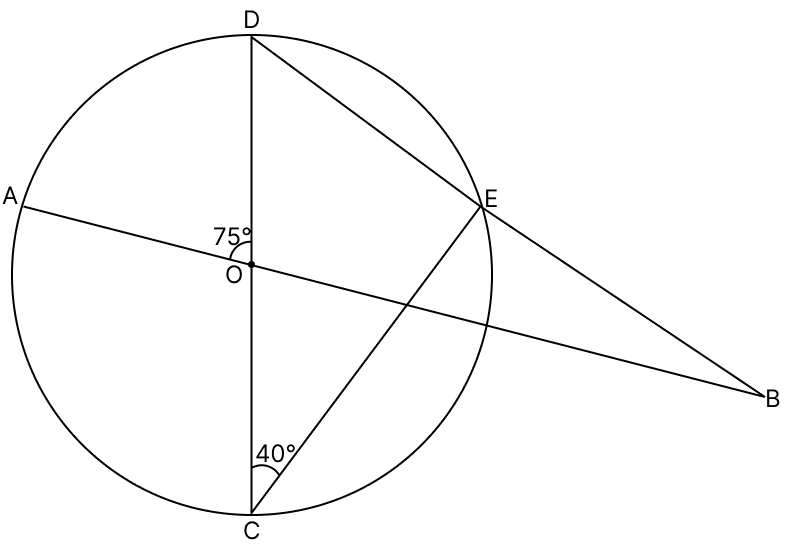
In the given figure, the straight lines AB and CD pass through the centre O of the circle. If ∠AOD = 75° and ∠OCE = 40°, find :
(i) ∠CDE
(ii) ∠OBE.
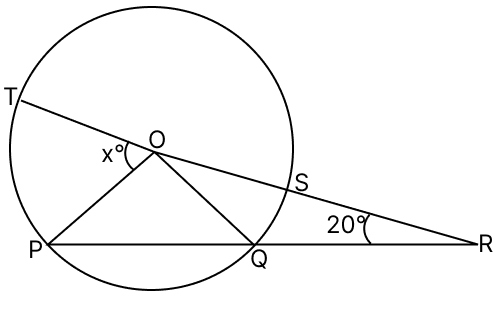
In the given figure, O is the centre of the circle. If QR = OP and ∠ORP = 20°, find the value of x giving reasons.