Mathematics
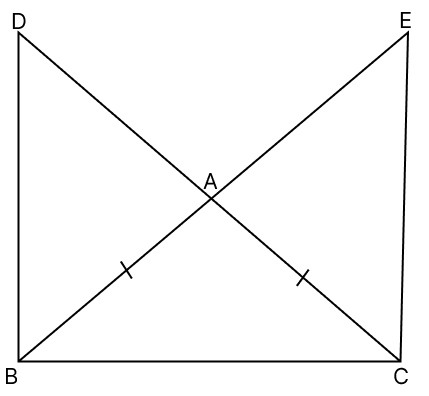
In the adjoining figure, AB = AC. If DB ⊥ BC and EC ⊥ BC, prove that :
(i) BD = CE
(ii) AD = AE
Answer
In △ABC,
AB = AC
⇒ ∠ABC = ∠ACB = x (let) (Angles opposite to equal sides in a triangle are equal)
Given, DB ⊥ BC, ∠DBC = 90°.
From figure,
⇒ ∠DBC = ∠DBA + ∠ABC
⇒ 90° = ∠DBA + x
⇒ ∠DBA = 90° - x …..(1)
Given, EC ⊥ BC, ∠ECB = 90°.
From figure,
⇒ ∠ECB = ∠ECA + ∠ACB
⇒ 90° = ∠ECA + x
⇒ ∠ECA = 90° - x …..(2)
From eq.(1) and (2), we have:
⇒ ∠DBA = ∠ECA
In △ABD and △ACE,
⇒ AB = AC (Given)
⇒ ∠DBA = ∠ECA (Proved above)
⇒ ∠DAB = ∠CAE (Vertically opposite angles are equal)
∴ △ABD ≅ △ACE (By A.S.A axiom)
(i) Since, △ABD ≅ △ACE
⇒ BD = CE (Corresponding parts of congruent triangles are equal)
Hence, proved that BD = CE.
(ii) Since, △ABD ≅ △ACE
⇒ AD = AE (Corresponding parts of congruent triangles are equal)
Hence, proved that AD = AE.
Related Questions
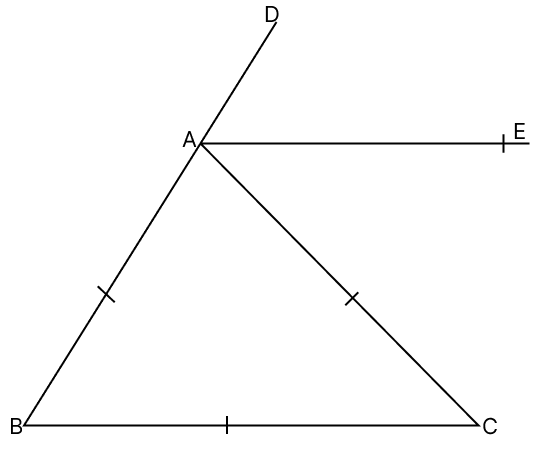
In the given figure, AB = AC and side BA has been produced to D. If AE is the bisector of ∠CAD, prove that AE || BC
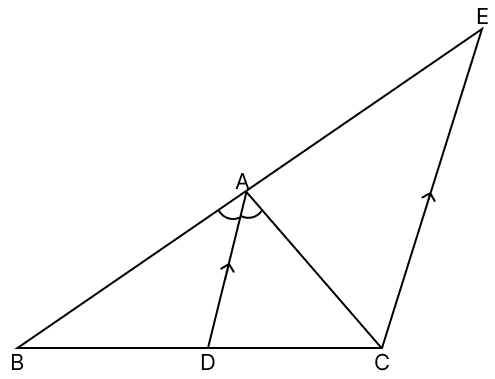
In the given figure, AD is the internal bisector of ∠A and CE || DA. If CE meets BA produced at E, prove that △CAE is isosceles.
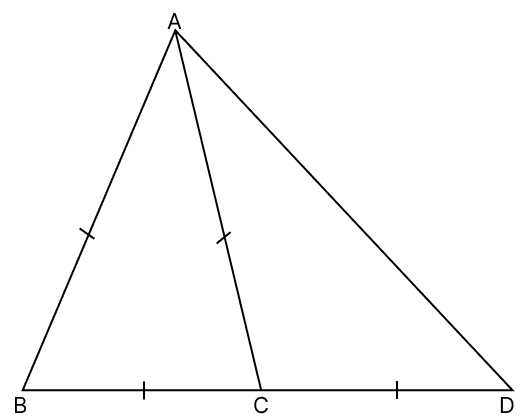
In the given figure, △ABC is an equilateral triangle and BC is produced to D such that BC = CD. Prove that AD ⊥ AB.
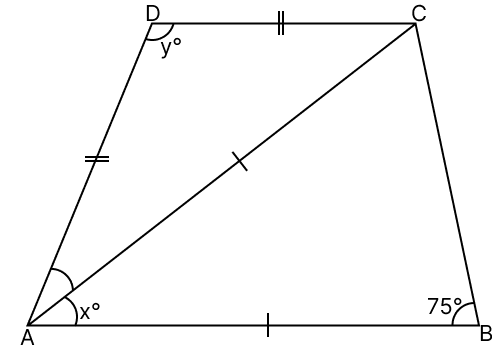
In the given figure, AC is the bisector of ∠A. If AB = AC, AD = CD and ∠ABC = 75°, find the values of x and y.