Mathematics
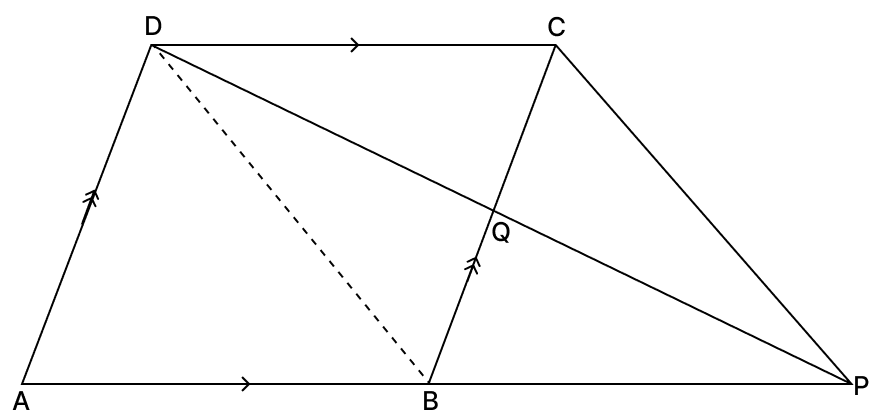
In the adjoining figure, ABCD is a parallelogram. AB is produced to a point P and DP intersects BC at Q. Prove that : ar (ΔAPD) = ar (quad. BPCD).
Theorems on Area
2 Likes
Answer
From figure,
AB // DC thus, AP // DC since AP is a straight line.
In parallelogram ABCD, the diagonal BD divides it into two triangles of equal area.
ar (ΔABD) = ar (ΔDBC) …..(1)
△ BPD and △ BPC lie on the same base BP and along the same parallel lines AP and DC.
ar (ΔBPD) = ar (ΔBPC) ….(2)
From figure,
ar (ΔAPD) = ar (ΔABD) + ar (ΔBPD)
Substituting values from equations (1) and (2) in above equation, we get :
ar (ΔAPD) = ar (ΔDBC) + ar (ΔBPC) ….(3)
From figure,
ar(quad. BPCD) = ar(△DBC) + ar(△BPC) ….(4)
From equations (3) and (4), we get :
∴ ar (ΔAPD) = ar(quad. BPCD)
Hence, proved that ar (ΔAPD) = ar(quad. BPCD).
Answered By
2 Likes
Related Questions
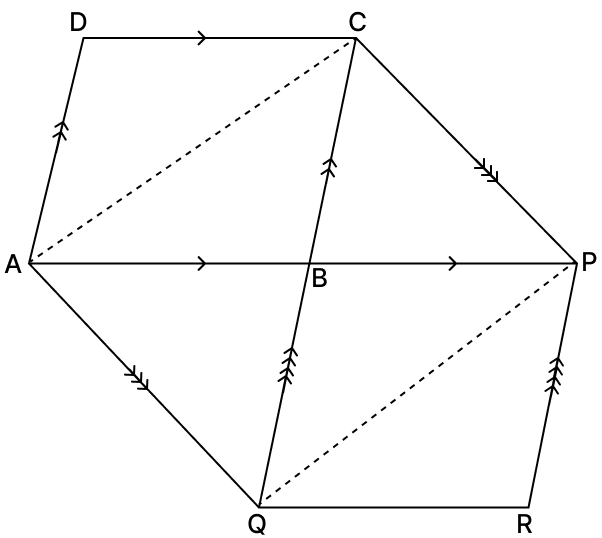
In the given figure, the side AB of ∥ gm ABCD is produced to a point P. A line through A drawn parallel to CP meets CB produced in Q and the parallelogram PBQR is completed. Prove that : ar (∥ gm ABCD) = ar (∥ gm BPRQ).
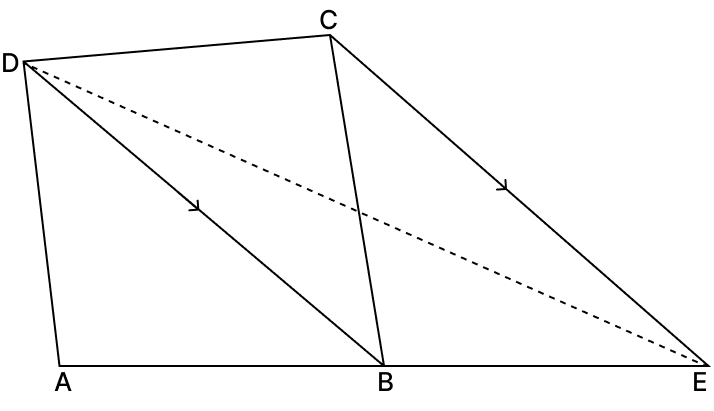
In the adjoining figure, CE is drawn parallel to DB to meet AB produced at E. Prove that : ar (quad. ABCD) = ar (ΔDAE).
In the adjoining figure, ABCD is a parallelogram. Any line through A cuts DC at a point P and BC produced at Q. Prove that : ar (ΔBPC) = ar (ΔDPQ).
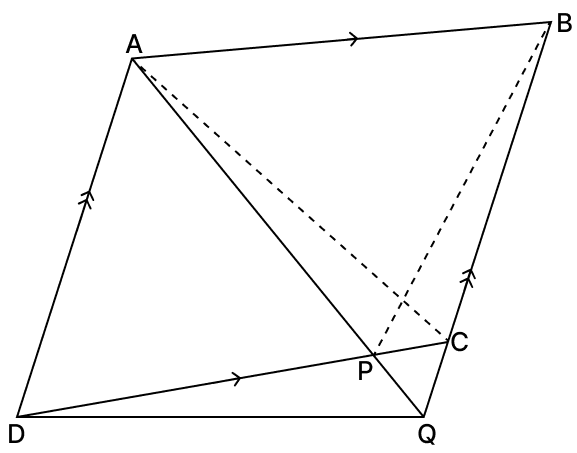
In the adjoining figure, ABCD is a parallelogram. P is a point on BC such that BP : PC = 1 : 2. DP produced meets AB produced at Q. Given ar (ΔCPQ) = 20 cm2. Calculate :
(i) ar (ΔCDP)
(ii) ar (∥ gm ABCD)