Mathematics
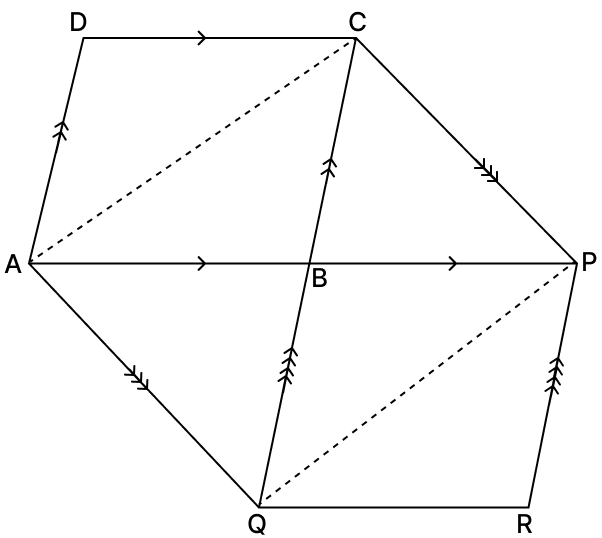
In the given figure, the side AB of ∥ gm ABCD is produced to a point P. A line through A drawn parallel to CP meets CB produced in Q and the parallelogram PBQR is completed. Prove that : ar (∥ gm ABCD) = ar (∥ gm BPRQ).
Theorems on Area
1 Like
Answer
Δ AQC and Δ AQP shares the base AQ lies between the same parallels AQ and CP.
ar (ΔAQC) = ar (ΔAQP) ……(1)
Both triangles share a common part, which is Δ AQB. Subtract this area from both sides of Equation (1):
ar (ΔAQC) - ar (ΔAQB) = ar (ΔAQP) - ar (ΔAQB)
ar (ΔABC) = ar (ΔQPB) …….(2)
We know that a diagonal of a parallelogram divides it into two triangles of equal area.
In parallelogram ABCD, AC is the diagonal,
ar(Δ ABC) = ar(∥ gm ABCD)
In parallelogram BPRQ, QP is the diagonal,
ar(Δ QPB) = ar(∥ gm BPRQ)
Substituting the values in equation (2), we get :
ar(∥ gm ABCD) = ar(∥ gm BPRQ)
ar(∥ gm ABCD) = ar(∥ gm BPRQ).
Hence, proved that ar(∥ gm ABCD) = ar(∥ gm BPRQ).
Answered By
2 Likes
Related Questions
In the adjoining figure, ABCD is a parallelogram and O is any point on its diagonal AC. Show that : ar (ΔAOB) = ar (ΔAOD).
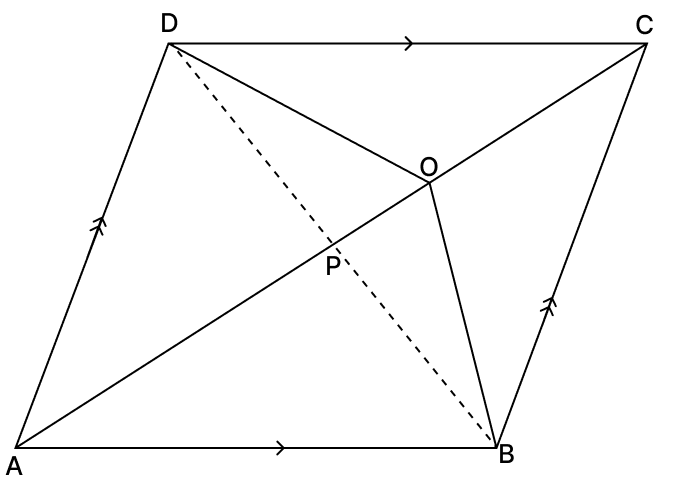
In the given figure, XY || BC, BE || CA and FC || AB. Prove that : ar (ΔABE) = ar (ΔACF).
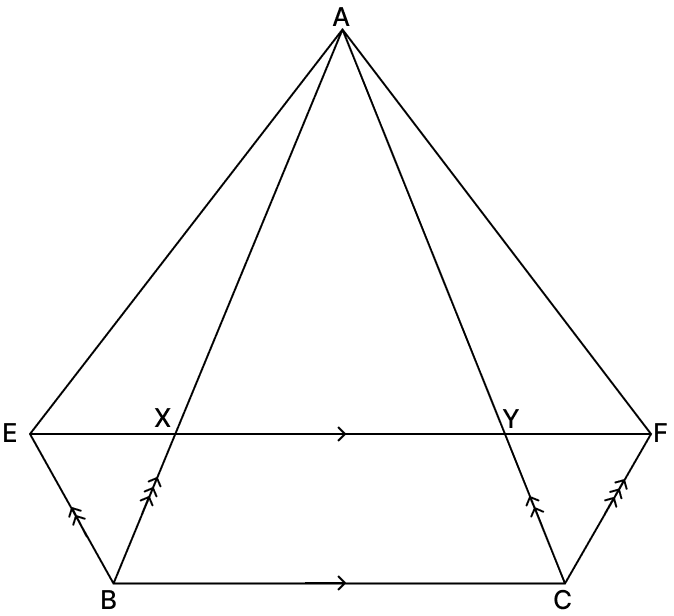
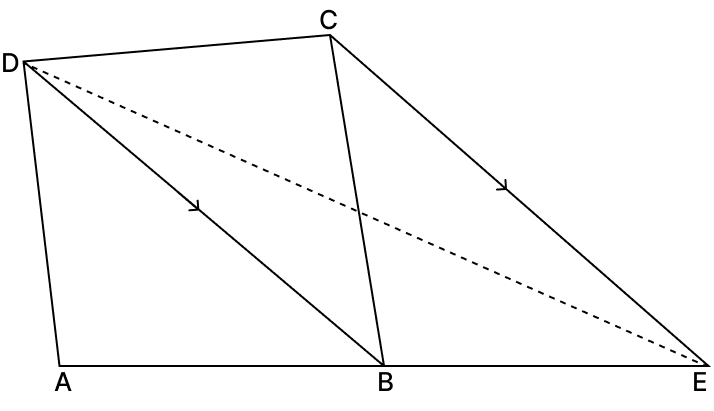
In the adjoining figure, CE is drawn parallel to DB to meet AB produced at E. Prove that : ar (quad. ABCD) = ar (ΔDAE).
In the adjoining figure, ABCD is a parallelogram. AB is produced to a point P and DP intersects BC at Q. Prove that : ar (ΔAPD) = ar (quad. BPCD).