Mathematics
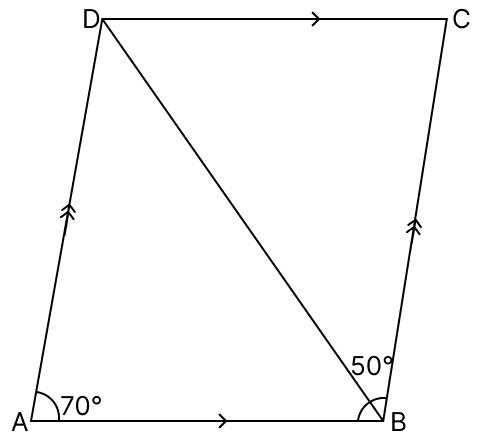
In the adjoining figure, ABCD is a parallelogram in which ∠BAD = 70° and ∠CBD = 50°. Calculate :
(i) ∠ADB
(ii) ∠CDB.
Answer
(i) Given,
∠BAD = 70°
∠CBD = 50°
ABCD is a parallelogram.
⇒ ∠ADB = ∠DBC = 50° [Alternate angles are equal,as AD ∥ BC and DB is transversal]
Hence, ∠ADB = 50°.
(ii) ∠BAD + ∠ABC = 180° [∵ AD ∥ BC and sum of Co-interior angles is 180°]
⇒ ∠ABC = 180° - ∠BAD
⇒ ∠ABC = 180° - 70°
⇒ ∠ABC = 110°.
From figure,
⇒ ∠ABC = ∠DBA + ∠CBD
⇒ 110° = ∠DBA + 50°
⇒ ∠DBA = 110° - 50°
⇒ ∠DBA = 60°
⇒ ∠CDB = ∠DBA = 60°.
⇒ ∠CDB = ∠DBA = 60° [Alternate angles are equal, as DC ∥ AB and DB is transversal]
Hence, ∠CDB = 60°.
Related Questions
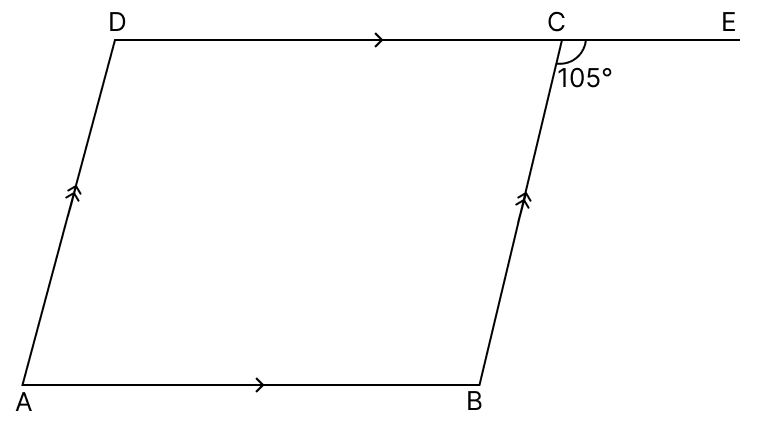
In the given figure, ABCD is a parallelogram. Side DC is produced to E and ∠BCE = 105°. Calculate ∠A, ∠B, ∠C and ∠D.
If an angle of a parallelogram is two-third of its adjacent angle, find the angles of the parallelogram.
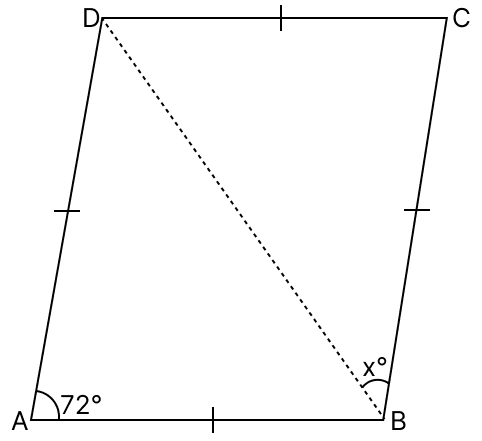
In the given figure, ABCD is a rhombus in which ∠A = 72°. If ∠CBD = x°, find the value of x.
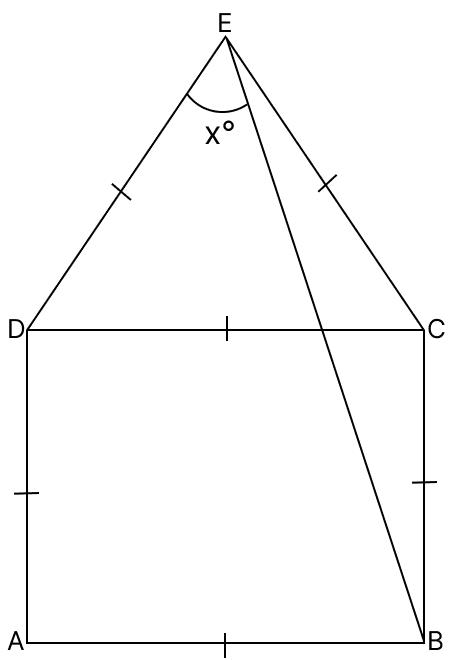
In the adjoining figure, equilateral △ EDC surmounts square ABCD. If ∠DEB = x°, find value of x.