Mathematics
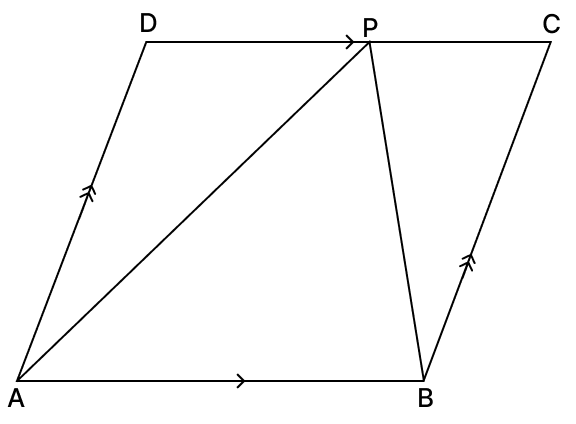
In the adjoining figure, ABCD is a parallelogram. P is a point on DC such that ar (ΔAPD) = 25 cm2 and ar (ΔBPC) = 15 cm2. Calculate :
(i) ar (∥ gm ABCD)
(ii) DP : PC
Theorems on Area
3 Likes
Answer
(i) Since,
∆APB and ||gm ABCD have same base AB and are between same parallel lines AB and DC. So,
area of ∆APB = area of ||gm ABCD
From figure,
⇒ area of ||gm ABCD = area of (∆DAP + ∆BCP)
⇒ area of ||gm ABCD = 25 + 15
⇒ area of ||gm ABCD = 40
⇒ area of ||gm ABCD = 2 × 40 = 80 cm2.
Hence, area of ||gm ABCD = 80 cm2.
(ii) From figure,
∆DAP and ∆BCP are on the same base CD and between the same parallel lines CD and AB.
Hence, DP : PC = 5 : 3.
Answered By
3 Likes
Related Questions
In the adjoining figure, ABCD is a parallelogram. Any line through A cuts DC at a point P and BC produced at Q. Prove that : ar (ΔBPC) = ar (ΔDPQ).
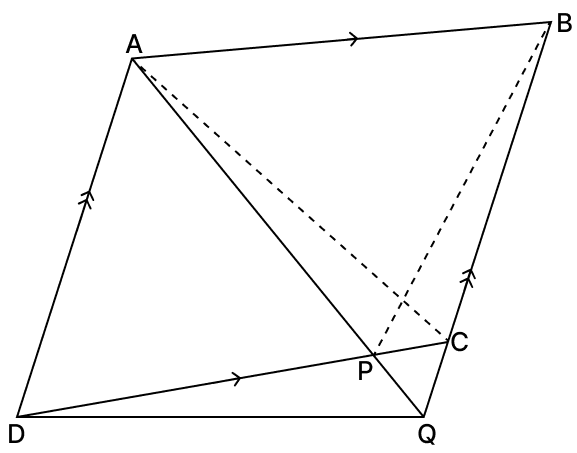
In the adjoining figure, ABCD is a parallelogram. P is a point on BC such that BP : PC = 1 : 2. DP produced meets AB produced at Q. Given ar (ΔCPQ) = 20 cm2. Calculate :
(i) ar (ΔCDP)
(ii) ar (∥ gm ABCD)
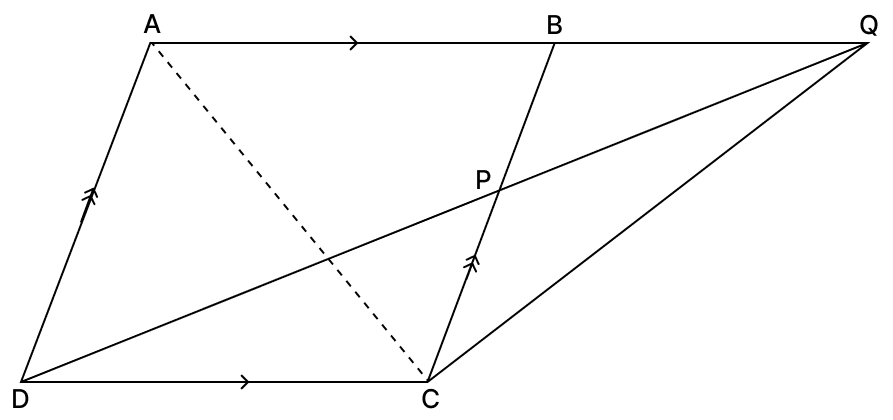
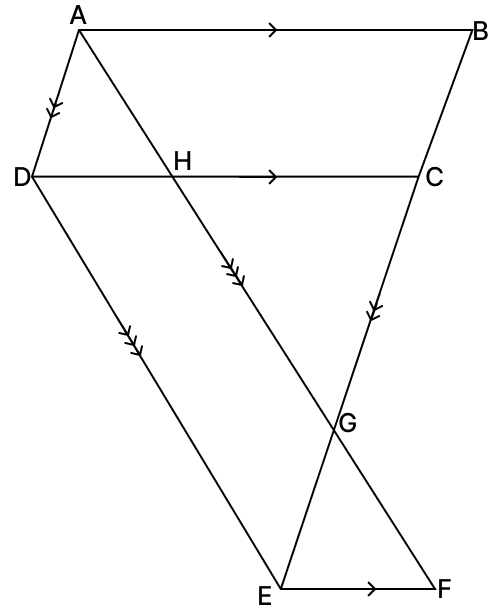
In the given figure, AB ∥ DC ∥ EF, AD ∥ BE and DE ∥ AF. Prove that : ar (∥ gm DEFH) = ar (∥ gm ABCD).
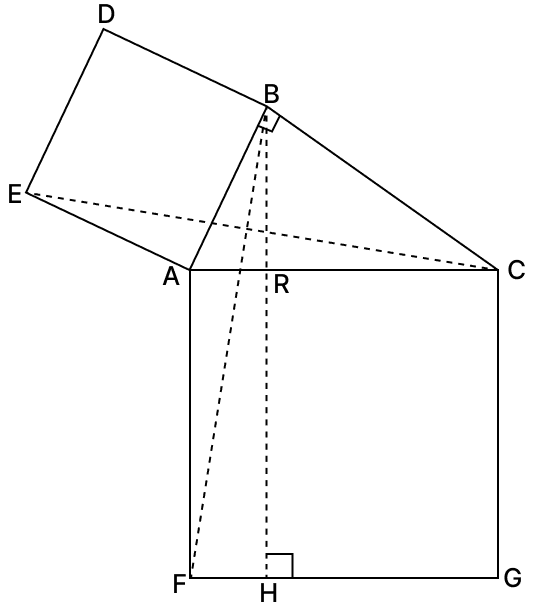
In the given figure, squares ABDE and AFGC are drawn on the side AB and hypotenuse AC of right triangle ABC and BH ⟂ FG. Prove that :
(i) ∠EAC = ∠BAF
(ii) ar (sq. ABDE) = ar (rect. ARHF)