Mathematics
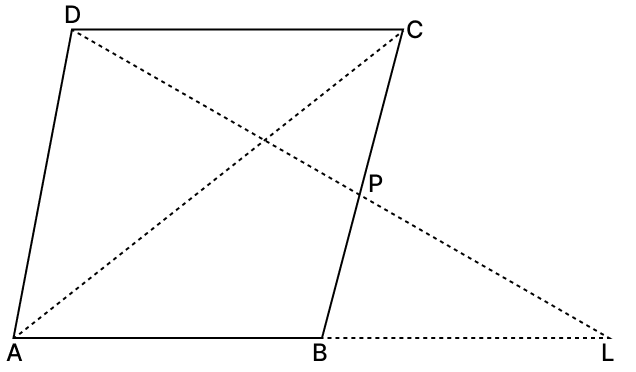
In the adjoining figure, ABCD is a parallelogram, P is a point on side BC and DP when produced meets AB produced at L. Prove that :
(i) DP : PL = DC : BL.
(ii) DL : DP = AL : DC.
Similarity
3 Likes
Answer
(i) Given,
ABCD is a parallelogram.
∴ AB || DC and AD || BC
In ΔDPC and ΔLPB,
∠PDC = ∠PLB [Alternate angles are equal]
∠DPC = ∠LPB [Vertically opposite angles are equal]
∴ ΔDPC ∼ ΔLPB (By A.A. axiom)
Corresponding sides of similar triangles are proportional.
DP : PL = DC : BL
Hence, proved DP : PL = DC : BL.
(ii) In ΔALD and ΔCPD,
∠ALD = ∠PDC [Alternate interior angles, AB || DC]
∠DAL = ∠PCD [Opposite angles of a parallelogram are equal]
∴ ΔLAD ∼ ΔDCP (By A.A. axiom)
Corresponding sides of similar triangles are proportional.
DL : DP = AL : DC
Hence, proved DL : DP = AL : DC.
Answered By
1 Like
Related Questions
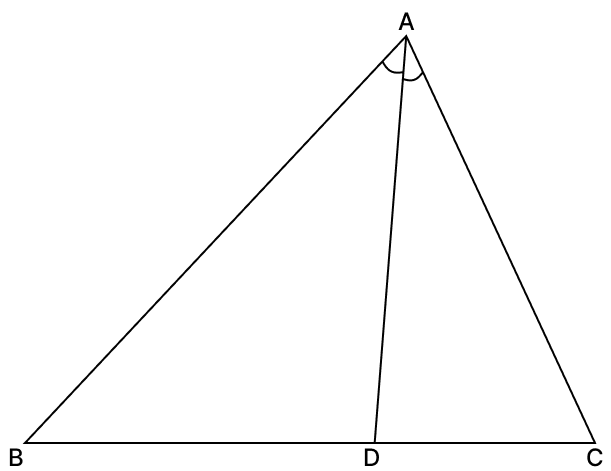
In ΔABC, AD is the bisector of ∠A. If BC = 10 cm, BD = 6 cm and AC = 6 cm, find AB.
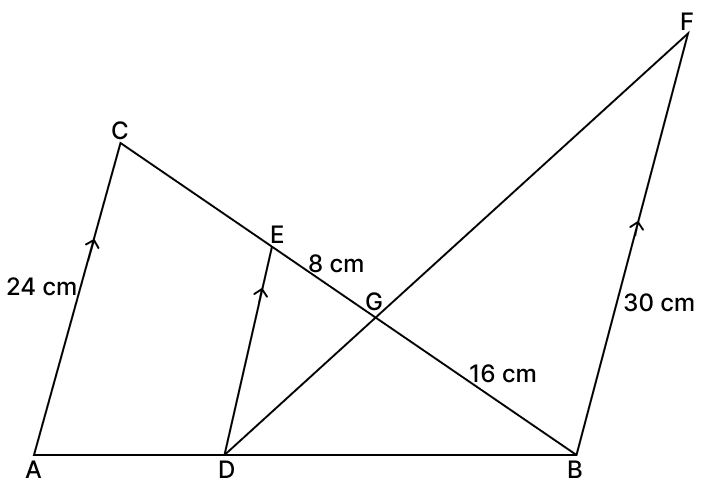
In the given figure, AC ∥ DE ∥ BF. If AC = 24 cm, EG = 8 cm, GB = 16 cm, BF = 30 cm.
(i) Prove that ΔGED ∼ ΔGBF.
(ii) Find DE.
(iii) Find DB : AB.
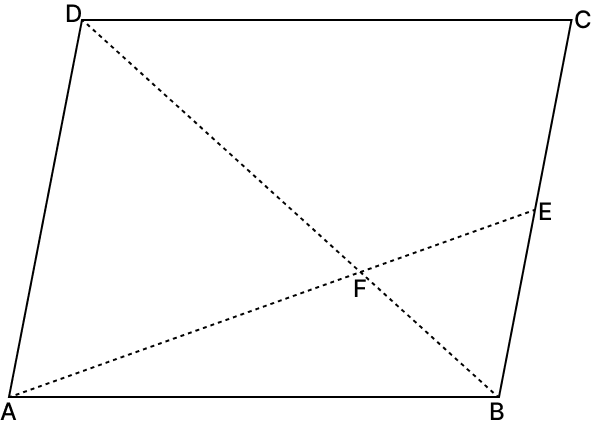
In the given figure, ABCD is a parallelogram, E is a point on BC and the diagonal BD intersects AE at F.
Prove that DF × FE = FB × FA.
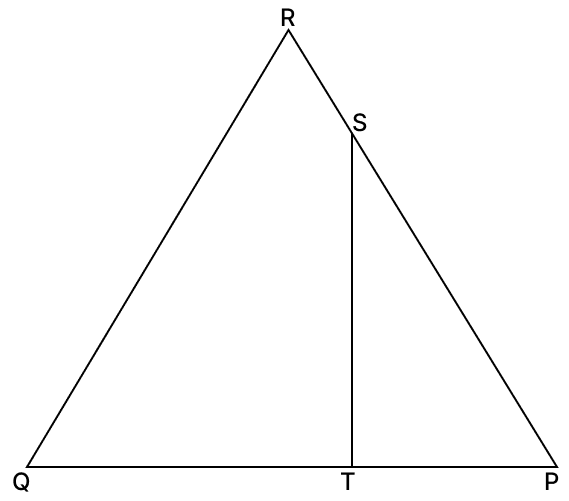
In the adjoining figure (not drawn to scale), PS = 4 cm, SR = 2 cm, PT = 3 cm and QT = 5 cm.
(i) Show that ΔPQR ∼ ΔPST.
(ii) Calculate ST, if QR = 5.8 cm.