Mathematics
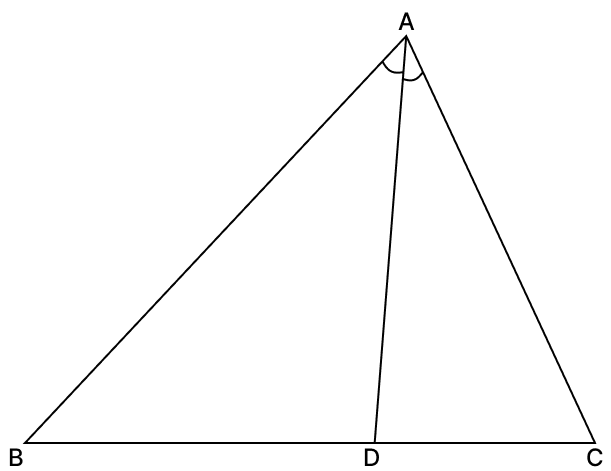
In ΔABC, AD is the bisector of ∠A. If BC = 10 cm, BD = 6 cm and AC = 6 cm, find AB.
Similarity
2 Likes
Answer
Construction: Draw a line through C parallel to AD, meeting BA produced at E.
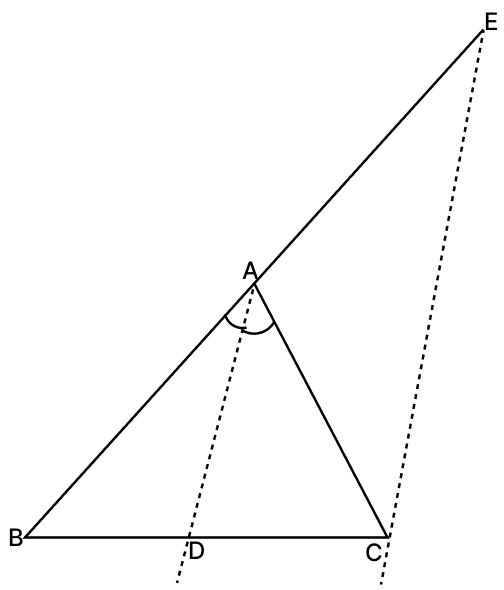
In ΔBCE,
Since AD ∥ CE, by Basic Proportionality Theorem:
…(i)
Also, since AD ∥ CE:
∠BAD = ∠AEC [Corresponding angles are equal]
∠DAC = ∠ACE [Alternate interior angles are equal]
Since AD is bisector of ∠A, ∠BAD = ∠DAC.
Therefore, ∠AEC = ∠ACE.
In ΔACE, sides opposite to equal angles are equal:
AE = AC …(ii)
Substitute (ii) into (i):
Given,
AC = 6 cm
BC = 10 cm
BD = 6 cm
DC = BC - BD [from figure]
DC = 10 - 6 = 4 cm
Let length of AB be x,
Hence, length of AB is 9 cm.
Answered By
2 Likes
Related Questions
D and E are points on the sides AB and AC respectively of ΔABC. For each of the following cases, state whether DE ∥ BC :
(i) AD = 5.7 cm, BD = 9.5 cm, AE = 3.6 cm and EC = 6 cm.
(ii) AB = 5.6 cm, AD = 1.4 cm, AC = 9.6 cm and EC = 2.4 cm.
(iii) AB = 11.7 cm, BD = 5.2 cm, AE = 4.4 cm and AC = 9.9 cm.
(iv) AB = 10.8 cm, BD = 4.5 cm, AC = 4.8 cm and AE = 2.8 cm.
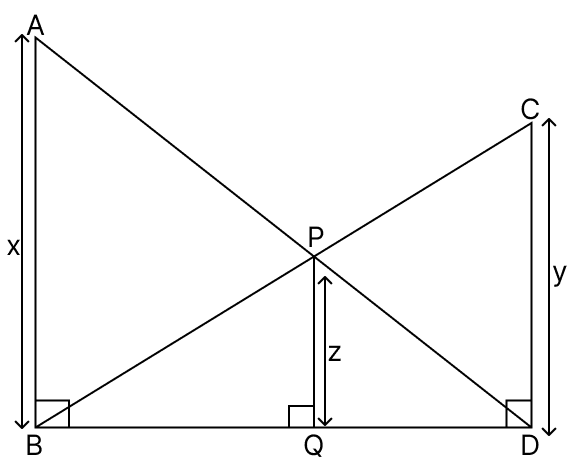
In the given figure, it is given that ∠ABD = ∠CDB = ∠PQB = 90°. If AB = x units, CD = y units and PQ = z units, prove that .
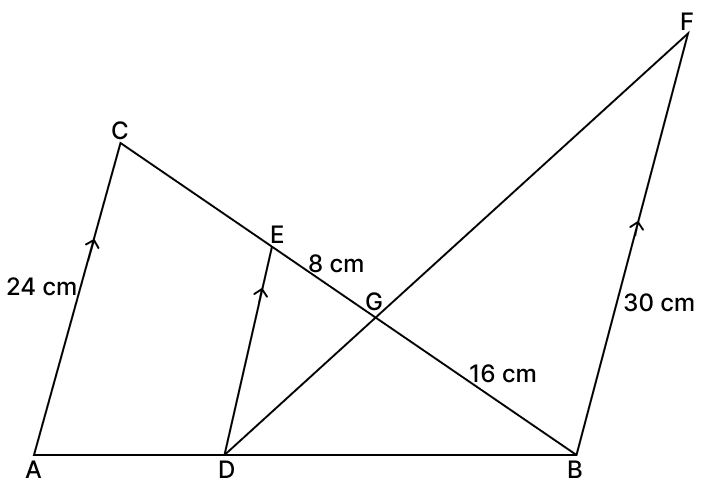
In the given figure, AC ∥ DE ∥ BF. If AC = 24 cm, EG = 8 cm, GB = 16 cm, BF = 30 cm.
(i) Prove that ΔGED ∼ ΔGBF.
(ii) Find DE.
(iii) Find DB : AB.
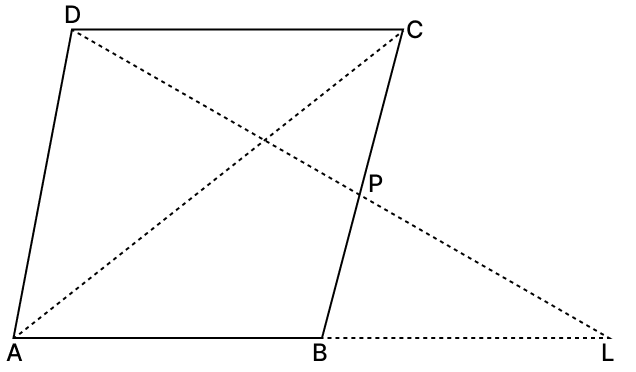
In the adjoining figure, ABCD is a parallelogram, P is a point on side BC and DP when produced meets AB produced at L. Prove that :
(i) DP : PL = DC : BL.
(ii) DL : DP = AL : DC.