Mathematics
D and E are points on the sides AB and AC respectively of ΔABC. For each of the following cases, state whether DE ∥ BC :
(i) AD = 5.7 cm, BD = 9.5 cm, AE = 3.6 cm and EC = 6 cm.
(ii) AB = 5.6 cm, AD = 1.4 cm, AC = 9.6 cm and EC = 2.4 cm.
(iii) AB = 11.7 cm, BD = 5.2 cm, AE = 4.4 cm and AC = 9.9 cm.
(iv) AB = 10.8 cm, BD = 4.5 cm, AC = 4.8 cm and AE = 2.8 cm.
Similarity
1 Like
Answer
By basic proportionality theorem,
A line drawn parallel to a side of triangle divides the other two sides proportionally.
(i) Given,
AD = 5.7 cm
BD = 9.5 cm
AE = 3.6 cm
EC = 6 cm.
Check for proportionality,
We conclude that DE is parallel to BC
Hence, DE is parallel to BC.
(ii) Given,
AB = 5.6 cm
AD = 1.4 cm
AC = 9.6 cm
EC = 2.4 cm.
From figure,
DB = AB - AD = 5.6 - 1.4 = 4.2 cm
AE = AC - EC = 9.6 - 2.4 = 7.2 cm
Check for proportionality,
We conclude that DE is not parallel to BC
Hence, DE is not parallel to BC.
(iii) Given,
AB = 11.7 cm
BD = 5.2 cm
AE = 4.4 cm
AC = 9.9 cm.
From figure,
AD = AB - BD = 11.7 - 5.2 = 6.5 cm
EC = AC - AE = 9.9 - 4.4 = 5.5 cm
Check for proportionality,
We conclude that DE is not parallel to BC
Hence, DE is not parallel to BC.
(iv) Given,
AB = 10.8 cm
BD = 4.5 cm
AC = 4.8 cm
AE = 2.8 cm.
AD = AB - BD = 10.8 - 4.5 = 6.3 cm
EC = AC - AE = 4.8 - 2.8 = 2 cm
Check for proportionality,
We conclude that DE is parallel to BC
Hence, DE is parallel to BC.
Answered By
2 Likes
Related Questions
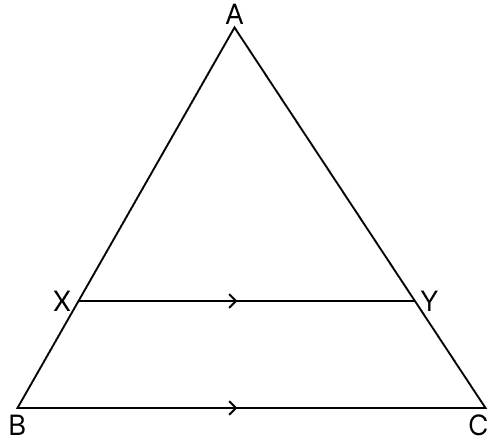
In the given figure, XY || BC. Given that AX = 3 cm, XB = 1.5 cm and BC = 6 cm.
(i) Calculate .
(ii) Calculate XY.
In the given figure, DE || BC.
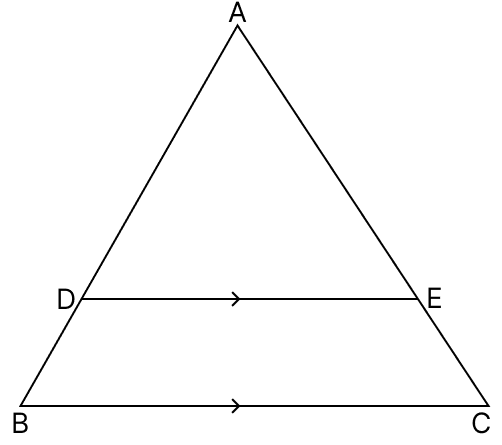
(i) If AD = 3.6 cm, AB = 9 cm and AE = 2.4 cm, find EC.
(ii) If and AC = 5.6 cm, find AE.
(iii) If AD = x cm, DB = (x − 2) cm, AE = (x + 2) cm and EC = (x − 1) cm, find the value of x.
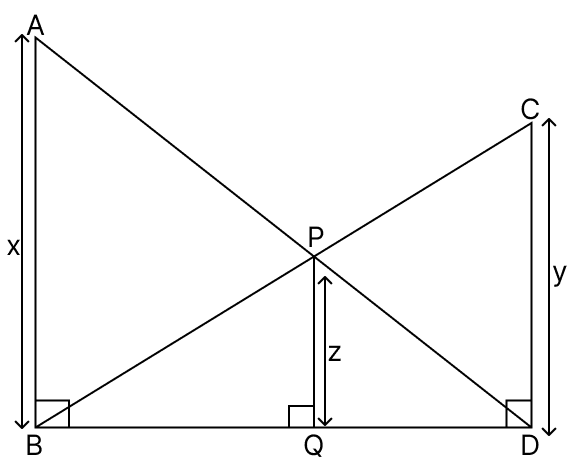
In the given figure, it is given that ∠ABD = ∠CDB = ∠PQB = 90°. If AB = x units, CD = y units and PQ = z units, prove that .
In ΔABC, AD is the bisector of ∠A. If BC = 10 cm, BD = 6 cm and AC = 6 cm, find AB.