Mathematics
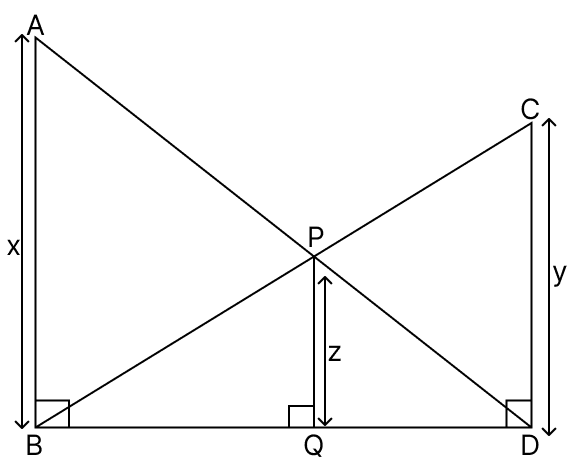
In the given figure, it is given that ∠ABD = ∠CDB = ∠PQB = 90°. If AB = x units, CD = y units and PQ = z units, prove that .
Similarity
7 Likes
Answer
In ΔPQD and ΔABD,
∠ABD = ∠PQD = 90° [From figure]
∠ADB = ∠PDQ [Common angles]
∴ ΔPQD ∼ ΔABD (By A.A. axiom)
Corresponding sides of similar triangles are proportional.
In ΔPQB and ΔCDB,
∠CDB = ∠PQB = 90° [Given]
∠CBD = ∠PBQ [Common angles]
∴ ΔPQB ∼ ΔCDB (By A.A. axiom)
Corresponding sides of similar triangles are proportional.
Add equations (1) and (2) we get,
Hence, proved that .
Answered By
3 Likes
Related Questions
In the given figure, DE || BC.
(i) If AD = 3.6 cm, AB = 9 cm and AE = 2.4 cm, find EC.
(ii) If and AC = 5.6 cm, find AE.
(iii) If AD = x cm, DB = (x − 2) cm, AE = (x + 2) cm and EC = (x − 1) cm, find the value of x.
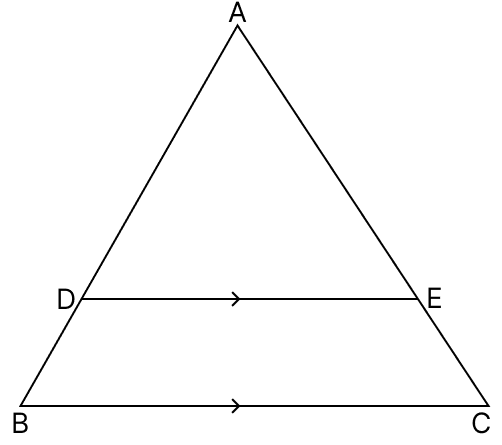
D and E are points on the sides AB and AC respectively of ΔABC. For each of the following cases, state whether DE ∥ BC :
(i) AD = 5.7 cm, BD = 9.5 cm, AE = 3.6 cm and EC = 6 cm.
(ii) AB = 5.6 cm, AD = 1.4 cm, AC = 9.6 cm and EC = 2.4 cm.
(iii) AB = 11.7 cm, BD = 5.2 cm, AE = 4.4 cm and AC = 9.9 cm.
(iv) AB = 10.8 cm, BD = 4.5 cm, AC = 4.8 cm and AE = 2.8 cm.
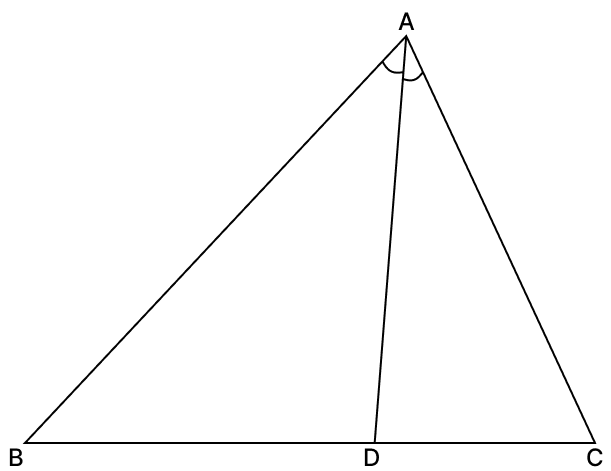
In ΔABC, AD is the bisector of ∠A. If BC = 10 cm, BD = 6 cm and AC = 6 cm, find AB.
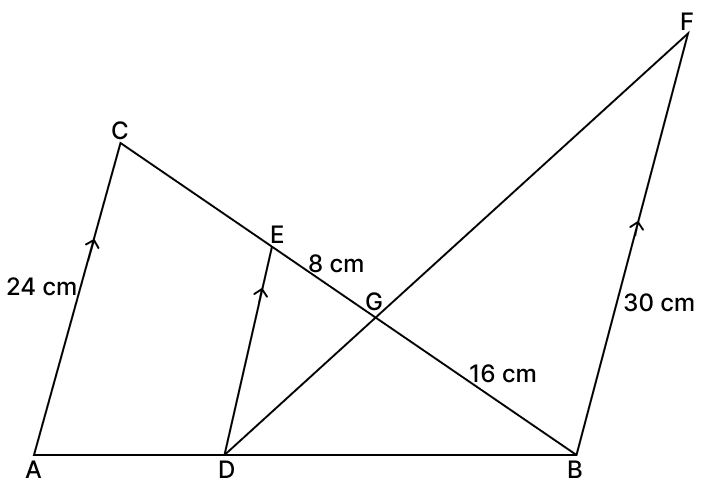
In the given figure, AC ∥ DE ∥ BF. If AC = 24 cm, EG = 8 cm, GB = 16 cm, BF = 30 cm.
(i) Prove that ΔGED ∼ ΔGBF.
(ii) Find DE.
(iii) Find DB : AB.