
Mathematics
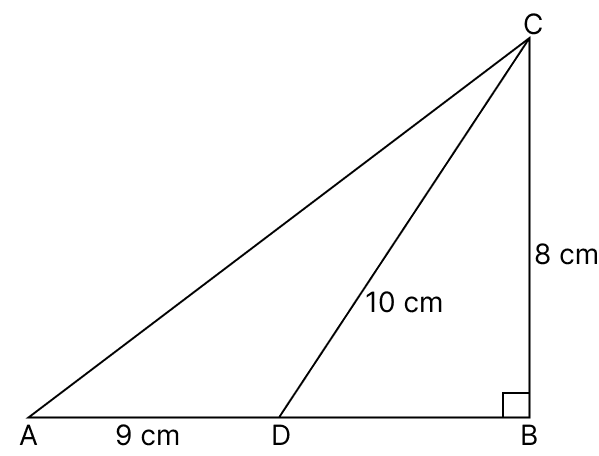
In the adjoining figure, AC =
17 cm
20 cm
22 cm
24 cm
Pythagoras Theorem
1 Like
Answer
In △ BCD,
By pythagoras theorem,
Hypotenuse2 = Base2 + Height2
⇒ CD2 = BD2 + BC2
⇒ 102 = BD2 + 82
⇒ 100 = BD2 + 64
⇒ BD2 = 100 - 64
⇒ BD2 = 36
⇒ BD =
⇒ BD = 6 cm
From figure,
AB = AD + BD = 9 + 6 = 15 cm
In △ ABC,
Using pythagoras theorem,
⇒ AC2 = AB2 + BC2
⇒ AC2 = 152 + 82
⇒ AC2 = 225 + 64
⇒ AC2 = 289
⇒ AC =
⇒ AC = 17 cm
Hence, option 1 is the correct option.
Answered By
2 Likes
Related Questions
In △ABC, ∠B is a right angle. If D is the foot of the perpendicular drawn from B on AC, then:
BC2 + CD2 = AC2
AB2 - BC2 = AD2 - CD2
BC2 - BD2 = AB2 - AD2
None of these.
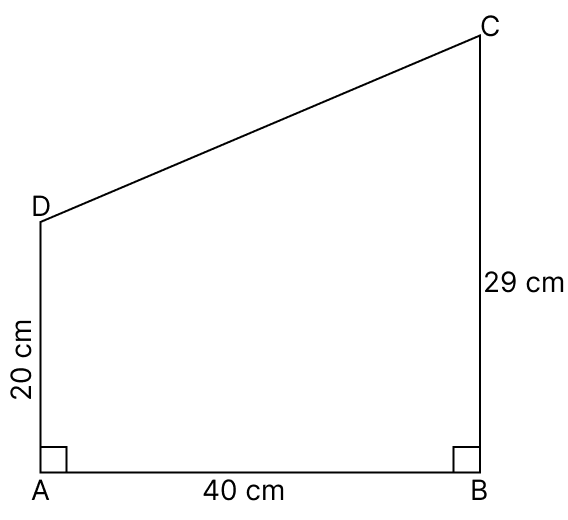
In the adjoining figure, CD =
36 cm
40 cm
41 cm
None of these
The lengths of the diagonals of a rhombus are 5 cm and 12 cm. The length of each side of the rhombus is:
13 cm
6.5 cm
6.25 cm
5.25 cm
The diagonals AC and BD of a rhombus ABCD are of lengths 6 cm and 8 cm. The length of each side of the rhombus is :
3 cm
5 cm
7 cm
9 cm