Mathematics
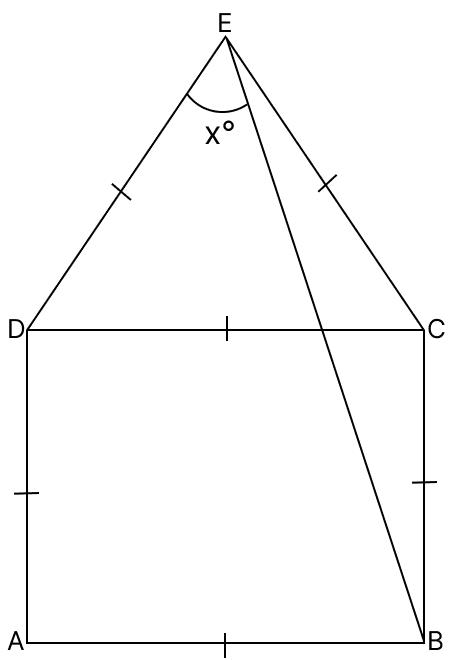
In the adjoining figure, equilateral △ EDC surmounts square ABCD. If ∠DEB = x°, find value of x.
Rectilinear Figures
1 Like
Answer
Given,
△EDC is an equilateral triangle, so all sides are equal.
ED = DC = EC ……(1)
In square all sides are equal.
AB = CB = DC = AD …..(2)
From (1) and (2) we get,
DC = EC = CB
⇒ EC = CB.
In △ECB,
EC = CB
⇒ ∠BEC = ∠CBE = a (let) (Angles opposite to equal sides are equal in isosceles triangle)
From figure,
⇒ ∠C = ∠ECD + ∠DCB
⇒ ∠ECD = 60° (As each angle of a equilateral triangle = 60°)
⇒ ∠DCB = 90° (As each angle of a square = 90°)
⇒ ∠ECB = ∠ECD + ∠DCB = 60° + 90° = 150°.
In triangle BEC,
⇒ ∠BEC + ∠CBE + ∠ECB = 180°
⇒ a + a + 150° = 180°
⇒ 2a = 180° - 150°
⇒ 2a = 30°
⇒ a = 15°.
From figure,
x° = ∠DEC - ∠BEC = 60° - 15° = 45°.
Hence, x = 45.
Answered By
2 Likes
Related Questions
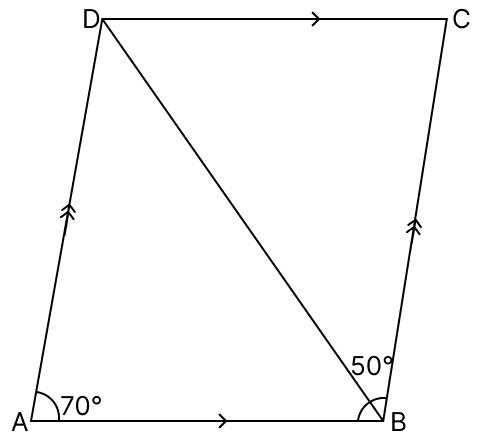
In the adjoining figure, ABCD is a parallelogram in which ∠BAD = 70° and ∠CBD = 50°. Calculate :
(i) ∠ADB
(ii) ∠CDB.
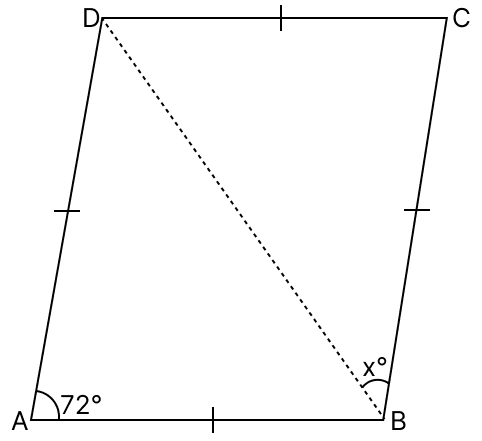
In the given figure, ABCD is a rhombus in which ∠A = 72°. If ∠CBD = x°, find the value of x.
In the adjoining figure, ABCD is a rhombus whose diagonals intersect at O. If ∠OAB : ∠OBA = 2 : 3, find the angles of △ OAB.
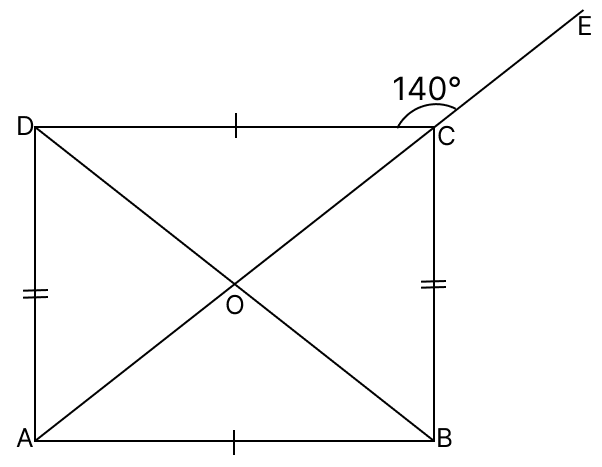
In the given figure, ABCD is a rectangle whose diagonals intersect at O. Diagonal AC is produced to E and ∠ECD = 140°. Find the angles of △ OAB.