
Mathematics
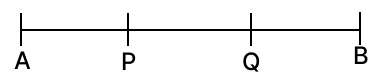
In the adjoining figure, P(5, -3) and Q(3, y) are the points of trisection of the line segment joining A(7, -2) and B(1, -5). Then, y equals :
-4
2
4
Section Formula
2 Likes
Answer
Since P and Q trisect the line segment AB, the point Q(3, y) divides A(7, -2) and B(1, -5) in the ratio 2 : 1.
Let point Q be (3, y).
Given,
m1 : m2 = 2 : 1
By section-formula,
(x, y) =
Substituting values we get :
Thus, y = -4.
Hence, Option 1 is the correct option.
Answered By
1 Like
Related Questions
In what ratio is the line segment joining the points P(-4, 2) and Q(8, 3) divided by y-axis?
1 : 3
3 : 1
1 : 2
2 : 1
Point P divides the line segment joining R(-1, 3) and S(9, 8) in the ratio k : 1. If P lies on the line x - y + 2 = 0, then the value of k is:
If the point P(6, -3) lies on the line segment joining points A(4, 2) and B(8, 4), then:
AP = AB
AP = AB
PB = AB
AP = AB
The mid-point of the line segment joining the points (-3, 2) and (7, 6) is:
(-2, -4)
(-2, 4)
(2, 4)
(4, 2)