Mathematics
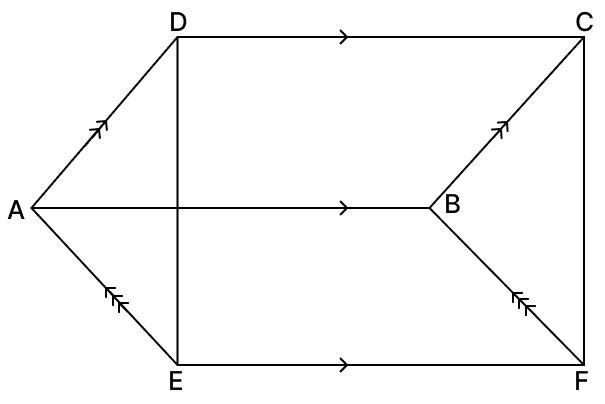
In the adjoining figure, two parallelograms ABCD and AEFB are drawn on opposite sides of AB. Prove that : ar (∥ gm ABCD) + ar (∥ gm AEFB) = ar (∥ gm EFCD).
Theorems on Area
1 Like
Answer
Parallelogram ABCD and Parallelogram AEFB are on opposite sides of the common base AB.
Let h1 be the distance between parallel lines AB and CD, h2 be the distance between parallel lines AB and EF.
Area of ||gm = Base × Height
ar (∥ gm ABCD) = AB × h1
ar (∥ gm AEFB) = AB × h2
ar (∥ gm ABCD) + ar(∥ gm AEFB) = AB × h1 + AB × h2
ar (∥ gm ABCD) + ar(∥ gm AEFB) = AB × (h1 + h2) ……(1)
From figure,
In ∥ gm EFCD,
Height = Height of ||gm ABCD + Height of ||gm AEFB = h1 + h2
ar (∥ gm EFCD) = DC × (h1 + h2)
Since, AB = DC [Opposite sides of parallelogram are equal]
ar (∥ gm EFCD) = AB × (h1 + h2)…..(2)
From equation (1) and (2),
ar(∥ gm ABCD) + ar(∥ gm AEFB) = ar (∥ gm EFCD)
Hence, proved that ar(∥ gm ABCD) + ar(∥ gm AEFB) = ar (∥ gm EFCD).
Answered By
1 Like
Related Questions
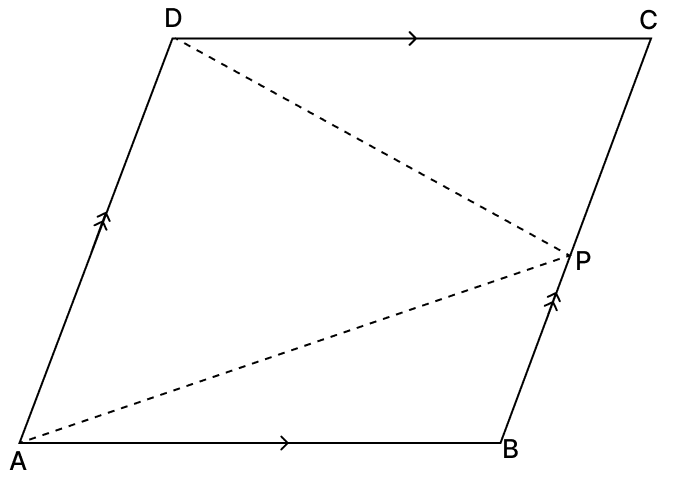
In the given figure, ABCD is a parallelogram and P is a point on BC. Prove that :
ar (ΔABP) + ar (ΔDPC) = ar (ΔAPD).
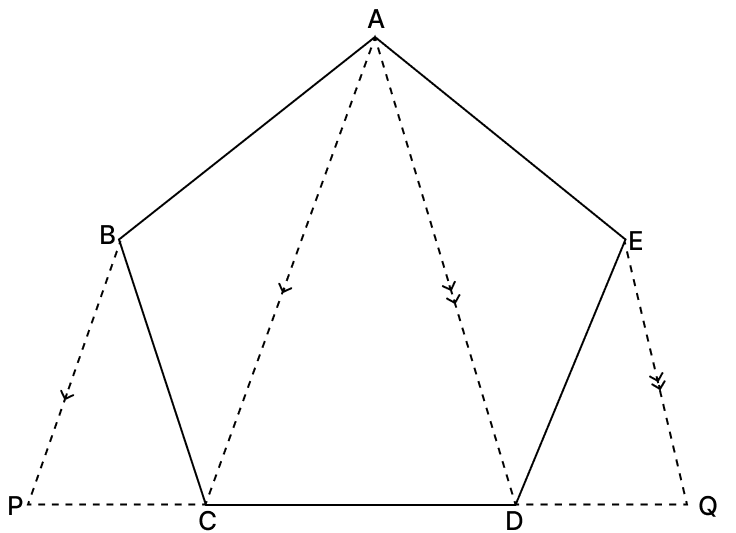
In the adjoining figure, ABCDE is a pentagon. BP drawn parallel to AC meets DC produced at P and EQ drawn parallel to AD meets CD produced at Q. Prove that : ar (Pentagon ABCDE) = ar (ΔAPQ).
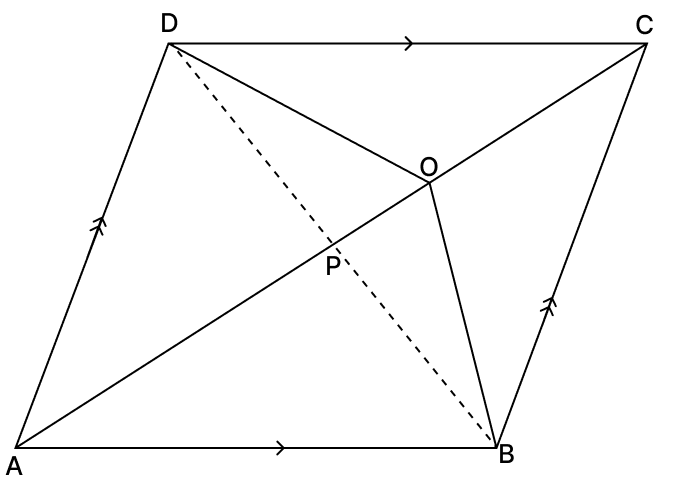
In the adjoining figure, ABCD is a parallelogram and O is any point on its diagonal AC. Show that : ar (ΔAOB) = ar (ΔAOD).
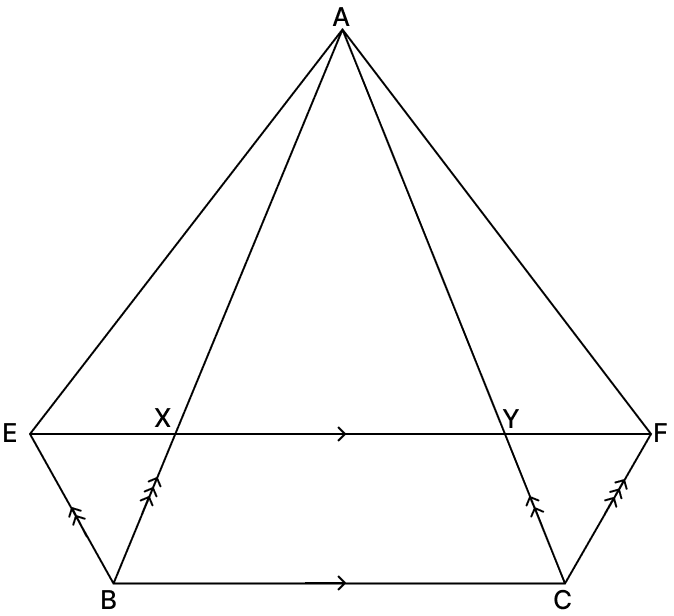
In the given figure, XY || BC, BE || CA and FC || AB. Prove that : ar (ΔABE) = ar (ΔACF).