Mathematics
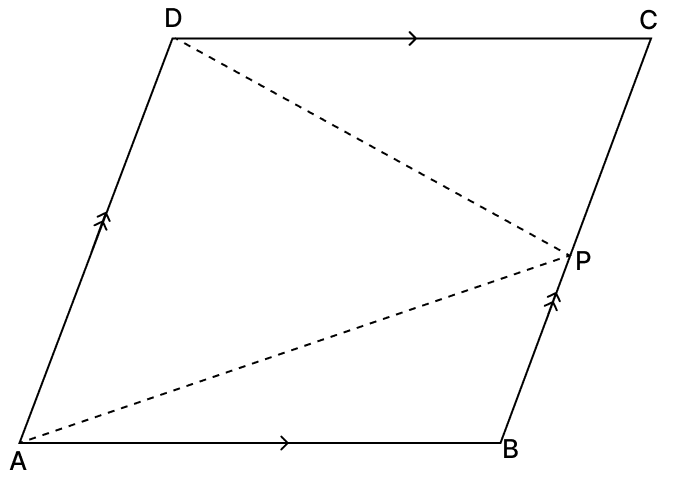
In the given figure, ABCD is a parallelogram and P is a point on BC. Prove that :
ar (ΔABP) + ar (ΔDPC) = ar (ΔAPD).
Theorems on Area
1 Like
Answer
We know that,
Area of a triangle is half that of a parallelogram on the same base and between the same parallel lines.
∆APD and ||gm ABCD are on the same base AD and between the same ∥ lines AD and BC,
Area of ∆APD = Area of ||gm ABCD ….(1)
From figure,
Area of ||gm ABCD = Area of ∆APD + Area of ∆ABP + Area of ∆DPC
Dividing the above equation by 2 we get,
Hence, proved that Area of ∆ABP + Area of ∆DPC = Area of ∆APD.
Answered By
2 Likes
Related Questions
In the adjoining figure, ABCD is a parallelogram. P and Q are any two points on the sides AB and BC respectively. Prove that :
ar (ΔCPD) = ar (ΔAQD).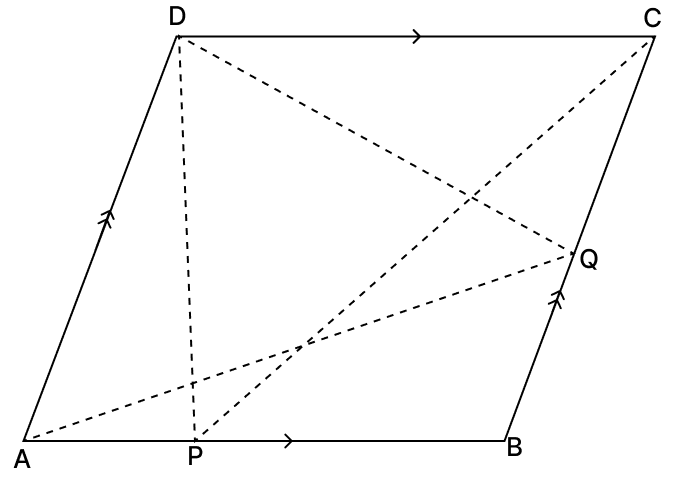
In the adjoining figure, DE ∥ BC. Prove that :
(i) ar (ΔABE) = ar (ΔACD)
(ii) ar (ΔOBD) = ar (ΔOCE)

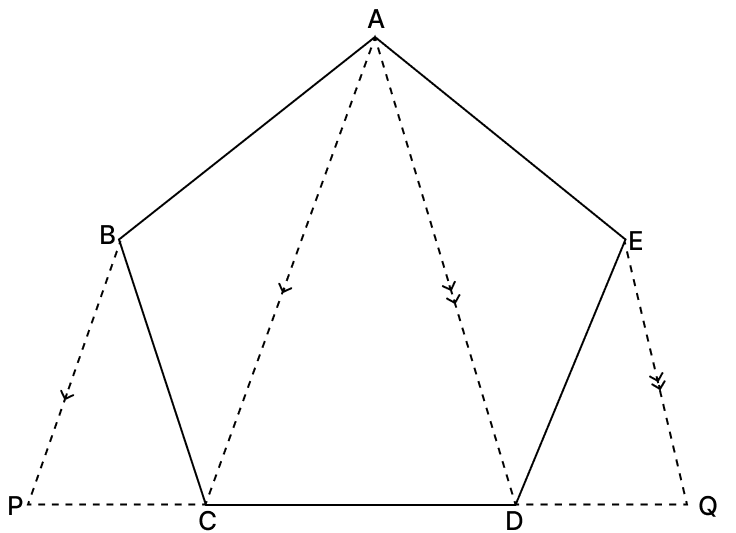
In the adjoining figure, ABCDE is a pentagon. BP drawn parallel to AC meets DC produced at P and EQ drawn parallel to AD meets CD produced at Q. Prove that : ar (Pentagon ABCDE) = ar (ΔAPQ).
In the adjoining figure, two parallelograms ABCD and AEFB are drawn on opposite sides of AB. Prove that : ar (∥ gm ABCD) + ar (∥ gm AEFB) = ar (∥ gm EFCD).