
Physics
An appliance with a metal covering, rated at 2 kW, 220 V, is to be connected in a circuit. Given below are four diagrams (P, Q, R & S) depicting different circuit configurations.

(a) Identify the safest circuit.
(b) Write two reasons, supported by mathematical calculations, where applicable, to justify your choice.
Household Circuits
21 Likes
Answer
Given,
- Power rating (P) = 2 KW = 2000 W
- Voltage rating (V) = 220 V
(a) The safest circuit is S.
(b) There are two criteria to choose the circuit S :
- It is earthed so that in the case short circuit all the excess current can flow to earth without harming the person.
- The current in the supply should be less than or equal to the current rating of the fuse.
So, current in the circuit = = 9.09 A
Circuit P
As the circuit is not earthed so it is not safe.
Circuit Q
- Circuit is earthed properly.
- Current in the circuit is 9.09 A but it has fuse which has current rating of 8 A so it will get damaged and hence someone can be hurt.
Circuit R
- Circuit is not earthed properly so it is not safe.
- Current in the circuit is 9.09 A and it has fuse which has current rating of 10 A.
Circuit S
- Circuit is earthed properly.
- Current in the circuit is 9.09 A and it has fuse which has current rating of 10 A.
So circuit S satisfy all the necessary criteria for a safe circuit.
Answered By
10 Likes
Related Questions
The below picture shows a mother pushing her daughter sitting on a swing. The swing is going through the positions A, B, C where A and C are extreme positions and B is the mean position.

(a) Which is the right position i.e. at A, B or C, for the mother to give a constant periodic push to the swing every time in the forward direction to increase the amplitude of the swing?
(b) Name the phenomenon involved in this.
(c) Explain with this example how this phenomenon helps to increase the amplitude of the swing.
The circuit depicted in the figure is employed for studying Ohm's Law. Instead of using a standard resistor, a student opts for a glass tube filled with mercury (tube 1), connected to the circuit through two electrodes E1 & E2. He records the readings of the ammeter and voltmeter, thereby calculates the resistance. The student repeats the experiment by substituting tube 1 with tube 2, where the same amount of mercury fills the tube 2.
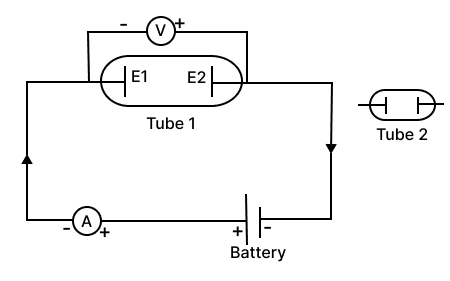
Neglecting internal resistance of the cell use (> or < or =) to compare
(a) the resistance in both the cases.
(b) the voltmeter readings in both the cases.
(c) the specific resistance in both the cases.
A nichrome wire X with length (l) & cross-sectional area (A) is connected to a 10 V source and another nichrome wire Y with length (2l) & cross-sectional area (A/2), is connected to a 20 V source.
(a) Compare the resistances of wires X and Y. [Given that the resistivity of nichrome is (ρ).]
(b) Compare the electrical power consumed by each wire.
(c) Compare the masses of these wires. (Given that the density of nichrome is d.)
(d) State True or False : Wire X and wire Y both show the same rise in temperature in the same time.
Three bulbs of powers P1, P2 and P3 (P1 < P2 < P3) are connected in a certain way that P3 glows brightest.
(a) What type of connection exists between these bulbs?
(b) Compare the voltage across these bulbs. (Use >, < or =)
(c) Will the circuit still function if one of the bulbs is fused?