Biology
Arrange and rewrite the terms in each group in the correct order so as to be in a logical sequence beginning with the term that is underlined.
(a) Apical meristem, Positive phototropism, Auxins, Cell elongation.
(b) Urethra, Urinary bladder, Ureter, Kidney.
(c) Auditory canal, Organ of Corti, Stapes, Malleus.
(d) Cell membrane, Chromatin fibres, Cell wall, Cytoplasm.
(e) Lungs, Right auricle, Inferior venacava, Pulmonary Artery.
Chemical Coordination in Plants
ICSE Sp 2025
30 Likes
Answer
(a) Auxins, Apical meristem, Cell elongation, Positive phototropism
(b) Kidney, Ureter, Urinary bladder, Urethra
(c) Auditory canal, Malleus, Stapes, Organ of Corti
(d) Chromatin fibres, Cytoplasm, Cell membrane, Cell wall
(e) Inferior venacava, Right auricle, Pulmonary Artery, Lungs
Answered By
18 Likes
Related Questions
Name the following:
(a) The basic units of heredity.
(b) The undesirable change in the environment leading to its deterioration.
(c) The structure that connects placenta and the human foetus.
(d) The statistical study of human population.
(e) The nitrogenous base that pairs with adenine.
Given below is the transverse section of the spinal cord. Read the information below the diagram and fill in the blanks:

The spinal cord extends from the medulla oblongata of the brain and runs down through the whole length of the vertebral column. The spinal cord is covered by the meninges. It conducts impulses from the skin and muscles to the brain. It also conducts impulses from the brain to the muscles of the trunk and limbs.
The spinal cord is a part of the (a) …………… Nervous System. The grey matter in the picture given above consists of (b) …………… while the white matter consists of (c) …………… . The spinal cord is concerned with the (d) …………… actions below the neck. (e) …………… is the bony structure that protects the spinal cord.
Read the explanations given below and name the structure:
Example: The largest gland in the human body that secretes bile.
Answer: Liver.
(a) Food conducting tissue in vascular plants.
(b) A cell formed by the fusion of gametes.
(c) The smallest blood vessels in the human body.
(d) A tubular passage that connects the pharynx and the middle ear.
(e) The openings on the barks of trees through which transpiration occurs.
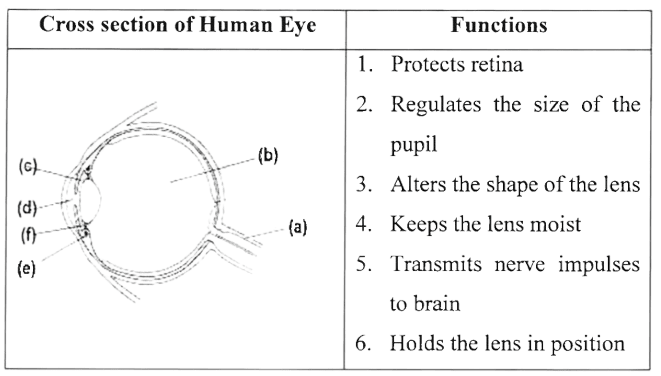
Given below is a cross section of the human eye. Match the structures marked (a) to (e) with their correct functions:
Example: (f) - 6. Holds the lens in position