
Biology
Name the following:
(a) The basic units of heredity.
(b) The undesirable change in the environment leading to its deterioration.
(c) The structure that connects placenta and the human foetus.
(d) The statistical study of human population.
(e) The nitrogenous base that pairs with adenine.
Genetics
ICSE Sp 2025
24 Likes
Answer
(a) Genes
(b) Pollution
(c) Umbilical Cord
(d) Demography
(e) Thymine
Answered By
14 Likes
Related Questions
A biology teacher asked her students to give two examples of vestigial organs in the human body.
Raj said: Wisdom teeth and Pinna
Sonu said: Body hair and large intestine
Lata said: Vermiform appendix and wisdom teeth
Abhay said: Pinna and Ossicles
Who were correct?
- Abhay and Sonu
- Sonu and Lata
- Raj and Lata
- Abhay and Raj
During a practical exam, a plant cell in a particular solution was placed under a compound microscope. Students were told to observe the cell and name the tonicity of the solution and mention the process that occurred in the cell.
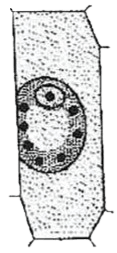
- Isotonic, Endosmosis
- Hypotonic, Active Transport
- Hypertonic, Endosmosis
- Hypertonic, Exosmosis
Given below is the transverse section of the spinal cord. Read the information below the diagram and fill in the blanks:

The spinal cord extends from the medulla oblongata of the brain and runs down through the whole length of the vertebral column. The spinal cord is covered by the meninges. It conducts impulses from the skin and muscles to the brain. It also conducts impulses from the brain to the muscles of the trunk and limbs.
The spinal cord is a part of the (a) …………… Nervous System. The grey matter in the picture given above consists of (b) …………… while the white matter consists of (c) …………… . The spinal cord is concerned with the (d) …………… actions below the neck. (e) …………… is the bony structure that protects the spinal cord.
Arrange and rewrite the terms in each group in the correct order so as to be in a logical sequence beginning with the term that is underlined.
(a) Apical meristem, Positive phototropism, Auxins, Cell elongation.
(b) Urethra, Urinary bladder, Ureter, Kidney.
(c) Auditory canal, Organ of Corti, Stapes, Malleus.
(d) Cell membrane, Chromatin fibres, Cell wall, Cytoplasm.
(e) Lungs, Right auricle, Inferior venacava, Pulmonary Artery.