Mathematics
Assertion (A) : The adjacent angles of a parallelogram are in ratio 2 : 3 the remaining angles are 78° and 102°.
Reason (R) : Opposite angles of a parallelogram are equal.
Both A and R are correct, and R is the correct explanation for A.
Both A and R are correct, and R is not the correct explanation for A.
Statement 1 is true, and statement 2 is false.
Statement 1 is false, and statement 2 is true.
Quadrilaterals
2 Likes
Answer
Given, the adjacent angles of a parallelogram are in ratio 2 : 3.
Let the adjacent angles be 2x and 3x.
We know that in a parallelogram, adjacent angles are supplementary.
⇒ 2x + 3x = 180°
⇒ 5x = 180°
⇒ x =
⇒ x = 36°
Adjacent angles = 2x = 2 x 36° = 72°
and, 3x = 3 x 36° = 108°.
Opposite angles of parallelogram are equal.
So, all angles of parallelogram are 78°, 108°, 78°, 108°.
So, assertion (A) is true.
By property,
Opposite angles of parallelogram are equal.
So, reason (R) is true.
∴ Both A and R are correct, and R is the correct explanation for A.
Hence, option 1 is the correct option.
Answered By
3 Likes
Related Questions
Assertion (A) : One of the diagonals of a rhombus is equal to one of its side. The angles of a rhombus are 60°, 120°, 60°, 120°.
Reason (R) : All sides of a rhombus are equal.
Both A and R are correct, and R is the correct explanation for A.
Both A and R are correct, and R is not the correct explanation for A.
Statement 1 is true, and statement 2 is false.
Statement 1 is false, and statement 2 is true.
Assertion (A) : If one angle of a parallelogram measures 90°, the parallelogram is a rectangle.
Reason (R) : If each interior angle of a parallelogram is 90°, then all sides of it are equal.
Both A and R are correct, and R is the correct explanation for A.
Both A and R are correct, and R is not the correct explanation for A.
Statement 1 is true, and statement 2 is false.
Statement 1 is false, and statement 2 is true.
The adjacent sides of a parallelogram are in the ratio 5 : 4. If the perimeter of the parallelogram is 108 cm, find the length of its sides.
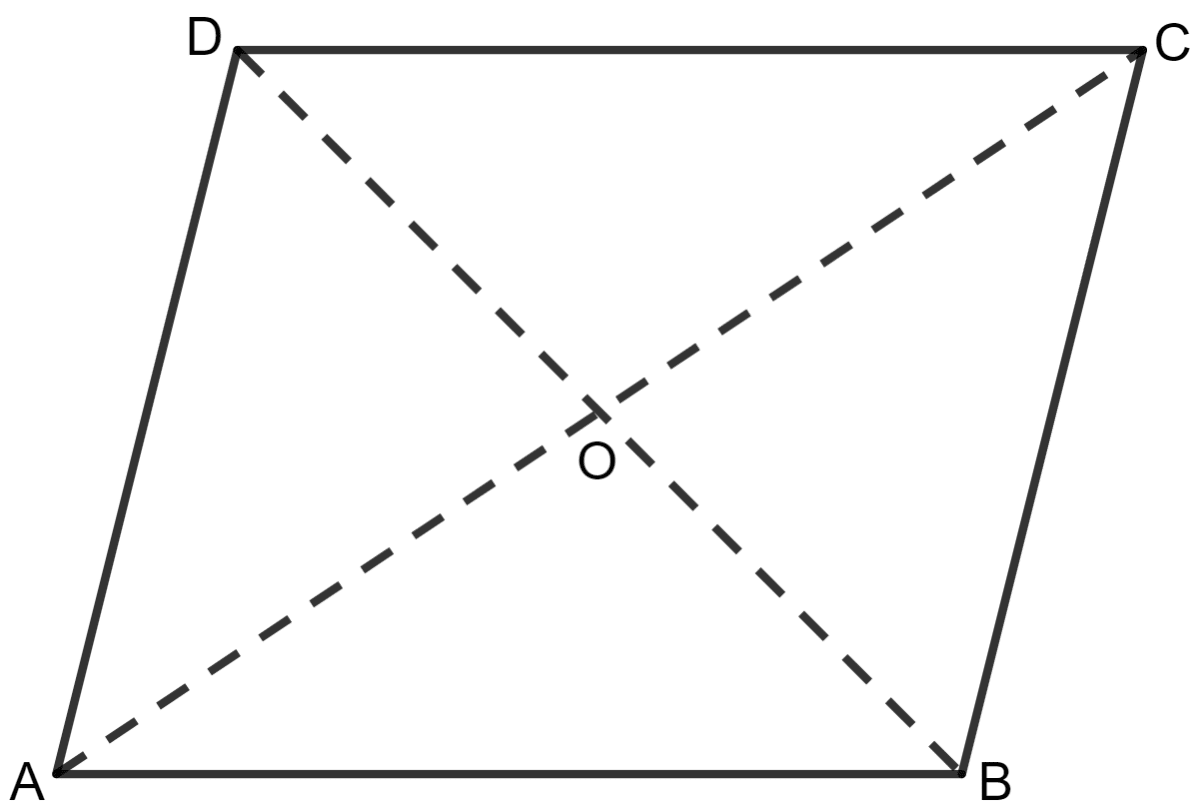
In the given figure, ABCD is a parallelogram. If OA = 6 cm and AC - BD = 2 cm; find the length of BD.