
Mathematics
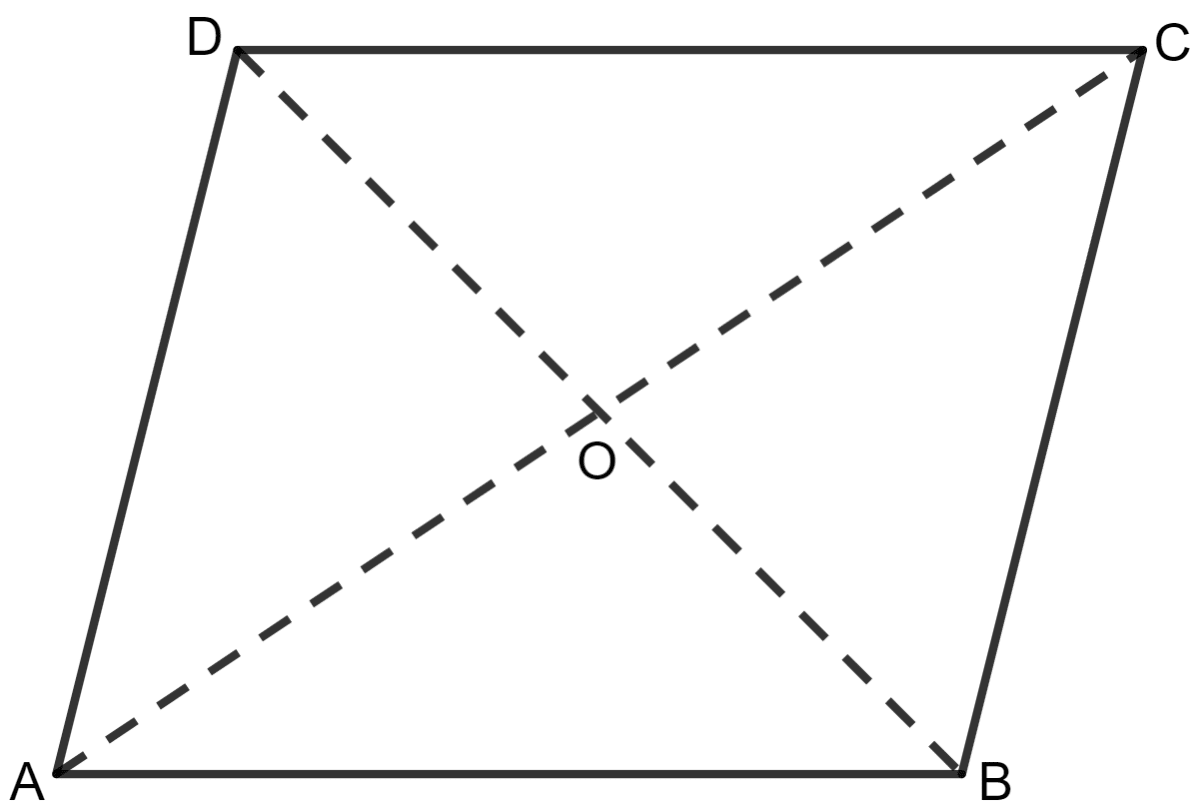
In the given figure, ABCD is a parallelogram. If OA = 6 cm and AC - BD = 2 cm; find the length of BD.
Quadrilaterals
22 Likes
Answer
In a parallelogram, diagonal always bisect each other.
So, OA = AC
⇒ AC = 2 times OA
⇒ AC = 2 x 6 cm
⇒ AC = 12 cm
It is given that AC - BD = 2 cm
⇒ 12 - BD = 2
⇒ BD = 12 - 2
⇒ BD = 10
Hence, the length of BD is 10 cm.
Answered By
14 Likes
Related Questions
Assertion (A) : The adjacent angles of a parallelogram are in ratio 2 : 3 the remaining angles are 78° and 102°.
Reason (R) : Opposite angles of a parallelogram are equal.
Both A and R are correct, and R is the correct explanation for A.
Both A and R are correct, and R is not the correct explanation for A.
Statement 1 is true, and statement 2 is false.
Statement 1 is false, and statement 2 is true.
The adjacent sides of a parallelogram are in the ratio 5 : 4. If the perimeter of the parallelogram is 108 cm, find the length of its sides.
The diagonals of a parallelogram ABCD intersect each other at point O. If OA = x + y, OC = 20, OD = x + 3 and OB = 18; find the values of x and y.
One of the diagonals of a rhombus and its sides are equal. Find the angles of the rhombus.