
Mathematics
Assertion (A) : If a circle is of radius 8 cm and the length of its minor arc is also 8 cm, then the length of major arc = 8(2π - 1) cm.
Reason (R) : For every circle, sum of the length of its major arc and length of its minor arc is equal to the circumference of the circle.
Both A and R are correct, and R is the correct explanation for A.
Both A and R are correct, and R is not the correct explanation for A.
A is true, but R is false.
A is false, but R is true.
Circles
4 Likes
Answer
Given, radius of a circle = 8 cm and the length of its minor arc = 8 cm
Circumference of the circle = 2πr = 2 x π x 8 = 16π
We know that,
Length of minor arc + length of major arc = Circumference of the circle
So, reason (R) is true.
⇒ 8 + length of major arc = 16π
⇒ length of major arc = 16π - 8
⇒ length of major arc = 8(2π - 1) cm
So, assertion (A) is true.
∴ Both A and R are correct, and R is the correct explanation for A.
Hence, option 1 is the correct option.
Answered By
1 Like
Related Questions
Assertion (A) : The radius of a circle is 20 cm, then the length of its largest chord is also 20 cm.
Reason (R) : Longest chord of a circle is equal to its diameter.
Both A and R are correct, and R is the correct explanation for A.
Both A and R are correct, and R is not the correct explanation for A.
A is true, but R is false.
A is false, but R is true.
Assertion (A) : When the radius of a circle is increased by 3 cm, its diameter will increase by 2 x 3 cm.
Reason (R) : Original radius is r cm, original diameter 2r cm
∴ Increase in length of diameter = 2(r + 3) cm - 2r
Both A and R are correct, and R is the correct explanation for A.
Both A and R are correct, and R is not the correct explanation for A.
A is true, but R is false.
A is false, but R is true.
Assertion (A) : A, B and C are three points on the circumference of a circle such that BC is diameter of the circle. If AC = 4 cm and AB = 3 cm, then diameter BC = 4 cm + 3 cm.
Reason (R) : Angle BAC = angle of semi-circle = 90° and so BC2 = AB2 + AC2
Both A and R are correct, and R is the correct explanation for A.
Both A and R are correct, and R is not the correct explanation for A.
A is true, but R is false.
A is false, but R is true.
The following figure shows the circle with centre O.
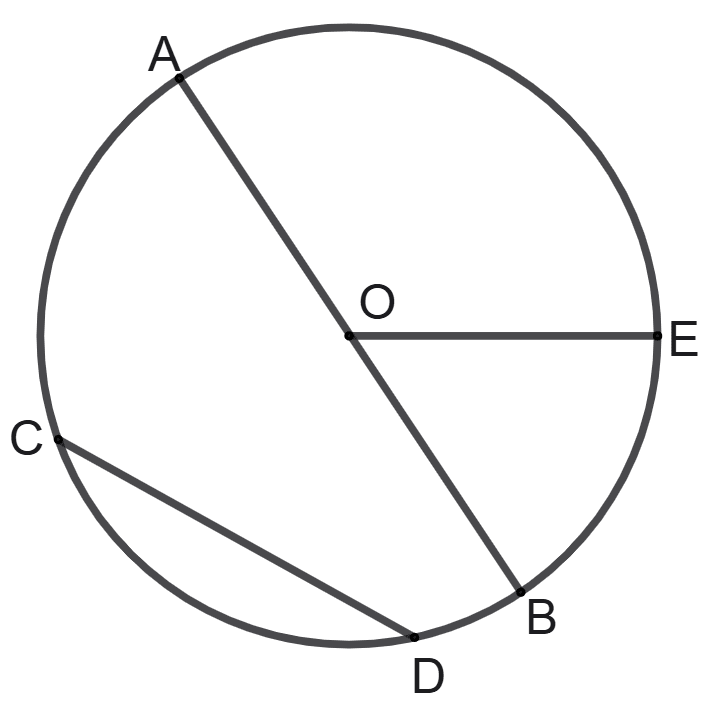
Use the figure to fill the blanks in each of the following :
(i) AB = ……………..
(ii) Radius = …………….
(iii) Chords = ……….. and ………..
(iv) Diameter = …………
(v) AB = 2 x ………….