
Mathematics
Assertion (A) : The radius of a circle is 20 cm, then the length of its largest chord is also 20 cm.
Reason (R) : Longest chord of a circle is equal to its diameter.
Both A and R are correct, and R is the correct explanation for A.
Both A and R are correct, and R is not the correct explanation for A.
A is true, but R is false.
A is false, but R is true.
Circles
3 Likes
Answer
As we know that radius is half of the diameter.
Diameter = 2 x radius = 2 x 20 = 40 cm.
We know that,
Longest chord of a circle is equal to its diameter.
So, reason (R) is true.
Longest chord = 40 cm
So, assertion (A) is false.
∴ A is false, but R is true.
Hence, option 4 is the correct option.
Answered By
1 Like
Related Questions
The given figure shows a circle with center O. If length of arc AQC is double of arc APB and ∠AOB = 65°; then angle AOC is :
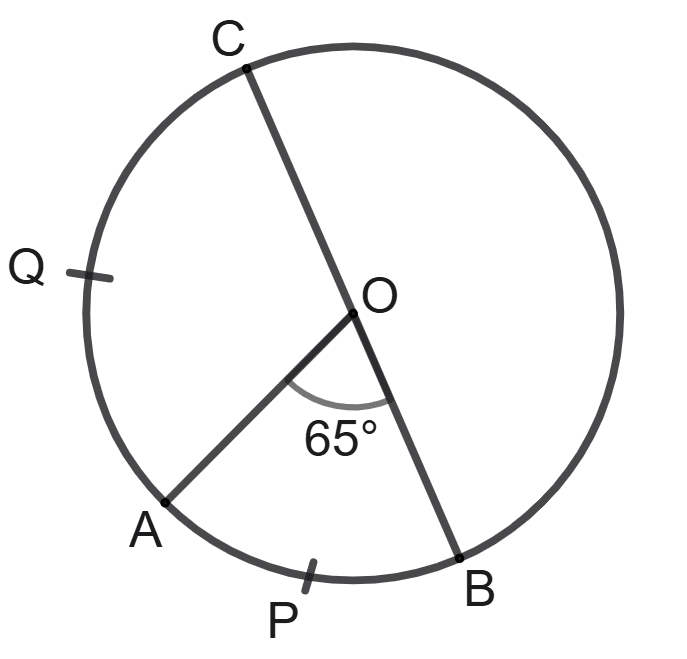
65°
2 x 65°
X 65°
none of these
Statement 1: The angle between a radius and tangent of a circle is 90°.
Statement 2: At the point of contact the angle between radius and tangent is equal to one right angle.
Which of the following options is correct?
Both the statements are true.
Both the statements are false.
Statement 1 is true, and statement 2 is false.
Statement 1 is false, and statement 2 is true.
Assertion (A) : When the radius of a circle is increased by 3 cm, its diameter will increase by 2 x 3 cm.
Reason (R) : Original radius is r cm, original diameter 2r cm
∴ Increase in length of diameter = 2(r + 3) cm - 2r
Both A and R are correct, and R is the correct explanation for A.
Both A and R are correct, and R is not the correct explanation for A.
A is true, but R is false.
A is false, but R is true.
Assertion (A) : If a circle is of radius 8 cm and the length of its minor arc is also 8 cm, then the length of major arc = 8(2π - 1) cm.
Reason (R) : For every circle, sum of the length of its major arc and length of its minor arc is equal to the circumference of the circle.
Both A and R are correct, and R is the correct explanation for A.
Both A and R are correct, and R is not the correct explanation for A.
A is true, but R is false.
A is false, but R is true.