
Physics
Assertion (A) : When current is passed through a wire, a magnetic field is generated around the wire.
Reason(R) : Whenever there is a change of magnetic flux linked up with the coil, the induced current is generated in the coil.
- Both A and R are correct, and R is the correct explanation of A.
- Both A and R are correct, but R is not the correct explanation of A.
- A is correct but R is wrong.
- Both A and R are wrong.
Electro-Magnetism
6 Likes
Answer
Both A and R are correct, but R is not the correct explanation of A
Explanation :
Assertion (A) is true: According to Oersted’s experiment and Ampere’s law, passing an electric current through a conductor generates concentric circular magnetic field lines around it.
Reason (R) is true: According to Faraday’s law of electromagnetic induction, A changing magnetic flux through a coil induces an electromotive force, hence a current.
Reason (R) describes electromagnetic induction (how a changing magnetic field induces current in a coil). Assertion (A) describes the generation of a magnetic field by a steady current. These are two distinct phenomenon, one is about field creation, the other about induced currents, so the Reason (R) does not explain the Assertion (A).
Answered By
2 Likes
Related Questions
If three resistors , and are connected in series and , then what is the relation between the currents , and respectively flowing through them?
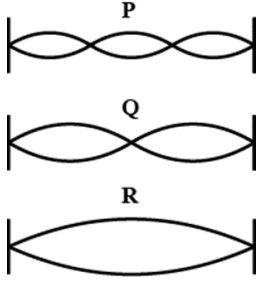
What is the ratio of wavelengths between P, Q and R?
- 3:2:1
- 1:2:3
- 6:3:2
- 2:3:6
During the change of state of a substance from solid to liquid, heat is absorbed by a body, but its temperature does not rise. Which of the following statements explains the phenomenon?
- Only K.E of the molecules increases, but P.E remains the same.
- Only P.E of the molecules increases, but K.E remains the same.
- Both K.E and P.E of the molecules increase.
- There is no increase in the P.E and K.E of the molecules.
Which of the following combinations correctly shows the charges on the particles?
+ 1.6 X 10⁻¹⁹ C - 1.6 X 10⁻¹⁹ C + 3.2 X 10⁻¹⁹ C (a) proton neutron alpha particle (b) alpha particle electron neutron (c) proton electron alpha particle (d) electron Proton alpha particle