
Mathematics
Assertion (A) : The diagonal of a rectangle is 17 m and its breadth is 8 m. Half of the area of rectangle is 120 m2.
Reason (R) : The diagonal of every rectangle, divide into two congruent right-triangles.
Both A and R are correct, and R is the correct explanation for A.
Both A and R are correct, and R is not the correct explanation for A.
A is true, but R is false.
A is false, but R is true.
Area Trapezium Polygon
3 Likes
Answer
Given,
The diagonal of the rectangle = 17 m
The breadth of the rectangle = 8 m
Using Pythagoras theorem in rectangle,
⇒ Diagonal2 = Length2 + Breadth2
⇒ 172 = l2 + 82
⇒ 289 = l2 + 64
⇒ l2 = 289 - 64
⇒ l2 = 225
⇒ l =
⇒ l = 15 m.
By formula,
Area of rectangle = l x b = 15 x 8 = 120 m2.
Half of the area of rectangle = = 60 m2.
So, assertion (A) is false.
ABCD is a rectangle. BD is a diagonal.
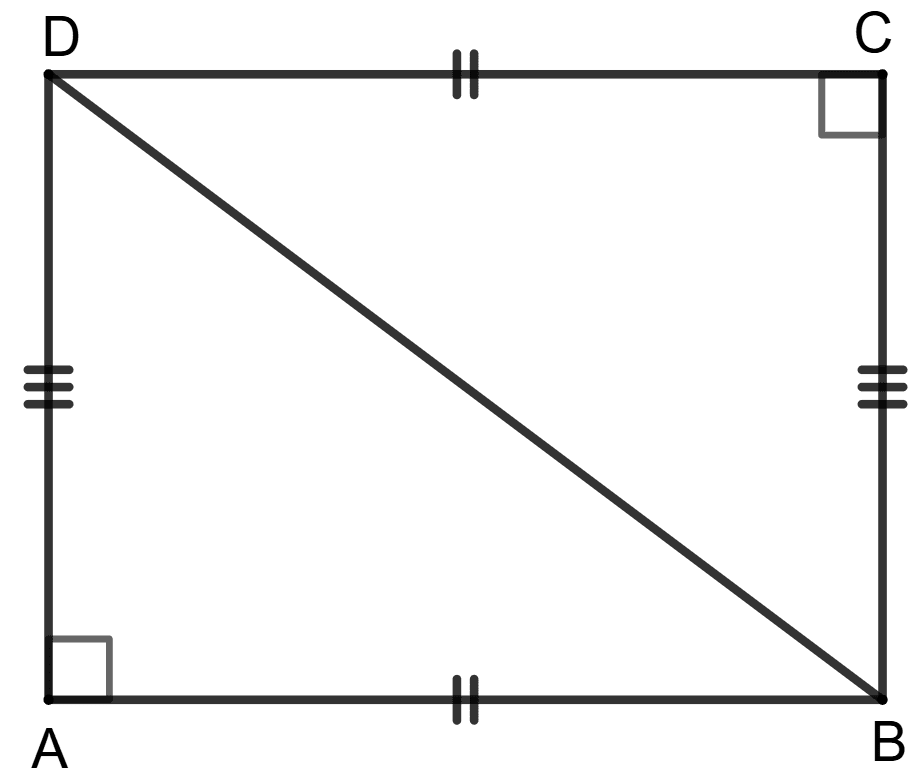
In Δ ABD and Δ BDC,
⇒ AB = DC (Opposite sides of rectangle are equal)
⇒ AD = BC (Opposite sides of rectangle are equal)
⇒ BD = BD (Common)
∴ Δ ABD ≅ Δ BDC (By SSS congruency criterion)
Thus the diagonal of every rectangle, divide into two congruent right-triangles.
So, reason (R) is true.
∴ A is false, but R is true.
Hence, option 4 is the correct option.
Answered By
3 Likes
Related Questions
The adjacent sides of a rectangle are 20 cm and 24 cm. If its perimeter is equal to the circumference of a circle, the radius of the circle is :
14 cm
21 cm
28 cm
7 cm
Statement 1: ABCD is a parallelogram, base AB = 12 cm, perpendicular dropped from D to AB is 9 cm, area of parallelogram ABCD = 54 cm2.
Statement 2: The area of parallelogram = Base x Height.
Which of the following options is correct?
Both the statements are true.
Both the statements are false.
Statement 1 is true, and statement 2 is false.
Statement 1 is false, and statement 2 is true.
Assertion (A) : The area of an equilateral triangle of height cm2.
Reason (R) : The area of an equilateral triangle = x (Height)2.
Both A and R are correct, and R is the correct explanation for A.
Both A and R are correct, and R is not the correct explanation for A.
A is true, but R is false.
A is false, but R is true.
Assertion (A) : The diagonal of a square is cm. Its area = 81 cm2.
Reason (R) : The area of a square = x d2, where d is the length of the diagonal
Both A and R are correct, and R is the correct explanation for A.
Both A and R are correct, and R is not the correct explanation for A.
A is true, but R is false.
A is false, but R is true.