
Physics
Assertion (A) : When the displacement is zero, then the work is zero. So, if the work done is zero, then it necessarily means the displacement is zero.
Reason(R) : Work done is calculated by the relation 𝑊=𝐹𝑆 𝑐𝑜𝑠 𝜃
- A and R are true, and R is the reason for A.
- A and R are true, and R is not the reason for A.
- A is true, but R is false.
- A is false, but R is true.
Work, Energy & Power
11 Likes
Answer
A is false, but R is true.
Explanation :
Work is given by so the reason is correct.
But zero work doesn't always mean zero displacement. For example, when force is perpendicular to displacement (like carrying a bag horizontally). Here, the angle between force and displacement is 90° so work done work is still zero, even though displacement exists. Therefore, the reason is correct, but the assertion is not.
Answered By
4 Likes
Related Questions
A metal ball is whirled inside a ring placed on a table, as shown in the diagram P. The diagram Q shows the motion of the ball after the ring is lifted.
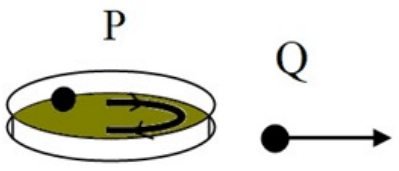
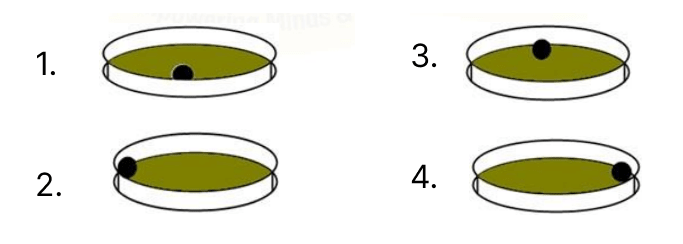
Which of the following diagrams shows the correct position of the metal ball in the ring when the ring is lifted?
Assertion (A): Sometimes the sky appears reddish in the evening.
Reason (R): Red, being longer in wavelength, scatter more than the other colours.
- A and R are true, and R is the reason for A.
- A and R are true, and R is not the reason for A.
- A is true, but R is false.
- A is false, but R is true.
Which of the following statement is CORRECT?
The frequency of a stretched string is:
- directly proportional to its length but inversely proportional to the tension of the wire.
- inversely proportional to its length but directly proportional to the tension of the wire.
- directly proportional to the square root of its length but inversely proportional to the tension of the wire.
- inversely proportional to its length but directly proportional to the square root of the tension of the wire.
A ray of light passes obliquely from an optical medium of refractive index 1.33 to another medium of refractive index 1.5. While passing from the first medium to the second, the light ray will:
- bend towards the normal.
- bend away from the normal.
- move along the normal.
- suffer total internal reflection.