
Physics
A metal ball is whirled inside a ring placed on a table, as shown in the diagram P. The diagram Q shows the motion of the ball after the ring is lifted.
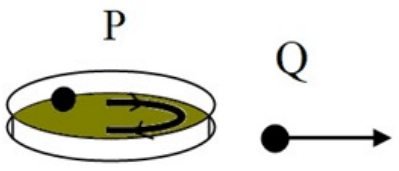
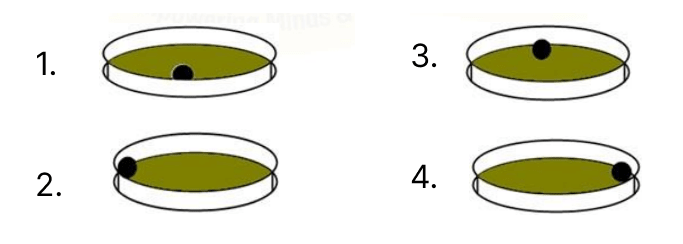
Which of the following diagrams shows the correct position of the metal ball in the ring when the ring is lifted?
Force
18 Likes
Answer
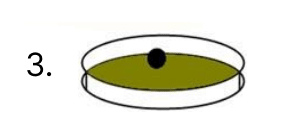
Reason — In circular motion, the velocity of an object is always tangential to the point on its path. In the figure, the ball is moving clockwise within the ring, and upon lifting the ring, the ball moves toward the right, making option 3 the correct choice.
Answered By
10 Likes
Related Questions
Two substances, A and B, have the same mass. Substance A has a higher specific heat capacity than substance B. What consequences would you expect when these substances are subjected to the same amount of heat energy?
- Substance A will experience a smaller temperature change than substance B.
- Substance A will experience a larger temperature change than substance B.
- Both substances will experience the same temperature change.
- Either of them can show a greater change in temperature as the temperature change depends on factors other than specific heat capacity.
A student traces the path of a ray of light through a glass prism for different angles of incidence. He analyses each diagram and draws the following conclusion:
I. On entering the prism, the light ray bends towards its base.
II. Light ray suffers refraction at the point of incidence and at the point of emergence while passing through the prism.
III. An emergent ray bends at a certain angle to the direction of the incident ray.
IV. While emerging from the prism at the second surface, the angle of refraction is less than the angle of incidence at that surface.
Which of the above inferences are correct?
- I, II and III
- I, III and IV
- II, III and IV
- All of these.
Assertion (A): Sometimes the sky appears reddish in the evening.
Reason (R): Red, being longer in wavelength, scatter more than the other colours.
- A and R are true, and R is the reason for A.
- A and R are true, and R is not the reason for A.
- A is true, but R is false.
- A is false, but R is true.
Assertion (A) : When the displacement is zero, then the work is zero. So, if the work done is zero, then it necessarily means the displacement is zero.
Reason(R) : Work done is calculated by the relation 𝑊=𝐹𝑆 𝑐𝑜𝑠 𝜃
- A and R are true, and R is the reason for A.
- A and R are true, and R is not the reason for A.
- A is true, but R is false.
- A is false, but R is true.