Mathematics
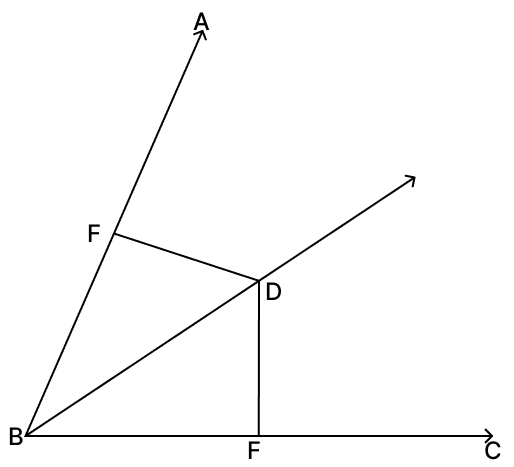
Assertion (A): In the figure, ∠ABD = ∠CBD, so DE = DF.
Reason (R): Every point on the angle bisector of two intersecting lines is equidistant from the lines.
A is true, R is false
A is false, R is true
Both A and R are true
Both A and R are false
Locus
1 Like
Answer
We know that,
Every point on the angle bisector of two intersecting lines is equidistant from the lines.
∴ Reason (R) is true.
Since,
∠ABD = ∠CBD only tells us that BD is the angle bisector of ∠ABC.
From the figure, DE and DF are not shown as perpendiculars to BA and BC respectively. Equality of distances from the sides is guaranteed only for perpendicular distances.
Therefore, concluding DE = DF is not justified.
∴ Assertion (A) is false.
Thus, A is false, R is true.
Hence, option 2 is the correct option.
Answered By
1 Like
Related Questions
The locus of a point which is equidistant from a given circle consists of:
a pair of circles concentric with the given circle.
a circle concentric with the given circle and inside it.
a circle concentric with the given circle and outside it.
a pair of lines parallel to each other on either side of the centre.
A and B are two fixed points in a plane. Then, the locus of a point P which moves in such a way that PA2 + PB2 = AB2, is:
a square with AB as one of its sides.
a rectangle with AB as one of its sides.
a rhombus with AB as one of its diagonal.
the circumference of a circle with AB as its diameter.
The locus of the tip of the pendulum of a clock is:
a circle
a chord of a circle
an arc of a circle
a diameter of a circle
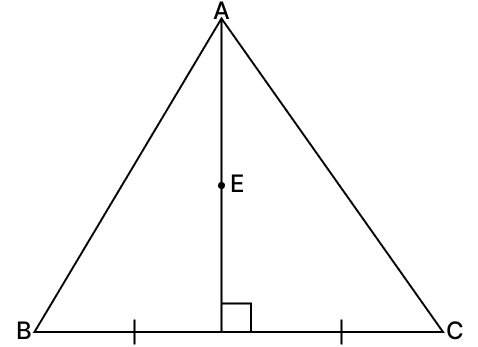
Assertion (A): In the figure, D is the mid-point of BC and AD ⟂ BC. If E lies on AD, then BE = CE.
Reason (R): Every point on the perpendicular bisector of a line segment is equidistant from its end points.
A is true, R is false
A is false, R is true
Both A and R are true
Both A and R are false