
Mathematics
Assertion (A): logx (m x n x p) = logx m + logx n + log p.
Reason (R): The logarithm of a product at any non-zero base is equal to the sum of the logarithms of its factors at the same base.
- A is true, R is false.
- A is false, R is true.
- Both A and R are true.
- Both A and R are false.
Logarithms
1 Like
Answer
A is false, R is true.
Explanation
Given,
logx (m x n x p) = logx m + logx n + log p
The product law of logarithms states that :
loga (b x c) = loga b + loga c
So, logx (m x n x p) = logx m + logx n + logx p
≠ logx m + logx n + log p
∴ Assertion (A) is false.
The logarithm of a product at any non-zero base is equal to the sum of the logarithms of its factors at the same base.
i.e., loga (b x c) = loga b + loga c
∴ Reason (R) is true.
Hence, Assertion (A) is false, Reason (R) is true.
Answered By
1 Like
Related Questions
Assertion (A): If log10x log105 = log1020
⇒ 5x = 20 and x = 4Reason (R): If log10x log105 = log1020
⇒ x + 5 = 20 and x = 15- A is true, R is false.
- A is false, R is true.
- Both A and R are true.
- Both A and R are false.
Assertion (A):
log25 log82 = .
Reason (R):
log25 log82 =
- A is true, R is false.
- A is false, R is true.
- Both A and R are true.
- Both A and R are false.
Assertion (A): log100(1000) = .
Reason (R): logb a = , for all a, b, x.
- A is true, R is false.
- A is false, R is true.
- Both A and R are true.
- Both A and R are false.
Assertion (A): Using the information in the given figure; we get BD = CE.
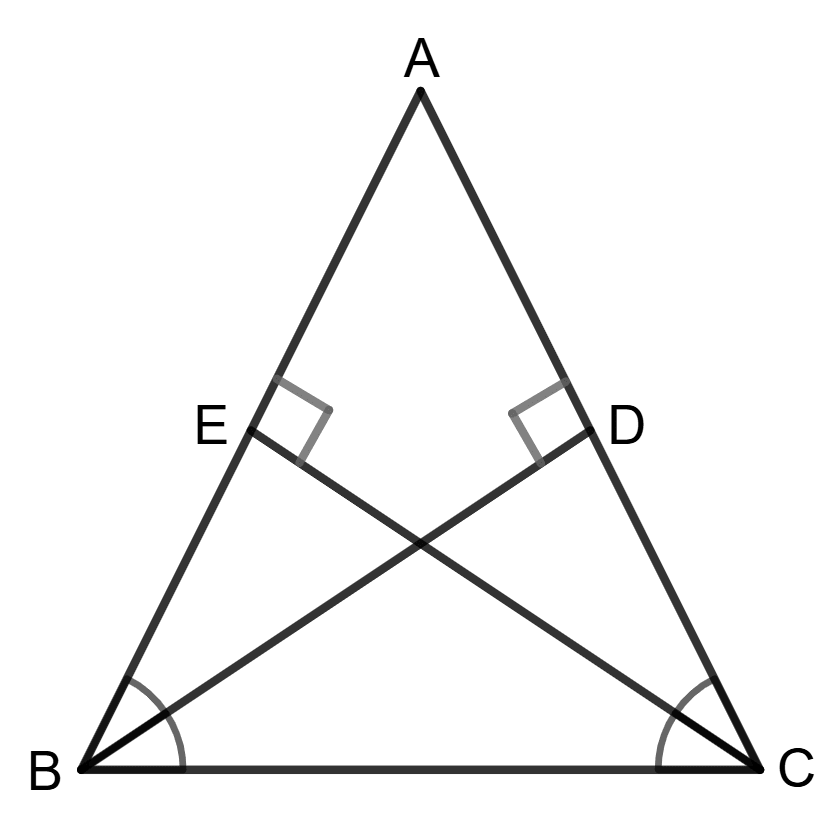
Reason (R):
∵ △BDC ≅ △CEB (By AAS or ASA)
BD = CE- A is true, R is false.
- A is false, R is true.
- Both A and R are true.
- Both A and R are false.