
Mathematics
Assertion (A): The number obtained on rationalizing the denominator of is .
Reason (R): If the product of two irrational numbers is rational, then each one is called the rationalizing factor of the other.
A is true, R is false
A is false, R is true
Both A and R are true
Both A and R are false.
Rational Irrational Nos
1 Like
Answer
Given,
Rationalizing the denominator of ,
∴ Assertion (A) is true.
We know that,
If the product of two irrational numbers is rational, then each one is called the rationalizing factor of the other.
∴ Reason (R) is true.
Hence, Option 3 is the correct option.
Answered By
2 Likes
Related Questions
Case Study
The union of the set of rational numbers (Q) and irrational numbers (P) form the set of real numbers (R). Rational numbers are the set of numbers which can be written in the form of , where a and b are integers and b is not equal to zero. The decimal expansion of a rational number is either terminating or non-terminating repeating. The number which cannot be expressed in the form are called irrational numbers. The decimal expansion of irrational numbers is non-terminating non-repeating.
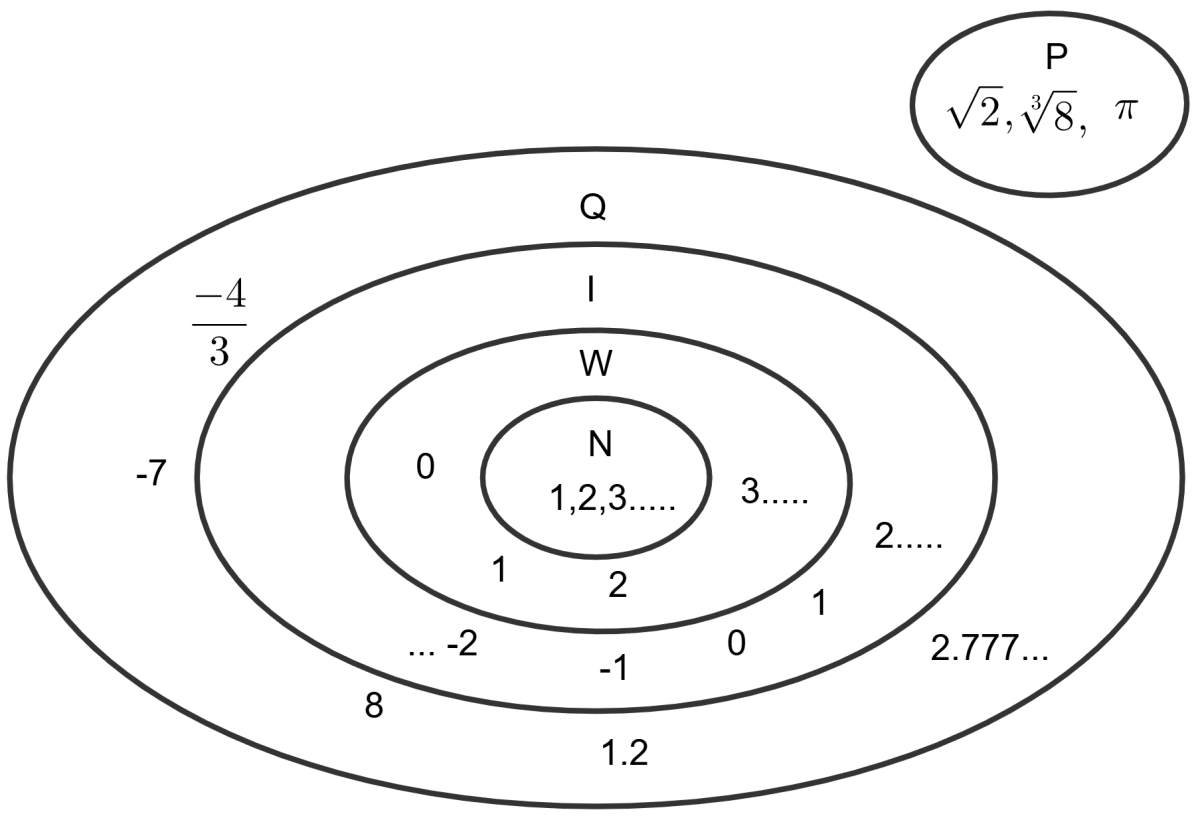
Based on this information, answer the following questions:
Every rational number is:
(a) a natural number
(b) a whole number
(c) an integer
(d) a real numberEvery real number is:
(a) an integer
(b) a rational number
(c) an irrational number
(d) either a rational number or an irrational number.The sum of two irrationals is:
(a) irrational
(b) rational
(c) either rational or irrational
(d) neither rational or irrational.The product of a rational and irrational number is:
(a) an irrational number
(b) a rational number
(c) either a rational number or an irrational number
(d) neither a rational number nor an irrational number.The number of irrational number is:
(a) finite
(b) infinite
(c) neither finite or infinite
(d) none of these.
Case Study
Ms Mehta teaches maths in a school. One day after teaching the lesson of number system, she wanted to check the understanding of the students of her class. So, she wrote two numbers, on the blackboard and asked few questions based on them. You please try to answer the following questions asked by Ms Mehta.
The decimal expansion of is:
(a) terminating
(b) non-terminating
(c) non-terminating non-repeating
(d) non-terminating repeatingis:
(a) non-terminating non-repeating
(b) non-terminating repeating
(c) non-terminating
(d) terminatingThe decimal form of :
(a) 0.27
(b) 0.2727
(c)
(d) 0.3as vulgar fraction becomes:
(a)
(b)
(c)
(d)The sum of is :
(a)
(b)
(c)
(d)
Assertion (A): Each of the numbers is irrational.
Reason (R): The cube roots of all natural numbers is irrational.
A is true, R is false
Both A and R are true
A is false, R is true
Both A and R are false.
The sum of all rational numbers between 0 and 0.1 is :
finite
infinite
can't say anything
none of these