
Physics
Assertion (A): In parallel combination of electrical appliances, total power consumption is equal to the sum of the power of individual appliances.
Reason (R): In parallel combination, the voltage across each appliance is the same.
- both A and R are true and R is the correct explanation of A
- both A and R are true and R is not the correct explanation of A
- assertion is false but reason is true
- assertion is true but reason is false
Current Electricity
3 Likes
Answer
both A and R are true and R is the correct explanation of A
Explanation
Assertion (A) is true because in a parallel combination, each appliance operates independently and draws its own current. The total current supplied by the source is the sum of currents in all branches. Since total power is given by P = VI, the total power consumed becomes the sum of the individual powers of all appliances.
Reason (R) is true because in a parallel circuit, each appliance is connected directly across the source, so the same potential difference (voltage) is applied across each appliance.
Hence, both A and R are true and R is the correct explanation of A.
Answered By
3 Likes
Related Questions
A bulb B1 100 W, bulb B2 60 W and bulb B3 40 W are connected as shown in the figure. The output powers of these would be :
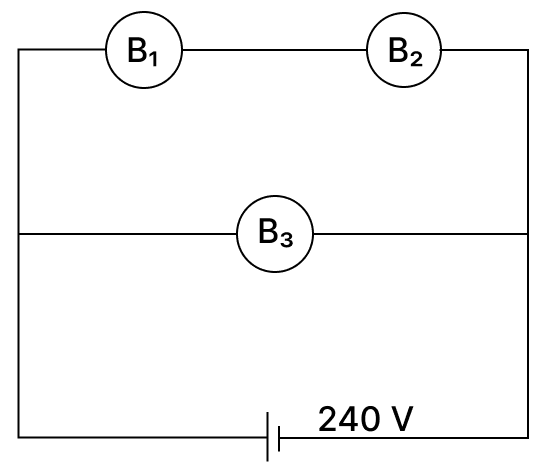
- W1 < W2 < W3
- W1 = W2 > W3
- W1 > W2 > W3
- W1 > W2 = W3
Assertion (A): In series combination of electric bulbs, the bulb of lower power emits more light than that of the higher power.
Reason (R): The lower power bulb in series gets more current than the higher power bulb
- both A and R are true and R is the correct explanation of A
- both A and R are true and R is not the correct explanation of A
- assertion is false but reason is true
- assertion is true but reason is false
Write an expression for the electrical energy spent in flow of current through an electrical appliance in terms of current, resistance and time.
Write an expression for the electrical power spent in flow of current through a conductor in terms of (a) resistance and potential difference, (b) current and resistance.