Chemistry
Assertion (A): Zinc can displace copper from aqueous copper sulphate solution.
Reason (R): Copper is placed above zinc in the reactivity series.
- Both A and R are true and R is the correct explanation of A.
- Both A and R are true but R is not the correct explanation of A.
- A is true but R is false.
- A is false but R is true.
Answer
A is true but R is false.
Explanation — Zinc is more reactive than copper. So, zinc is placed above copper in reactivity series. Hence, zinc displaces copper from aqueous copper sulphate solution. Hence the assertion (A) is true.
CuSO4 (aq) + Zn → ZnSO4 + Cu ↓
Copper is less reactive than zinc and is placed below zinc in reactivity series. Less reactive elements cannot displace more active elements. Hence, copper cannot displace zinc from its salt solution. Hence the reason (R) is false.
Related Questions
KI + Cl2 ⟶ KCl + I2
(a) Balance the equation given above.
(b) Which type of reaction is it ?
(c) Which element is more reactive ?
(d) What will be the product formed if KCl reacts with I2 ?
See the diagram given below and answer the following questions:
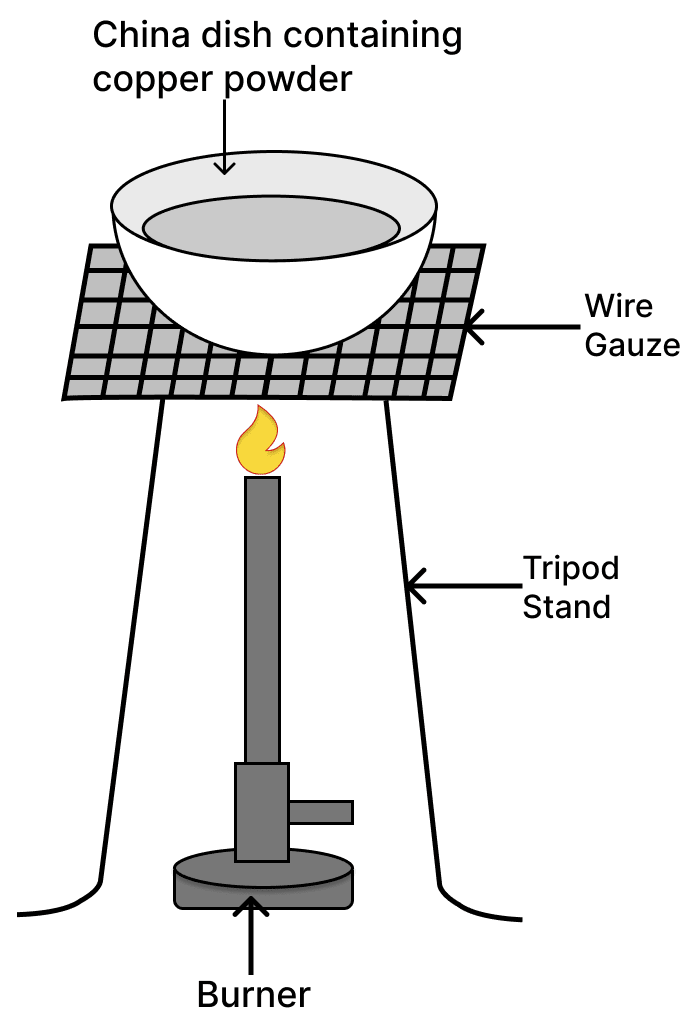
(a) Write the chemical reaction involved in the process.
(b) Mention the colour of :
(i) copper powder and
(ii) the substance formed after heating it.(c) Can we reverse the above reaction ? If yes, write the equation for the reverse reaction and state the substance that undergoes oxidation and the substance that undergoes reduction.
Assertion (A): In a redox reaction, the electron gaining species acts as a reducing agent.
Reason (R): Oxidation and reduction reactions occur simultaneously in redox reaction.
- Both A and R are true and R is the correct explanation of A.
- Both A and R are true but R is not the correct explanation of A.
- A is true but R is false.
- A is false but R is true.
Assertion (A): The decomposition of vegetable matter into compost is an endothermic reaction.
Reason (R): Decomposition reactions involve the breakdown of a single reactant into simpler products.
- Both A and R are true and R is the correct explanation of A.
- Both A and R are true but R is not the correct explanation of A.
- A is true but R is false.
- A is false but R is true.