
Mathematics
The bisectors of ∠A and ∠B of the parallelogram ABCD intersect at P on the side CD. If BC = 3 cm, then AB =
4 cm
5 cm
6 cm
8 cm
Rectilinear Figures
1 Like
Answer
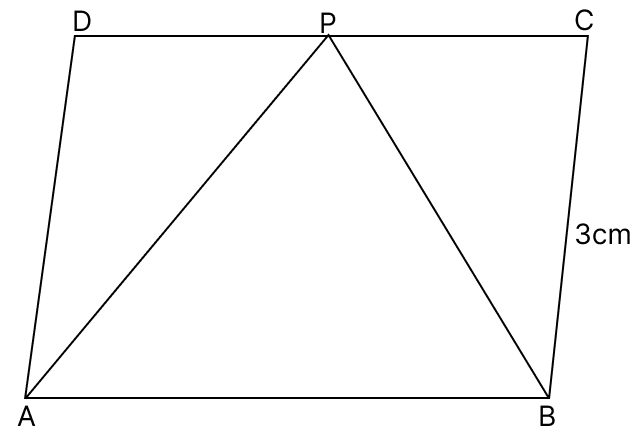
In parallelogram ABCD, we know that AB ∥ DC. The line AP is a transversal.
∠PAB = ∠APD (Alternate interior angles are equal) ….(1)
Since AP is the bisector of ∠A:
∠PAB = ∠PAD …….(2)
From equation (1) and (2), we get :
∴ ∠PAD = ∠APD
In triangle APD, since two angles are equal, the triangle is isosceles.
AD = DP
ABCD is a parallelogram, AD = BC = 3 cm.
Thus, DP = 3 cm.
Similarly, for the bisector BP and transversal BP:
∠PBA = ∠BPC (Alternate interior angles are equal) …….(3)
Since BP bisects ∠B:
∠PBA = ∠PBC ……….(4)
From equation (3) and (4), we get :
∴ ∠BPC = ∠PBC
In triangle BCP, since two angles are equal, the triangle is isosceles.
PC = BC = 3 cm.
Length of CD = DP + PC = 3 + 3 = 6 cm.
AB = CD = 6 cm [Opposite sides of parallelogram are equal]
Hence, option 3 is the correct option.
Answered By
3 Likes
Related Questions
In the parallelogram ABCD, ∠A : ∠B = 3 : 5. ∠C =
67.5°
112.5°
45°
135°
The bisectors of ∠A and ∠B of the parallelogram ABCD intersect at E. ∠AEB =
100°
90°
80°
60°
If the lengths of the diagonals of a rhombus are 24 cm and 10 cm, then the length of its each side is :
26 cm
17 cm
15 cm
13 cm
If the opposite angles of a quadrilateral are equal, then it will definitely be a :
rectangle
square
rhombus
parallelogram