
Mathematics
Case Study :
A farmer was having a field in the form of a parallelogram ABCD. He divided the field into several parts by taking a point X on the side CD and joining it to vertices A and B. The farmer sowed wheat and pulses in equal portions of the field separately.
Based on the above information, answer the following questions :
1. By joining XA and XB, the field has been divided into how many parts?
(a) 2
(b) 3
(c) 4
(d) 5
2. The shapes of the parts obtained above are :
(a) triangles
(b) rectangles
(c) one triangle two squares
(d) none of these
3. Area of ΔXAB is equal to :
(a) area of parallelogram ABCD
(b) area of parallelogram ABCD
(c) area of ΔADX + area of ΔBCX
(d) both 2. and 3.
4. ΔABX and parallelogram ABCD are :
(a) On the same base DC
(b) On the same base AB and between the same parallels BC and AD
(c) On the same base AB and between the same parallels AB and CD
(d) On the same base CD and between the same parallels AB and CD
5.If instead of taking point X on side CD, the farmer takes a point Y on side BC and joins YA and YD, then :
(a) area of ΔADY = area of ΔABY + area of ΔDCY
(b) area of ΔADY = area of parallelogram ABCD
(c) area of ΔADY = area of ΔABY
(d) area of ΔADY = area of ΔDCY
Theorems on Area
2 Likes
Answer
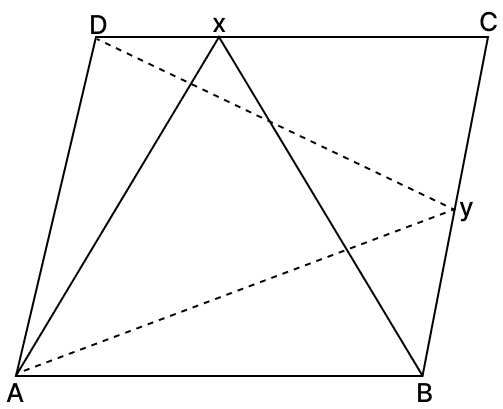
1. When point X is chosen on the side CD and joined to vertices A and B, the parallelogram is split into three distinct triangular regions: △ ADX, △ ABX, and △ BCX.
Hence, option (b) is the correct option.
2. Since X is a point on a line segment (CD) and it is connected to the endpoints of the opposite parallel side (A and B), all three resulting closed figures are three-sided polygons.
All three parts formed are triangles.
Hence, option (a) is the correct option.
3. Since ΔABX and parallelogram ABCD are on the same base AB and between the same parallels AB and CD,
Area of △XAB = Area of parallelogram ABCD
Since ΔXAB is half the total area, the sum of the remaining two triangles is also half the total area.
ar(△ADX) + ar(△BCX) = Area of parallelogram ABCD
Thus,
△XAB = △ADX + △BCX
Hence, option (d) is the correct option.
4. ΔABX and parallelogram ABCD stand on the same base AB and lie between the same parallels AB and CD.
Hence, option (c) is the correct option.
5. If Y is taken on BC and YA, YD are joined.
△ADY now shares the base AD with the parallelogram and lies between parallels AD and BC. Thus,
Area(△ ADY) = Area(ABCD) meaning it is equal to the sum of the remaining two triangles ΔABY and ΔDCY.
area of ΔADY = area of ΔABY + area of ΔDCY
Hence, option (a) is the correct option.
Answered By
3 Likes
Related Questions
Two diagonals of a parallelogram ABCD intersect at O. If the area of the parallelogram is 20 cm2, then the area of ΔAOB is :
20 cm2
15 cm2
10 cm2
5 cm2
E is the mid-point of the side AB of a parallelogram ABCD. If the area of the ABCD is 60 sq. cm, then the area of ΔBDE is :
60 sq. cm
30 sq. cm
15 sq. cm
10 sq. cm
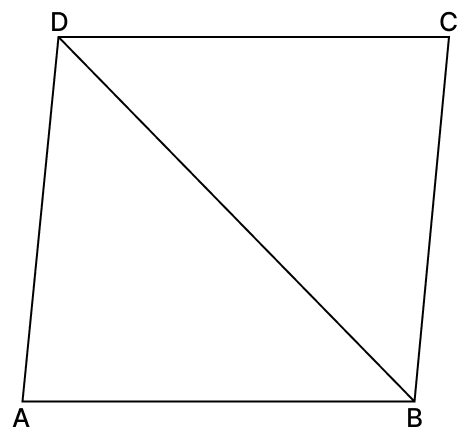
Assertion (A) : In the figure, ABCD is a parallelogram. Area of ΔABD = Area of ∥ gm ABCD.
Reason (R) : If a triangle and a parallelogram are on the same base and between the same parallels, then area of the triangle is equal to half of the area of the parallelogram.
A is true, R is false
A is false, R is true
Both A and R are true
Both A and R are false
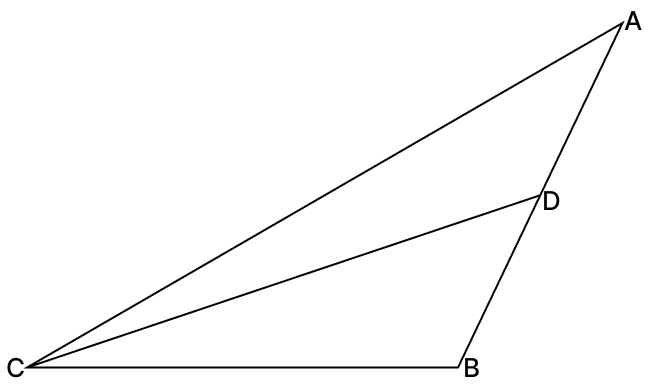
Assertion (A) : In ΔABC, if D is the mid-point of side AB, then area of ΔBCD = area of ΔACD.
Reason (R) : A triangle and a parallelogram on the same base and between the same parallels are equal in area.
A is true, R is false
A is false, R is true
Both A and R are true
Both A and R are false