Mathematics
Construct a ΔABC in which BC = 5.3 cm, CA = 4.8 cm and AB = 4 cm. Find by construction a point P which is equidistant from BC and AB and also equidistant from B and C.
Answer
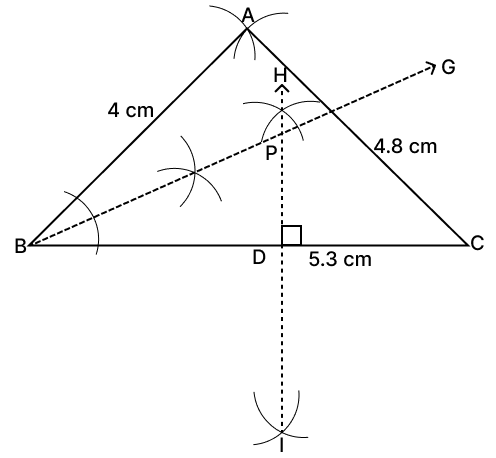
Steps of construction:
Draw base BC of length 5.3 cm.
With B as the center and a radius of 4 cm, draw an arc.
With C as the center and a radius of 4.8 cm, draw a second arc intersecting previous arc at A. Join ABC to get required triangle.
Draw BG angle bisector of ∠ABC.
Draw HI, the perpendicular bisector of BC.
The intersection of the angle bisector BG and the perpendicular bisector HI is the required point P.
Related Questions
Describe and construct each of the following loci:
(i) The locus of the tip of a minute hand of a watch.
(ii) The locus of the tip of the pendulum of a clock.
(iii) The locus of a point 5 cm from a fixed point O.
(iv) The locus of a point at a distance of 3 cm from a fixed line AB.
(v) The locus of a point equidistant from the arms OA and OB of ∠AOB.
(vi) The locus of the centres of all circles, each of radius 1 cm and touching externally a fixed circle with centre O and radius 3 cm.
(vii) The locus of the centres of all circles to which both the arms of an angle ∠AOB are tangents.
(viii) The locus of a point 1 cm from the circumference of a fixed circle towards the centre O, whose radius is 3 cm.
(ix) The locus of a point 1 cm from the centre of a circle of radius 2.5 cm.
(x) The locus of a stone dropped from a tower.
(xi) AB is a fixed line. State the locus of a point P such that ∠APB = 90°.
Describe the locus of a point in a rhombus ABCD which is equidistant from
(i) AB and AD
(ii) A and C
Construct ∠AOB = 60°. Mark a point P equidistant from OA and OB such that its distance from another given line CD is 3 cm.
ABC is an equilateral triangle of side 3.2 cm. Find the points on AB and AB produced which are 2 cm from BC.