Mathematics
Construct a quadrilateral ABCD in which AB = 3.2 cm, BC = 2.8 cm, CD = 4 cm, DA = 4.5 cm and BD = 5.3 cm. Also construct a triangle equal in area to this quadrilateral.
Answer
Steps of construction:
Draw AB = 3.2 cm.
With A as centre and radius 4.5 cm, draw an arc.
With B as centre and radius 5.3 cm draw another arc, cutting the previous arc at D.
Join AD.
With D as centre and radius 4 cm, draw an arc.
With B as centre and radius 2.8 cm, draw another arc cutting the previous arc at C.
Join BC and DC, to form quadrilateral ABCD.
Join BD and through C, construct a straight line parallel to DB to meet AB produced at E.
Join DE.
Since △DBC and △DBE have same base DB and are between the same parallels BD and EC, we have;
ar(△DBC) = ar(△DBE)
ar(quad ABCD) = ar(△ABD) + ar(△DBC)
ar(quad ABCD) = ar(△ABD) + ar(△DBE)
ar(quad ABCD) = ar(△AED)
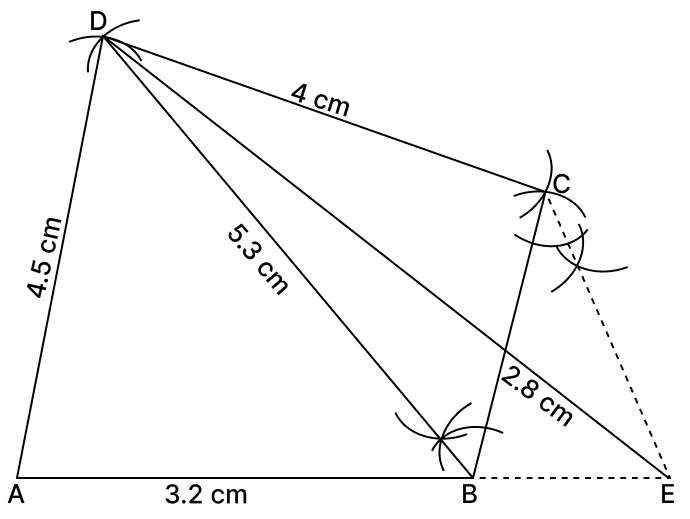
Hence, triangle AED is the required triangle whose area is equal to the area of the quadrilateral ABCD.
Related Questions
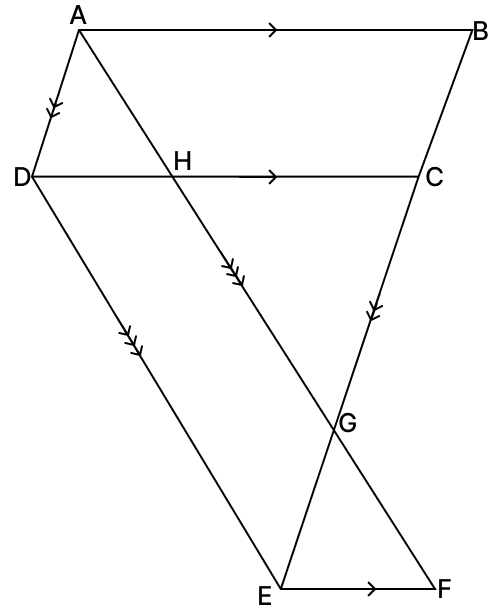
In the given figure, AB ∥ DC ∥ EF, AD ∥ BE and DE ∥ AF. Prove that : ar (∥ gm DEFH) = ar (∥ gm ABCD).
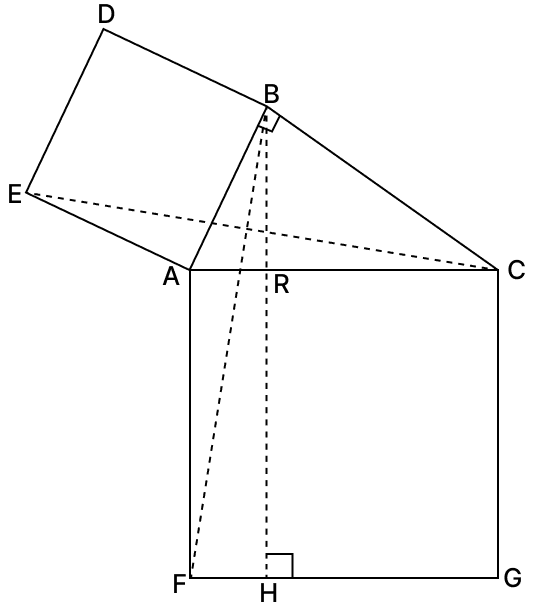
In the given figure, squares ABDE and AFGC are drawn on the side AB and hypotenuse AC of right triangle ABC and BH ⟂ FG. Prove that :
(i) ∠EAC = ∠BAF
(ii) ar (sq. ABDE) = ar (rect. ARHF)
Area of the rhombus whose diagonals are 16 cm and 24 cm will be :
182 cm2
202 cm2
92 cm2
192 cm2
The area of the trapezium whose parallel sides are 9 cm and 6 cm respectively and distance between these sides is 8 cm, will be :
50 cm2
60 cm2
70 cm2
80 cm2