
Chemistry
Copper shows variable valency and forms two different compounds with oxygen — Cu2O and CuO.
P — A is cuprous oxide, B is cupric oxide.
Q — A is cupric oxide, B is cuprous oxide.
R — A is copper (I) oxide, B is copper (II) oxide.
Only P
Only Q
Only R
Both P and R
Valency
8 Likes
Answer
Both P and R
Reason — Certain elements exhibit more than one valency and they show variable valency.
For example, copper shows valency of 1 and 2 and forms compounds like, cuprous [copper(I)] oxide and cupric [copper(II)] oxide, respectively.
Hence, both P and R are true.
Answered By
3 Likes
Related Questions
Which of the following reactions is not correct according to the laws?
P4 + 5O2 ⟶ P4O10
C2H6 ⟶ CO2 + H2O
2Zn + O2 ⟶ 2ZnO
CH4 + 2O2 ⟶ CO2 + 2H2O
In the compound magnesium nitride (Mg3N2):
P — Mg is trivalent, N is divalent.
Q — Mg is divalent. N is trivalent.
R — Mg is divalent, N is divalent.
Which of the statements given above is/are true?
Only P
Only Q
Only R
Both P and Q
The figure given below shows the molecule of an element, where 'a' denotes the atom with atomic mass 32.
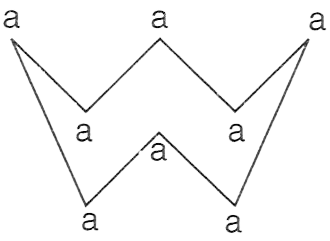
P — Element is tetratomic with molecular mass 128.
Q — Element is octatomic with molecular mass 256.
R — Element is crown-shaped with molecular mass 256.
Only P
Only Q
Only R
Both P and R
Fill in the blanks:
(a) Dalton used symbol …………… for oxygen and …………… for hydrogen.
(b) Symbol represents …………… atom of an element.
(c) Symbolic expression for a molecule is called …………… .
(d) Sodium chloride has two radicals. Sodium is a …………… radical while chloride is a …………… radical.
(e) Valency of phosphorus in PCl3 is …………… and in PCl5 is …………… .
(f) Valency of Iron in FeCl2 is …………… and in FeCl3 it is …………… .
(g) Formula of iron (III) carbonate is …………… .