
Mathematics
Diagonals of rhombus ABCD intersect each other at point O. Prove that :
OA2 + OC2 = 2AD2 -
Pythagoras Theorem
10 Likes
Answer
By formula,
By pythagoras theorem,
⇒ (Hypotenuse)2 = (Perpendicular)2 + Base2
In right angle triangle AOD,
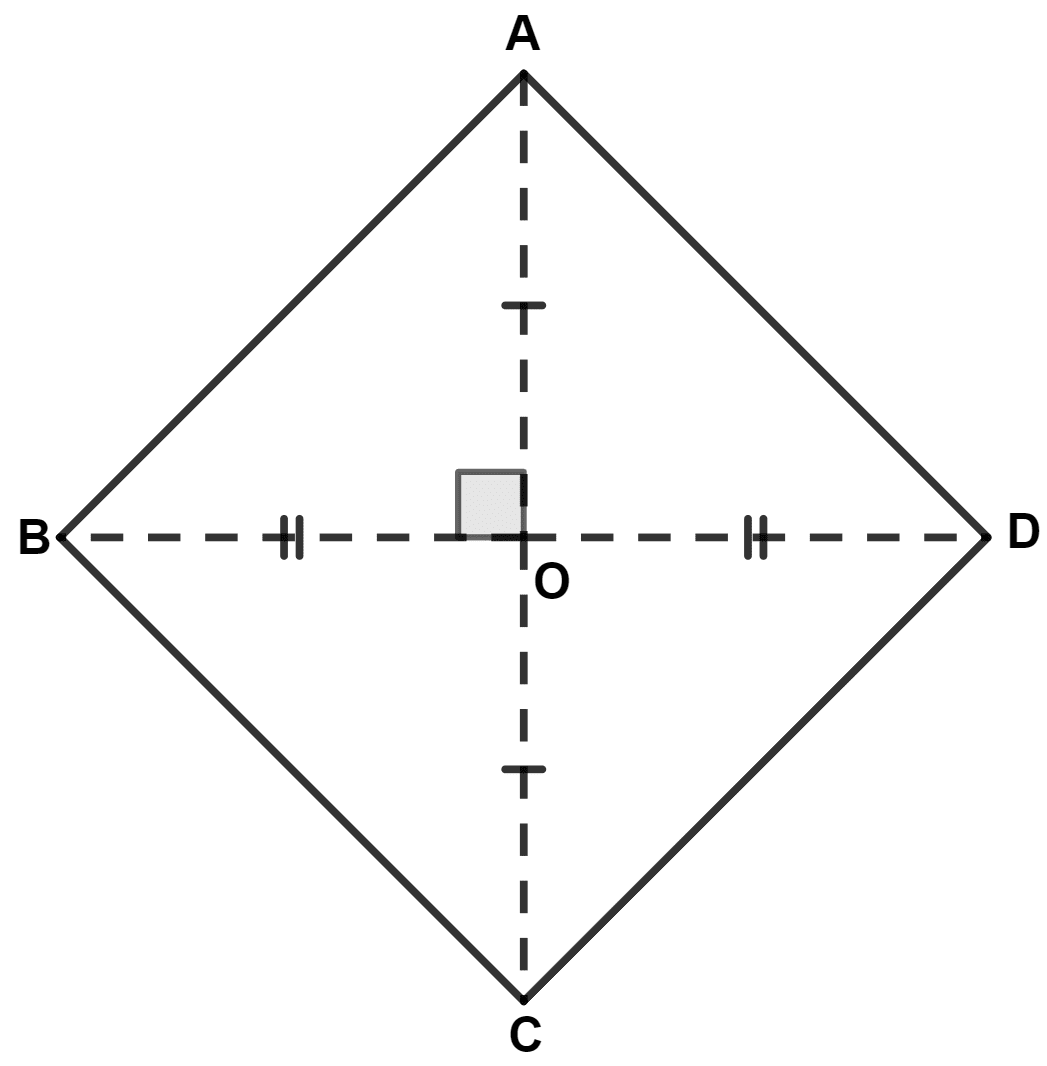
By pythagoras theorem,
⇒ AD2 = OA2 + OD2
⇒ OA2 = AD2 - OD2 ……….(1)
In right angle triangle COD,
By pythagoras theorem,
⇒ CD2 = OC2 + OD2
⇒ OC2 = CD2 - OD2 ……….(2)
To prove :
OA2 + OC2 = 2AD2 -
Solving L.H.S. of the above equation, we get :
⇒ OA2 + OC2 = AD2 - OD2 + CD2 - OD2
⇒ OA2 + OC2 = AD2 + CD2 - 2OD2 ………(3)
Since, all sides of a rhombus are equal and diagonals of rhombus bisect each other,
∴ CD = AD and OD =
Substituting value of CD and OD in equation (3), we get :
⇒ OA2 + OC2 = AD2 + AD2 -
⇒ OA2 + OC2 = 2AD2 -
⇒ OA2 + OC2 = 2AD2 - = R.H.S.
Hence, proved that OA2 + OC2 = 2AD2 - .
Answered By
6 Likes
Related Questions
If a side of a rhombus is 10 cm and one of the diagonals is 16 cm, find the other diagonal.
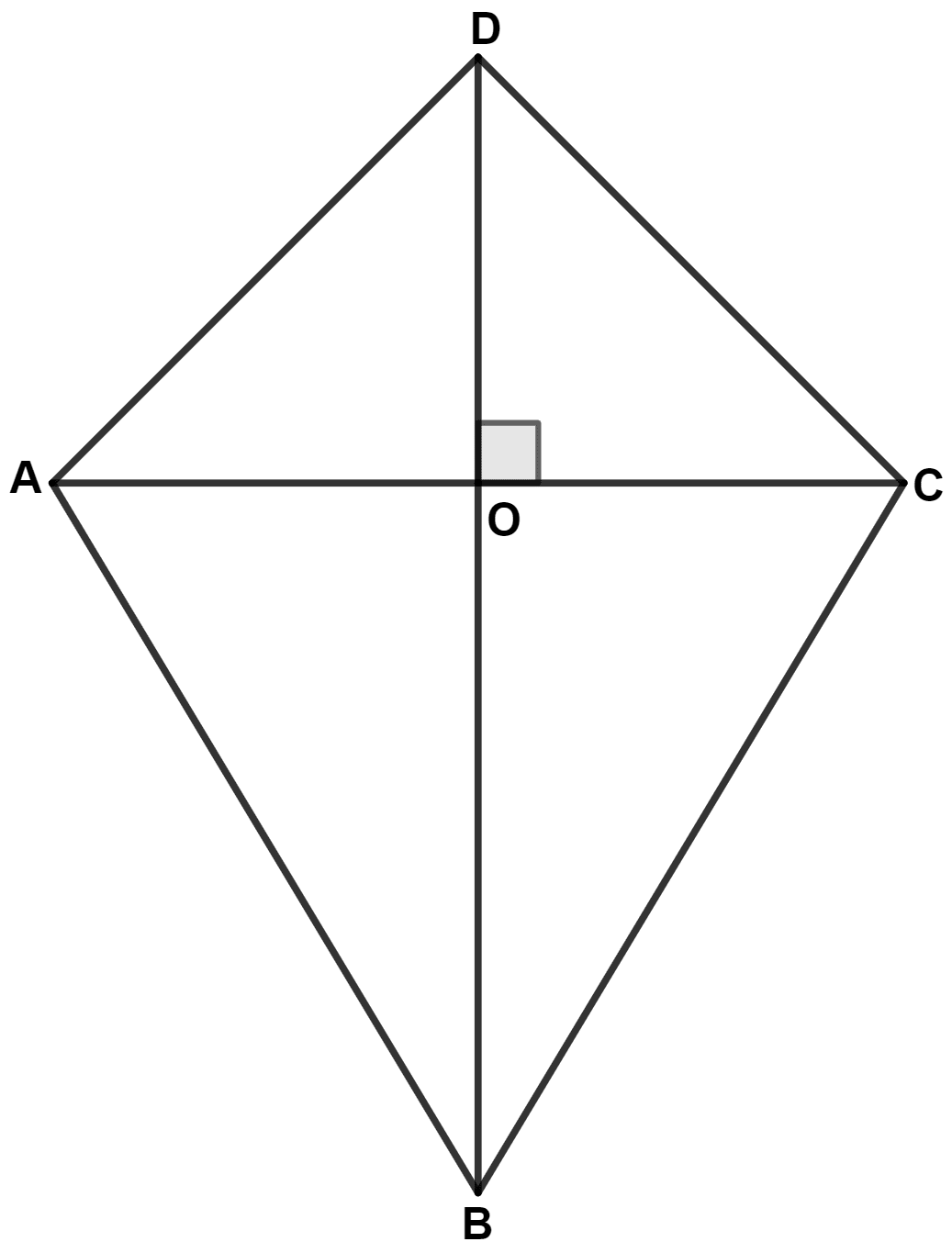
In the given figure, diagonals AC and BD intersect at right angle. Show that :
AB2 + CD2 = AD2 + BC2
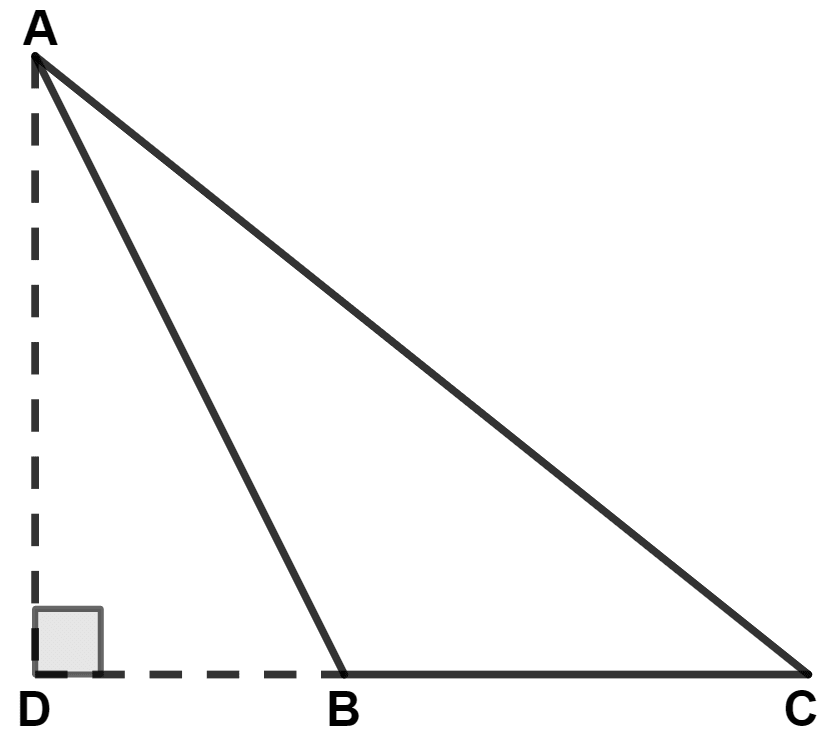
In the figure, AB = BC and AD is perpendicular to CD. Prove that :
AC2 = 2.BC.DC.
In an isosceles triangle ABC; AB = AC and D is a point on BC produced. Prove that :
AD2 = AC2 + BD.CD