
Physics
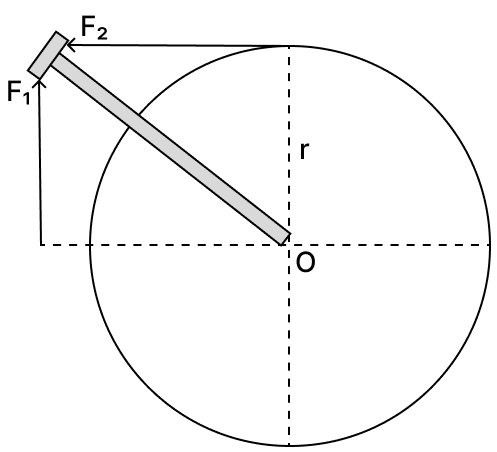
The diagram shows a wheel with a handle. Two forces, F1 and F2 of equal magnitudes are acting on the handle as shown in the diagram.
(a) Which force produces negative moment?
(b) Is the wheel in equilibrium? (Yes or No)
(c) Justify your answer stated in (b).
Force
5 Likes
Answer
(a) The force F1 produces the negative moment because it tends to rotate the wheel in the clockwise direction, which is taken as negative.
(b) No, the wheel is not in equilibrium.
(c) For equilibrium, the sum of clockwise moments must be equal to the sum of anticlockwise moments about the centre O. Although F1 and F2 have equal magnitudes, their perpendicular distances from the centre (moment arms) are different. Hence, the moments produced by them are not equal and opposite, so the net moment is not zero and the wheel is not in equilibrium.
Answered By
3 Likes
Related Questions
(a) Atmospheric temperature after a hailstorm is greater than the temperature during the hailstorm. State True or False.
(b) Which thermal physical quantity of a frying pan changes by making its base heavier?
(c) State the principle of Calorimetry.
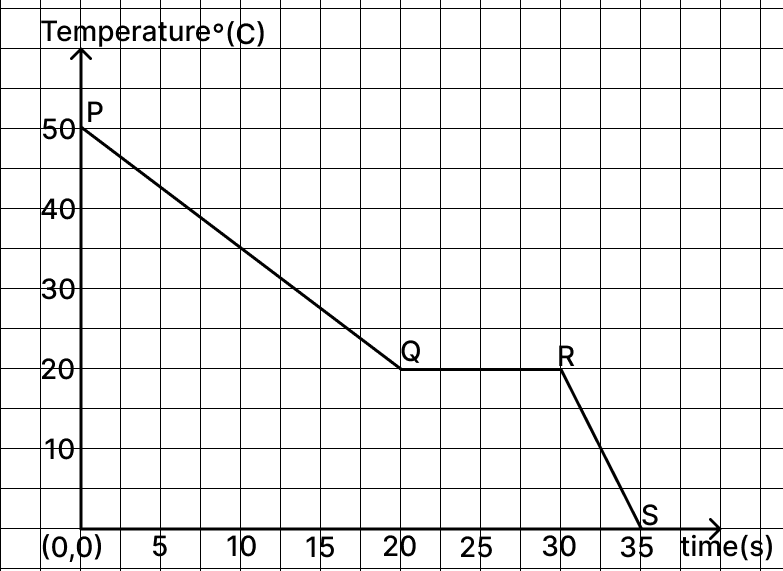
The given graph represents the cooling curve of a liquid.
(a) State the freezing temperature of the liquid.
(b) Name the phase change happening at the region QR.
(c) In which state (solid / liquid) does the above substance liberate heat at a faster rate? Justify.
(a) Name the unit of work done, used in subatomic scale.
(b) To which class of lever does a pair of scissors belong?
(c) A stone is tied to a string and displaced from A to B by application of constant force F in three different ways as shown in the diagram below.
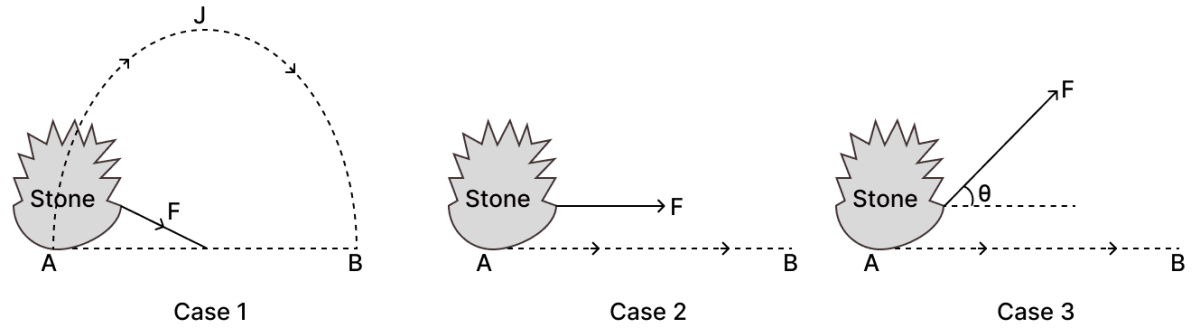
Arrange the three cases in ascending order of the work done by the force. (Given AJB is a semi-circle, θ < 90° and AB = 20 m)
A ball of mass 20 g falls from a height of 45 m. It rebounds from the ground to a height of 40 m. Calculate :
(a) initial potential energy of the ball.
(b) the speed of the ball at which it hits the ground.
(c) the loss in kinetic energy on striking the ground.
[g = 10 m s-2]