
Mathematics
Draw the graphs of the following sets of lines. In each case, reflect on the role of 'a' and 'b'.
(i) y = 4x, y = 2x, y = x
(ii) y = – 6x, y = – 3x, y = – x
(iii) y = 5x, y = –5x
(iv) y = 3x – 1, y = 3x, y = 3x + 1
(v) y = –2x – 3, y = –2x, y = 2x + 3
Polynomials
12 Likes
Answer
To draw the graphs, we identify two points for each line by substituting values of x and finding the corresponding values of y.
(i) y = 4x, y = 2x, y = x
For y = 4x: when x = 0, y = 0; when x = 1, y = 4. Points: (0, 0) and (1, 4).
For y = 2x: when x = 0, y = 0; when x = 1, y = 2. Points: (0, 0) and (1, 2).
For y = x: when x = 0, y = 0; when x = 1, y = 1. Points: (0, 0) and (1, 1).
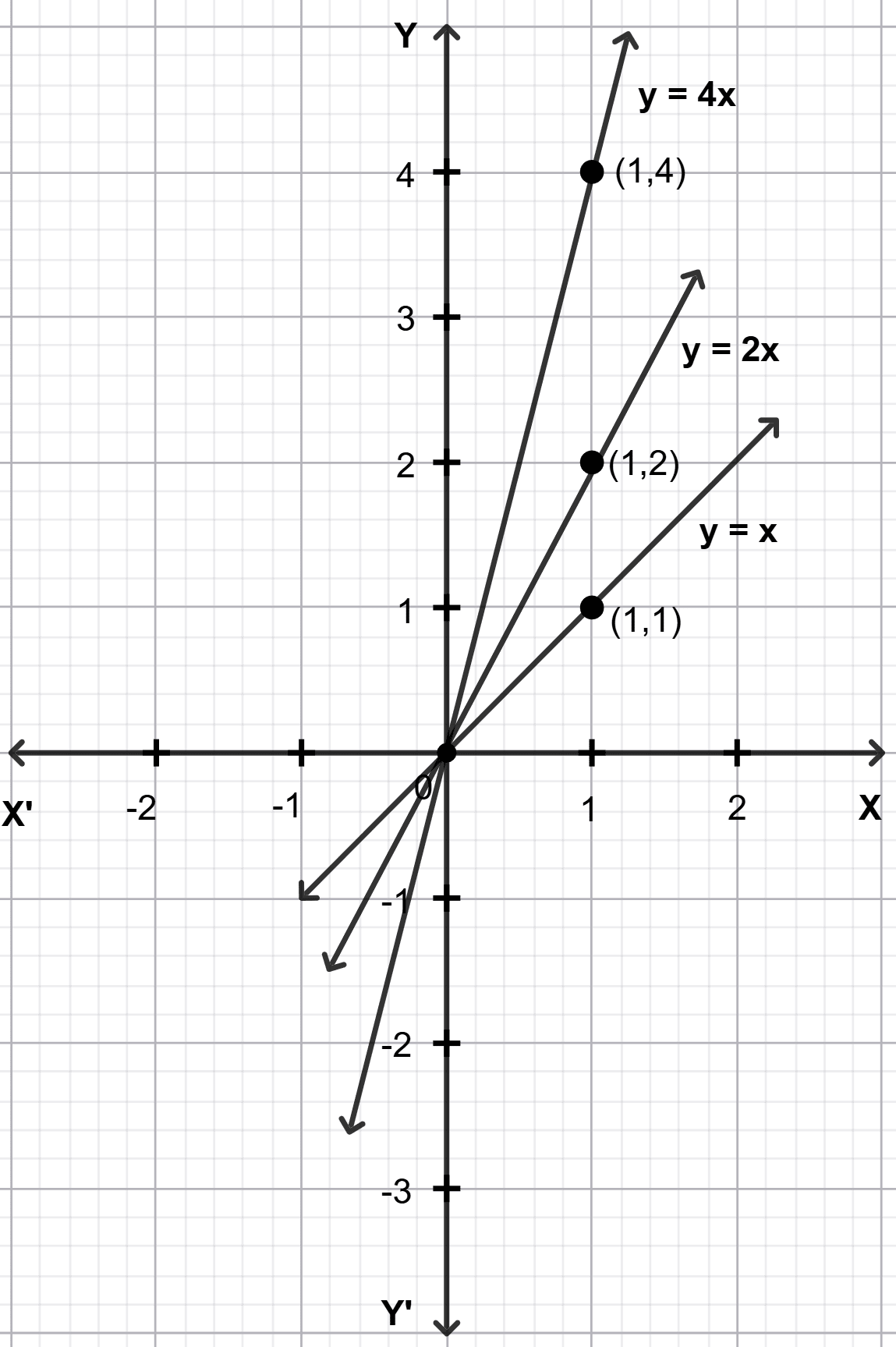
Observation:
All three lines pass through the origin (0, 0) since b = 0 in each.
The slopes are different (4, 2, 1). As 'a' increases, the line becomes steeper. The line y = 4x is the steepest, while y = x is the least steep.
(ii) y = -6x, y = -3x, y = -x
For y = -6x: when x = 0, y = 0; when x = 1, y = -6. Points: (0, 0) and (1, -6).
For y = -3x: when x = 0, y = 0; when x = 1, y = -3. Points: (0, 0) and (1, -3).
For y = -x: when x = 0, y = 0; when x = 1, y = -1. Points: (0, 0) and (1, -1).
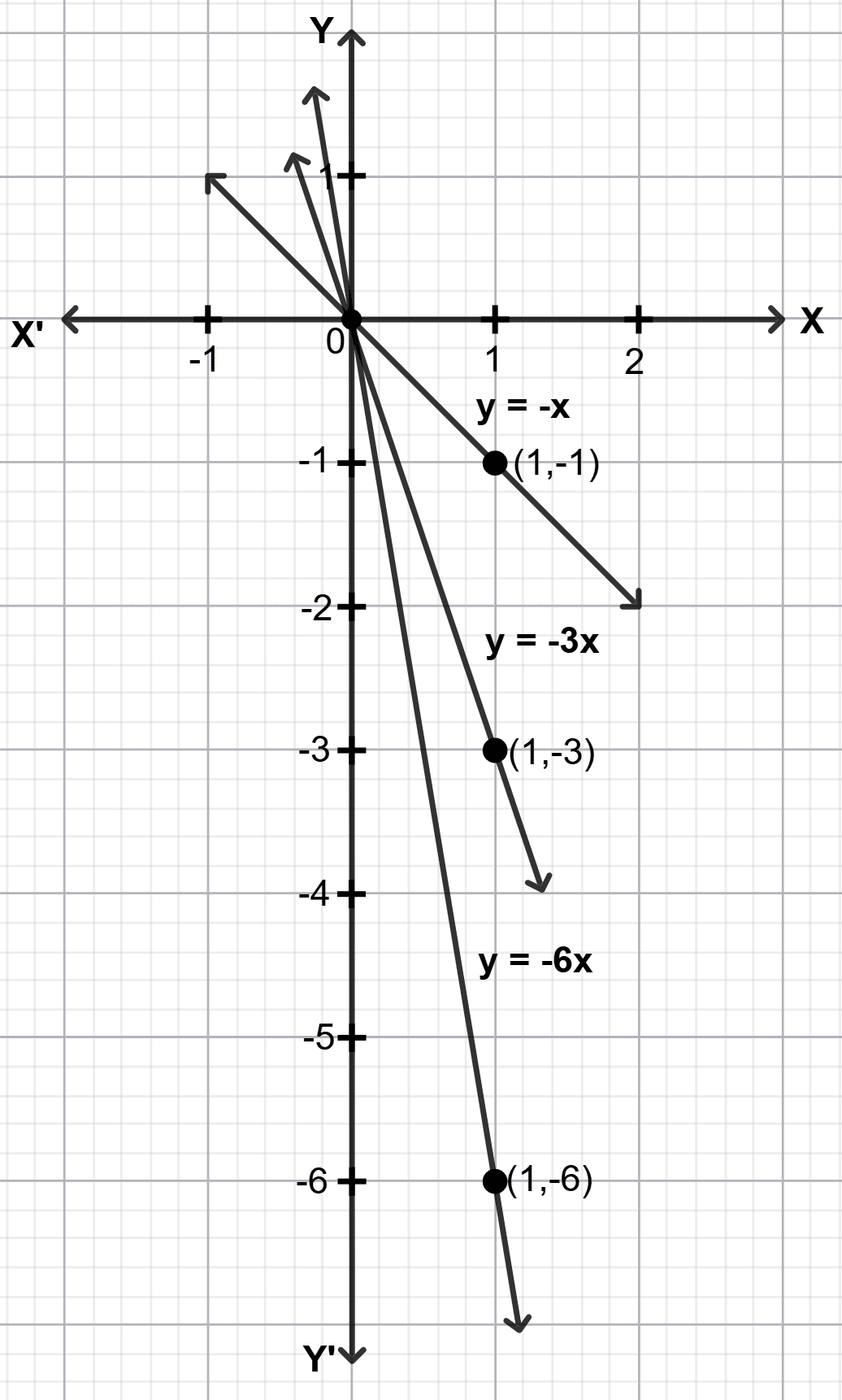
Observation:
All three lines pass through the origin (0, 0) since b = 0 in each.
All three lines have negative slopes, so they fall from top-left to bottom-right. As the magnitude of 'a' increases, the line becomes steeper. The line y = -6x is the steepest, while y = -x is the least steep.
(iii) y = 5x, y = -5x
For y = 5x: when x = 0, y = 0; when x = 1, y = 5. Points: (0, 0) and (1, 5).
For y = -5x: when x = 0, y = 0; when x = 1, y = -5. Points: (0, 0) and (1, -5).
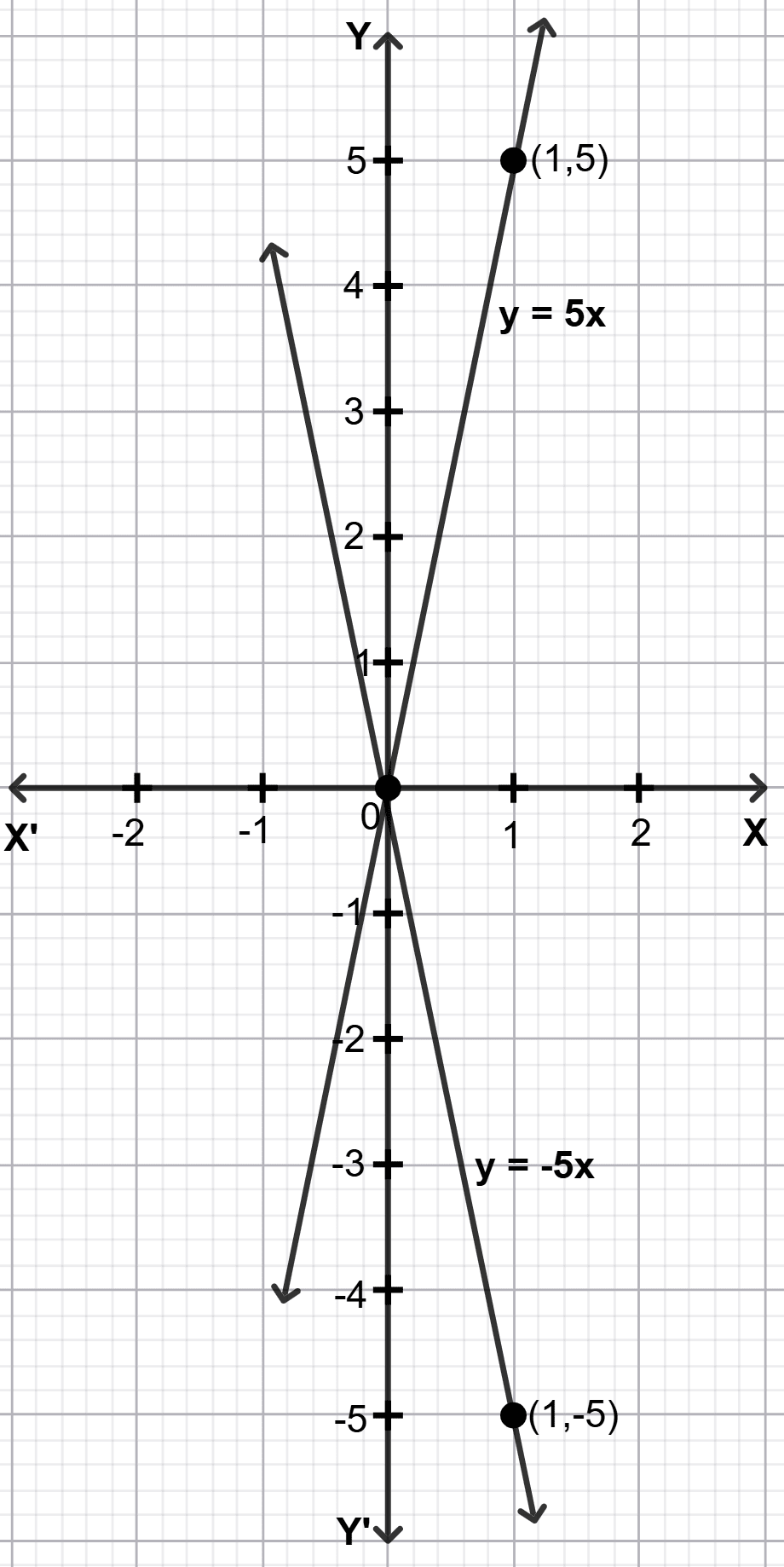
Observation:
Both lines pass through the origin (0, 0) since b = 0 in each.
The slopes are equal in magnitude but opposite in sign. The line y = 5x rises from bottom-left to top-right, while y = -5x falls from top-left to bottom-right. The two lines are reflections of each other across the x-axis (and the y-axis).
(iv) y = 3x - 1, y = 3x, y = 3x + 1
For y = 3x - 1: when x = 0, y = -1; when x = 1, y = 2. Points: (0, -1) and (1, 2).
For y = 3x: when x = 0, y = 0; when x = 1, y = 3. Points: (0, 0) and (1, 3).
For y = 3x + 1: when x = 0, y = 1; when x = 1, y = 4. Points: (0, 1) and (1, 4).
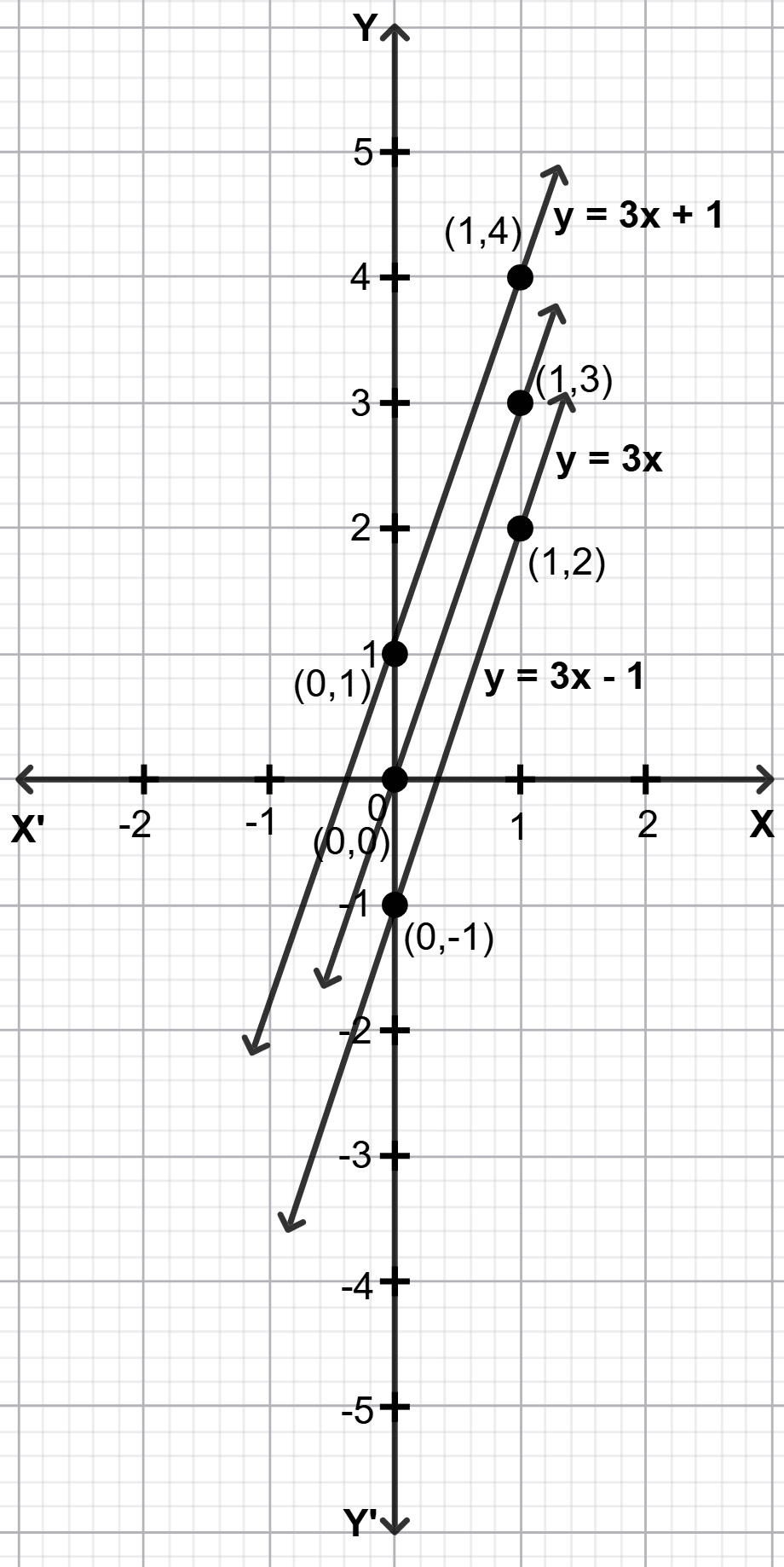
Observation:
All three lines have the same slope (a = 3), so they are parallel to each other.
The y-intercepts are different (-1, 0, 1). The lines cut the y-axis at (0, -1), (0, 0) and (0, 1), respectively.
When 'a' is fixed and 'b' varies, the lines are parallel and shift along the y-axis.
(v) y = -2x - 3, y = -2x, y = 2x + 3
For y = -2x - 3: when x = 0, y = -3; when x = 1, y = -5. Points: (0, -3) and (1, -5).
For y = -2x: when x = 0, y = 0; when x = 1, y = -2. Points: (0, 0) and (1, -2).
For y = 2x + 3: when x = 0, y = 3; when x = 1, y = 5. Points: (0, 3) and (1, 5).
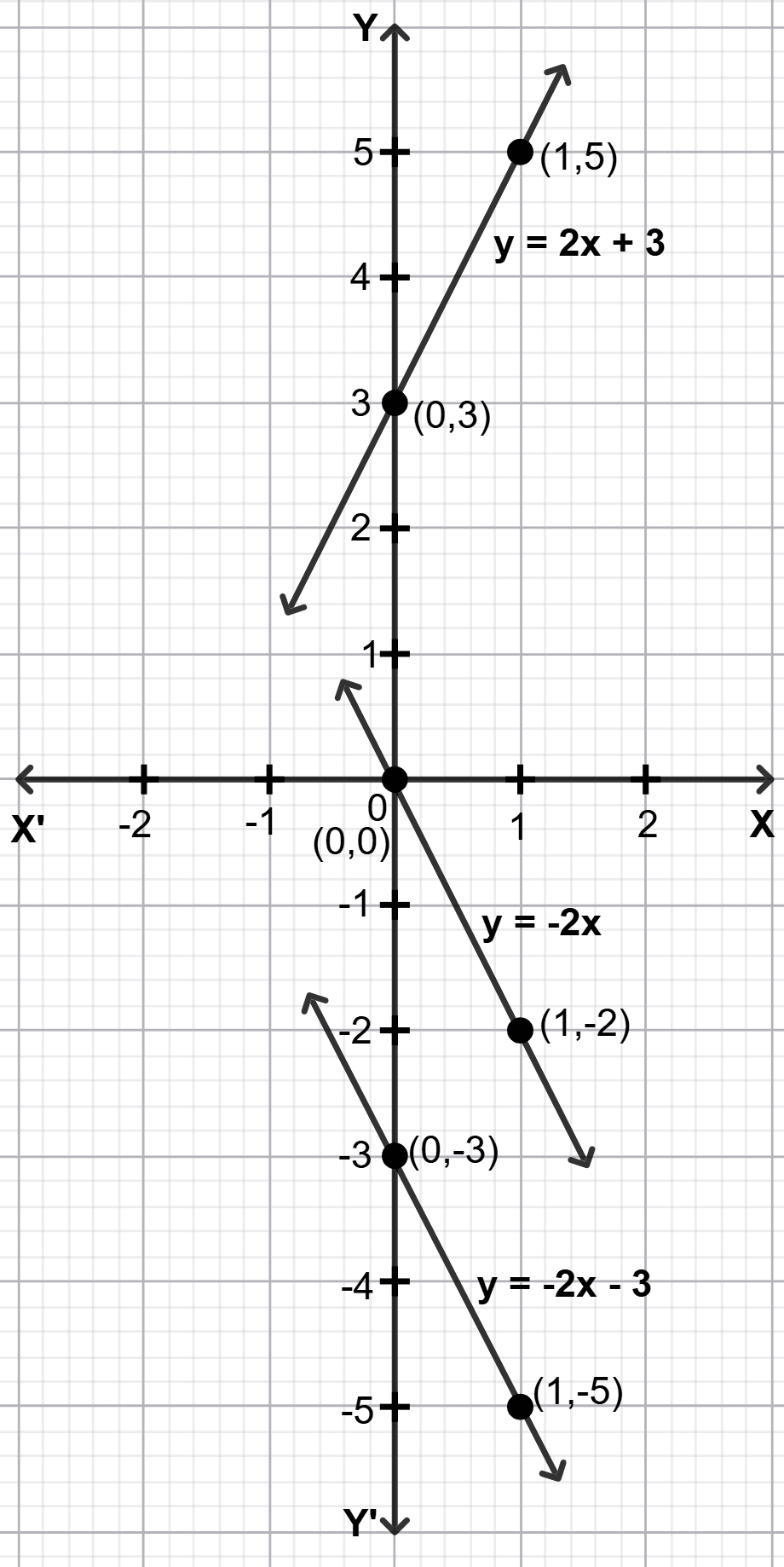
Observation:
The lines y = -2x - 3 and y = -2x have the same slope (a = -2), so they are parallel to each other. Their y-intercepts are -3 and 0, respectively.
The line y = 2x + 3 has a positive slope (a = 2), so it is not parallel to the other two lines. Its y-intercept is 3.
This shows that lines with the same slope (regardless of the y-intercept) are parallel, while lines with different slopes are not parallel.
Answered By
8 Likes
Related Questions
Differentiate between the graphs of the equations y = 3x + 1, and y = –3x + 1.
Does this help you to conclude anything about the linear equation y = ax + b when a is fixed but b varies?
Write a polynomial of degree 3 in the variable x, in which the coefficient of the x2 term is –7.
Find the values of the following polynomials at the indicated values of the variables.
(i) 5x2 – 3x + 7 if x = 1
(ii) 4t3 – t2 + 6 if t = a