
Physics
In the figure given below, a ray of light PQ is incident normally on the face AB of an equilateral glass prism. Complete the ray diagram showing its emergence into air after passing through the prism. Take critical angle for glass = 42°
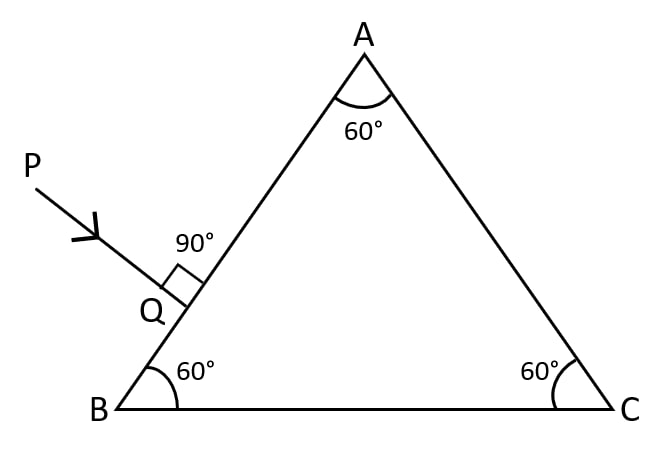
(a) Write the angles of incidence at the faces AB and AC of the prism.
(b) Name the phenomenon suffered by the ray of light at the face AB, AC and BC of the prism respectively.
Refraction Plane Surfaces
3 Likes
Answer
Below is the completed diagram showing the path of the light ray till it emerges out of the prism with all angles marked:
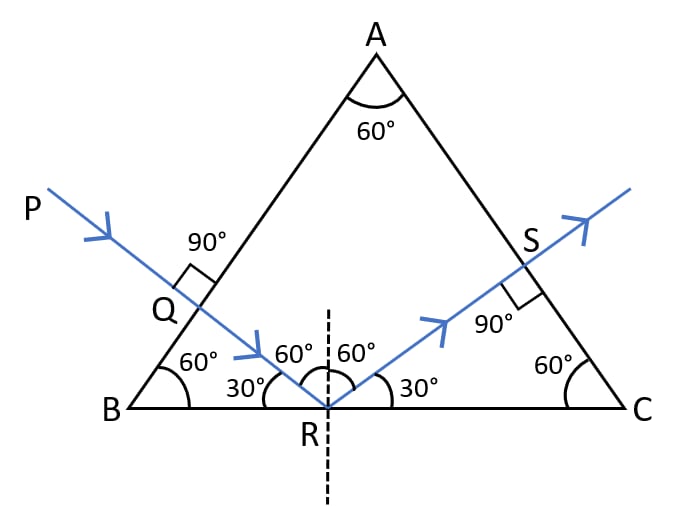
(a)
Angle of incidence at face AB = 90°
Angle of incidence at face AC = 60°
Angle of incidence at face BC = 90°
(b)
At face AB and AC — The ray of light passes undeviated
At face BC — The ray of light suffers total internal reflection
Answered By
2 Likes
Related Questions
A lens of focal length 15 cm forms an erect image three times the size of the object on a screen.
(a) What kind of lens is this?
(b) Find the position of the object from the lens.
(c) Find the position of the screen from the lens.
The diagram given below shows a ray of blue, yellow and red light incident on one face of a prism.
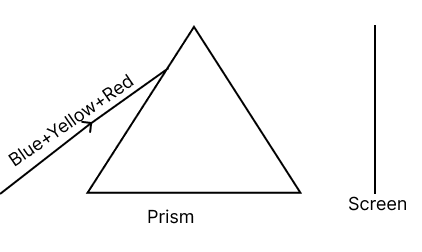
(a) Complete the diagram to show the effect of the prism on the ray of light and to show what is seen on the screen.
(b) A slit is placed in between the prism and the screen to pass yellow light only. What will be your observation on the screen ?
(c) What conclusion do you draw from the observation in part (ii) above ?
A uniform metre scale is in equilibrium as shown in the diagram :

(i) Calculate the weight of the metre scale.
(ii) Which of the following options is correct to keep the ruler in equilibrium when 40 gf wt is shifted to 0 cm mark?
F is shifted towards 0 cm
or
F is shifted towards 100 cm.
State whether work is done or not by writing yes or no, in the following cases?
(a) A man pushes a wall.
(b) A coolie stands with a box on his head for 15 min.
(c) A boy climbs up 20 stairs.