Mathematics
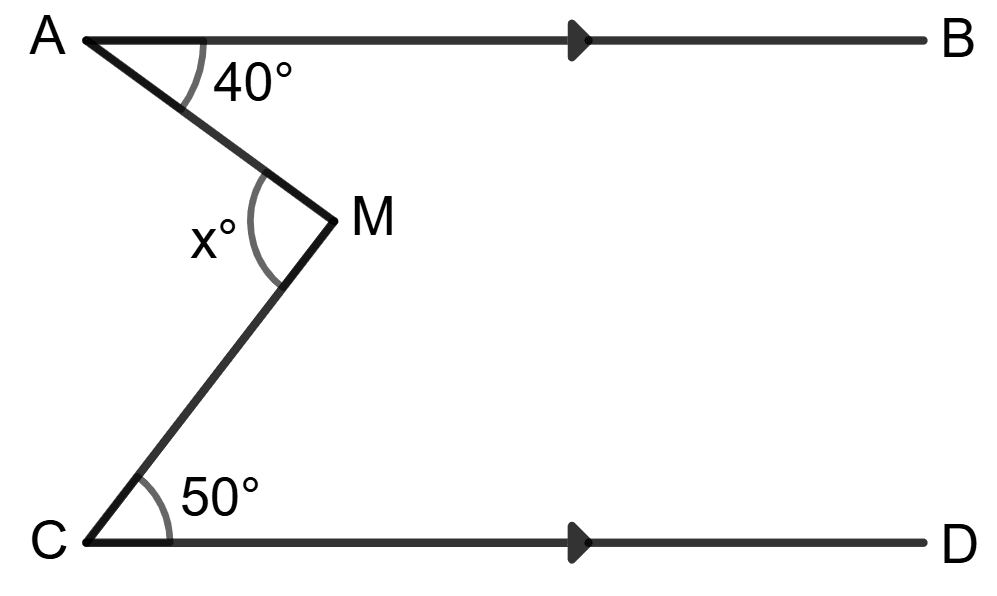
In each of the figures given below, AB || CD. Find the unknown angles, giving reasons.
(i)
(ii)
(iii)
(iv)
(v)
(vi)
(vii)
(viii)
Lines & Angles
2 Likes
Answer
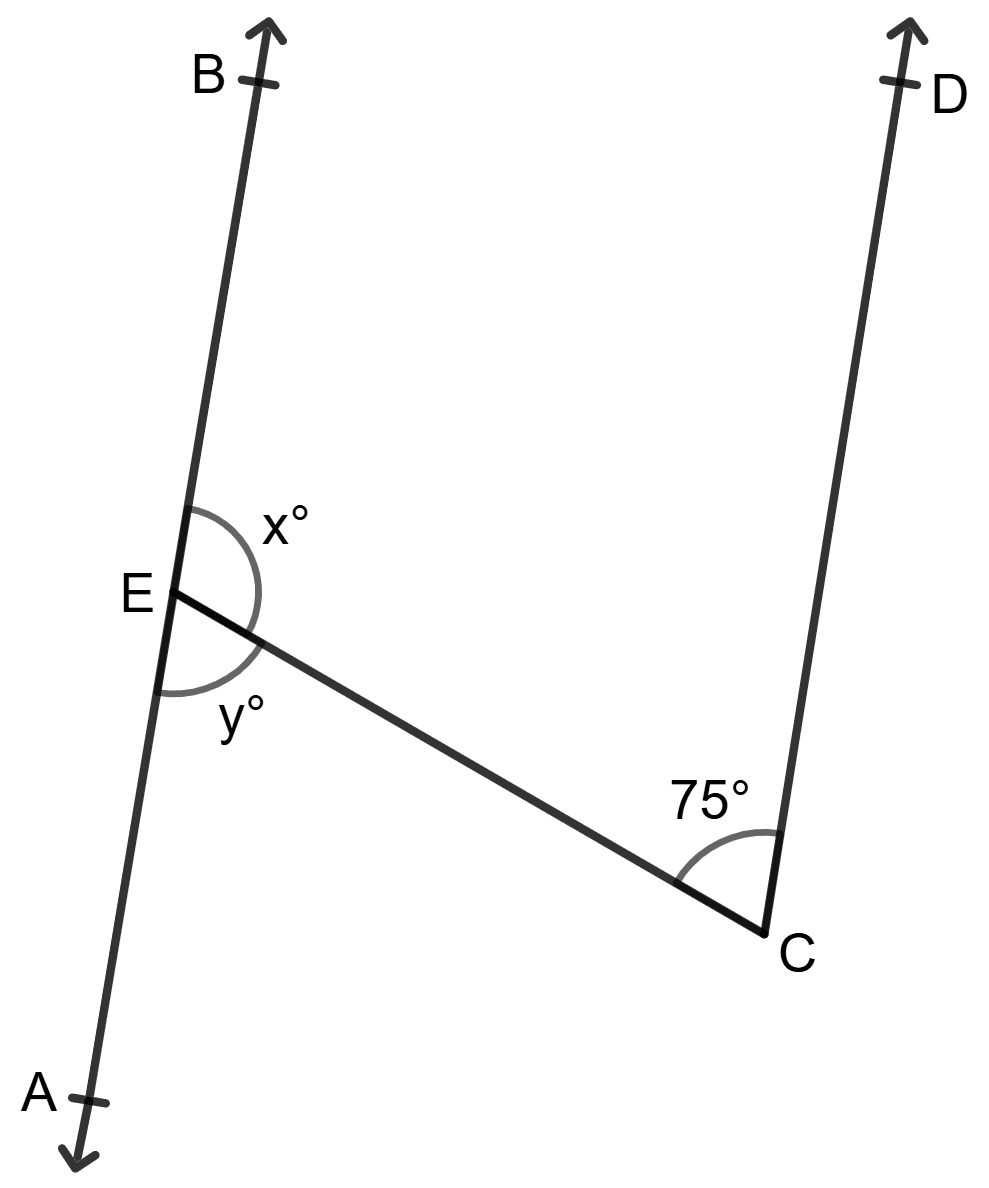
(i)
Given:
AB || CD
∠ECD = 75°
∠AEC = ∠ECD [Alternate angles]
⇒ y° = ∠ECD
⇒ y° = 75° [Substituting the value of ∠ECD]
Since, AB is a straight line:
∠BEC + ∠AEC = 180° [Linear pair]
⇒ x° + y° = 180°
⇒ x° + 75° = 180° [Substituting the value of y]
⇒ x° = 180° - 75°
⇒ x° = 105°
x° = 105° and y° = 75°
(ii)
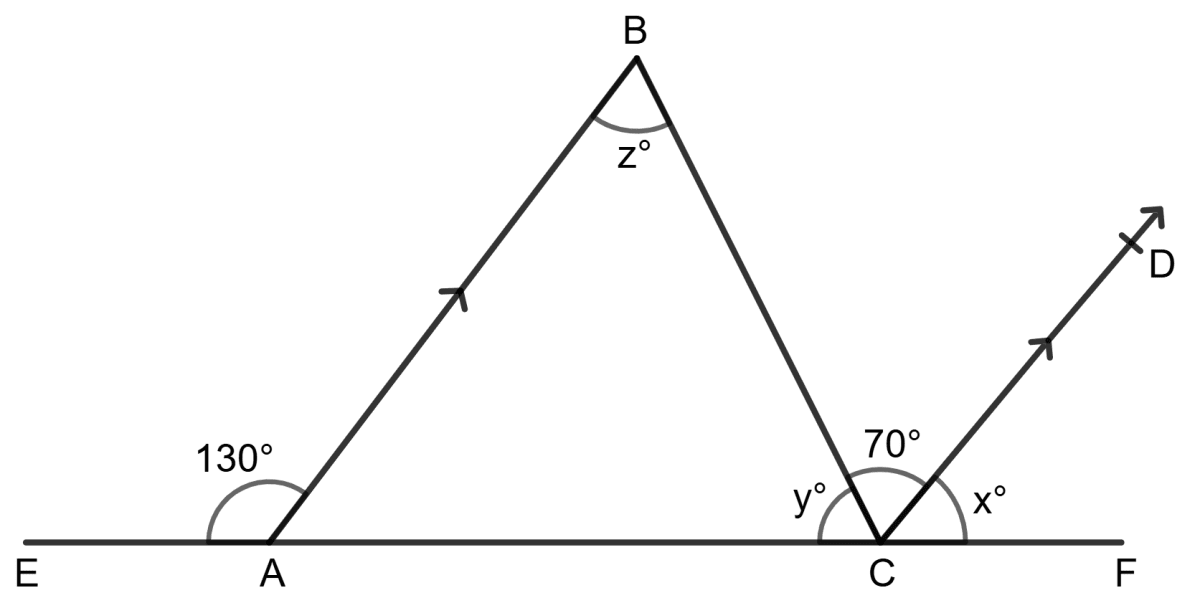
Given:
AB || CD
∠EAB = 130°
∠BCD = 70°
Since, EF is a straight line:
∠EAB + ∠BAC = 180° [Linear pair]
⇒ 130° + ∠BAC = 180° [Substituting the value of ∠EAB]
⇒ ∠BAC = 180° - 130°
⇒ ∠BAC = 50°
∠DCF = ∠BAC [Corresponding angles]
⇒ x° = ∠BAC
⇒ x° = 50° [Substituting the value of ∠BAC]
Since EF is a straight line:
∠BCA + ∠BCF = 180° [Linear pair]
⇒ y° + (x° + 70°) = 180°
⇒ y° + 50° + 70° = 180° [Substituting the value of x]
⇒ y° + 120° = 180°
⇒ y° = 180° - 120°
⇒ y° = 60°
In △ABC, we know that the sum of interior angles is 180°.
∴ ∠BAC + ∠ABC + ∠BCA = 180°
⇒ 50° + z° + y° = 180°
⇒ 50° + z° + 60° = 180° [Substituting the value of y]
⇒ z° + 110° = 180°
⇒ z° = 180° - 110°
⇒ z° = 70°
x° = 50°, y° = 60° and z° = 70°
(iii)
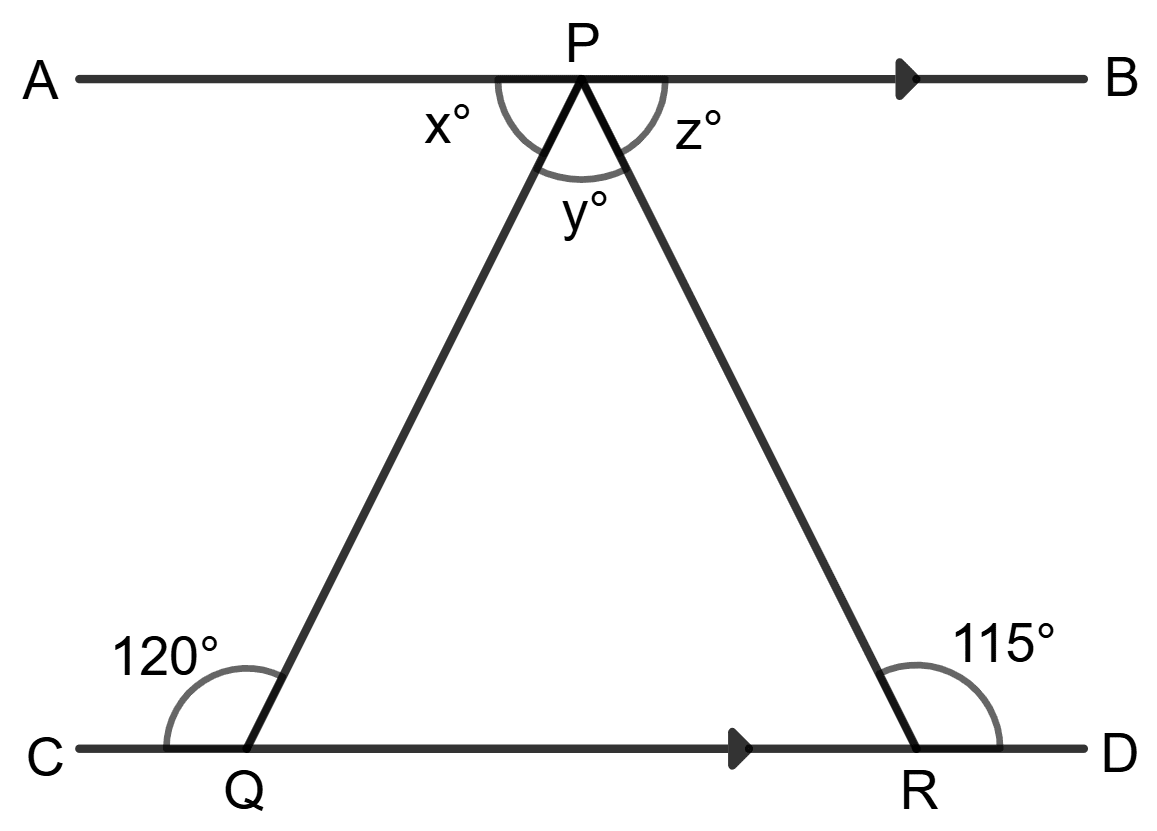
Given:
∠CQP = 120°
∠DRP = 115°
Since, CD is a straight line:
∠CQP + ∠PQR = 180° [Linear pair]
⇒ 120° + ∠PQR = 180° [Substituting the value of ∠CQP]
⇒ ∠PQR = 180° - 120°
⇒ ∠PQR = 60°
AB || CD and PQ is a transversal:
∠APQ = ∠PQR [Alternate angles]
⇒ x° = ∠PQR
⇒ x° = 60° [Substituting the value of ∠PQR]
Since, CD is a straight line:
∠PRD + ∠PRQ = 180° [Linear pair]
⇒ 115° + ∠PRQ = 180° [Substituting the value of ∠PRD]
⇒ ∠PRQ = 180° - 115°
⇒ ∠PRQ = 65°
AB || CD and PR is a transversal:
∠BPR = ∠PRQ [Alternate angles]
⇒ z° = ∠PRQ
⇒ z° = 65° [Substituting the value of ∠PRQ]
In △PQR, we know that the sum of interior angles is 180°.
∴ ∠PQR + ∠QPR + ∠PRQ = 180°
⇒ 60° + y° + 65° = 180°
⇒ y° + 125° = 180°
⇒ y° = 180° - 125°
⇒ y° = 55°
x° = 60°, y° = 55° and z° = 65°
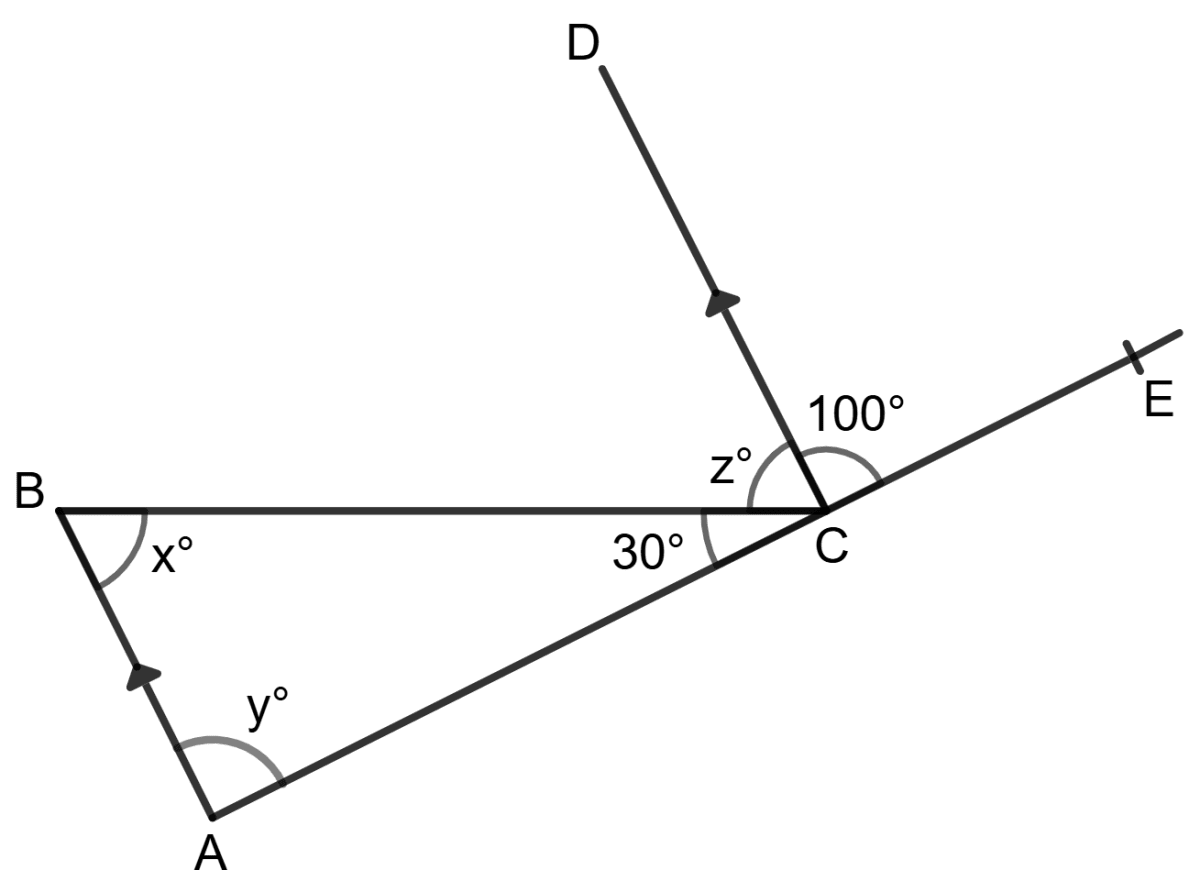
(iv)
Given:
∠DCE = 100°
∠BCA = 30°
Since, AE is a straight line:
∠BCA + ∠BCD + ∠DCE = 180°
⇒ 30° + z° + 100° = 180°
⇒ z° + 130° = 180°
⇒ z° = 180° - 130°
⇒ z° = 50°
AB || CD and BC is a transversal:
∠ABC = ∠BCD [Alternate angles]
⇒ x° = z°
⇒ x° = 50°
In △ABC, we know that the sum of interior angles is 180°.
∴ ∠ABC + ∠BAC + ∠BCA = 180°
⇒ x° + y° + 30° = 180°
⇒ 50° + y° + 30° = 180°
⇒ y° + 80° = 180°
⇒ y° = 180° - 80°
⇒ y° = 100°
x° = 50°, y° = 100° and z° = 50°
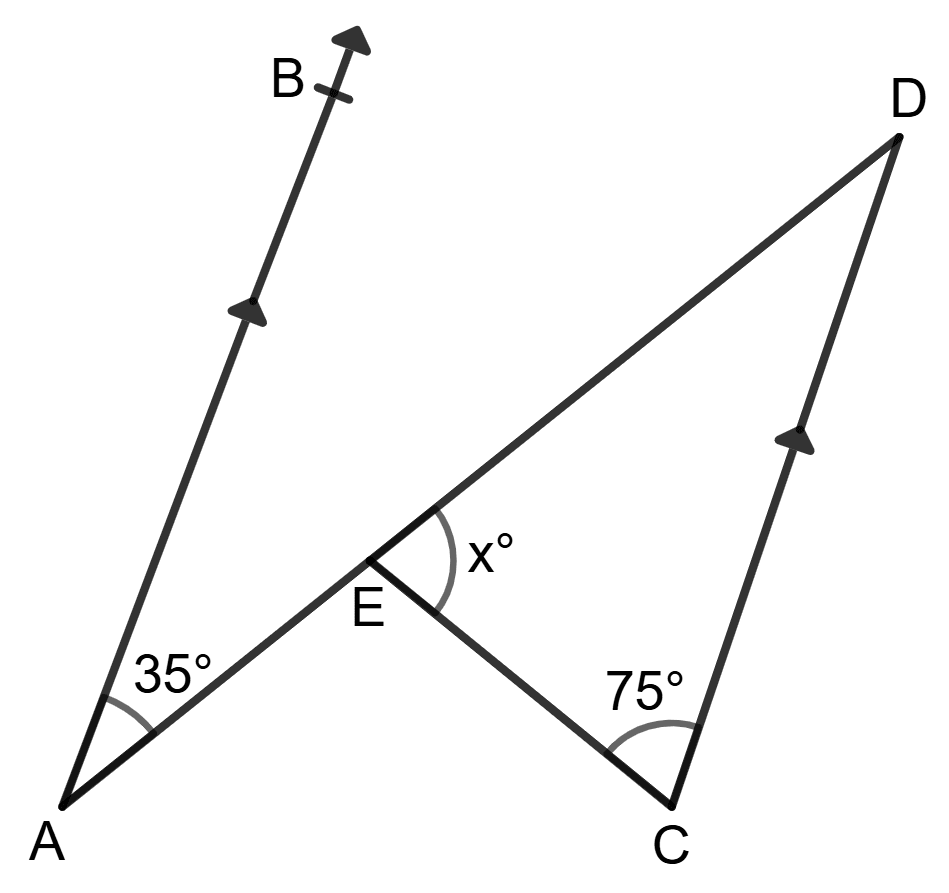
(v)
From figure,
∠BAD = 35°
∠ECD = 75°
AB || CD and AD is a transversal:
∠ADC = ∠BAD [Alternate angles]
∠ADC = 35°
∴ ∠CDE = 35° [Both are same angles i.e., ∠D]
In △CDE, we know that the sum of interior angles is 180°.
∴ ∠ECD + ∠CDE + ∠DEC = 180°
⇒ 75° + 35° + x° = 180°
⇒ x° + 110° = 180°
⇒ x° = 180° - 110°
x° = 70°
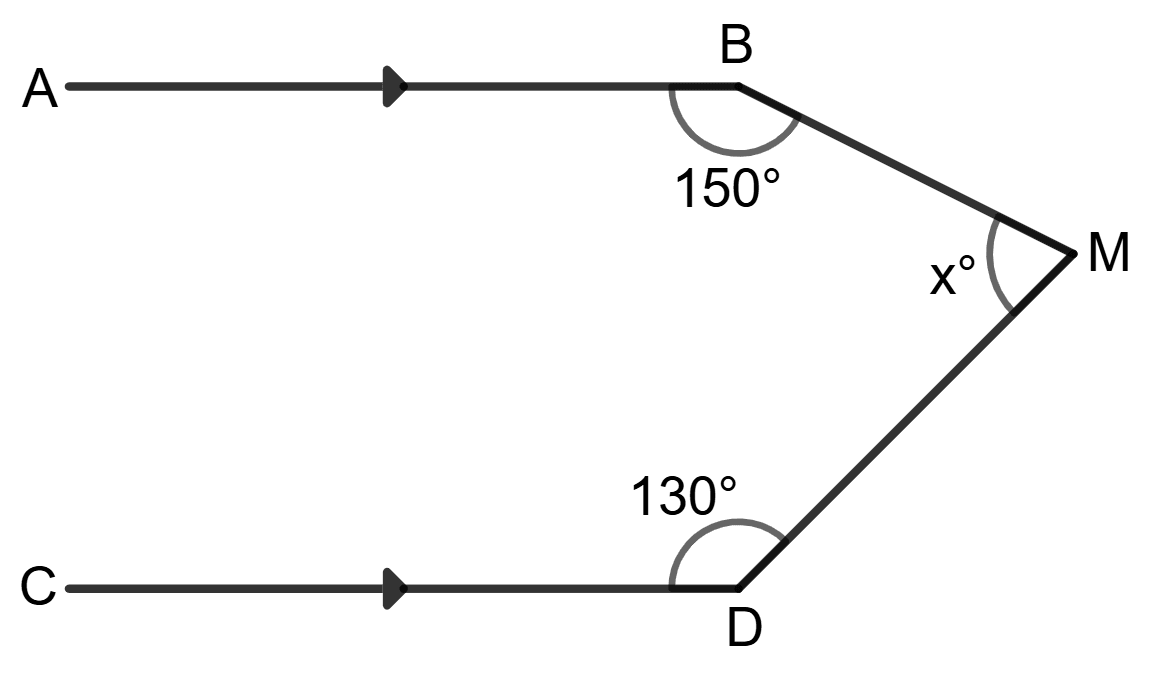
(vi)
Through M, draw a line EMF such that EF || AB || CD.
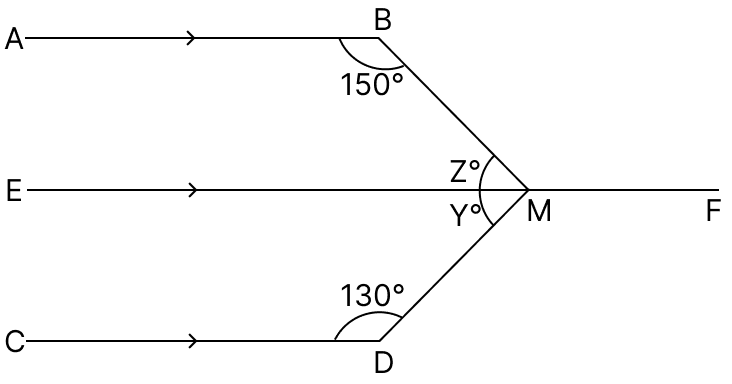
This line splits the angle x into two parts:
Let ∠EMB = z° and ∠EMD = y°
Now, EF || CD and MD is a transversal.
∴ The sum of co-interior angles is 180°.
∴ ∠CDM + ∠DME = 180°
⇒ 130° + y° = 180°
⇒ y° = 180° - 130°
⇒ y° = 50°
Again, Now, EF || AB and MB is a transversal.
∴ The sum of co-interior angles is 180°.
∴ ∠ABM + ∠BME = 180°
⇒ 150° + z° = 180°
⇒ z° = 180° - 150°
⇒ z° = 30°
x° = y° + z°
⇒ x° = 50° + 30°
x° = 80°
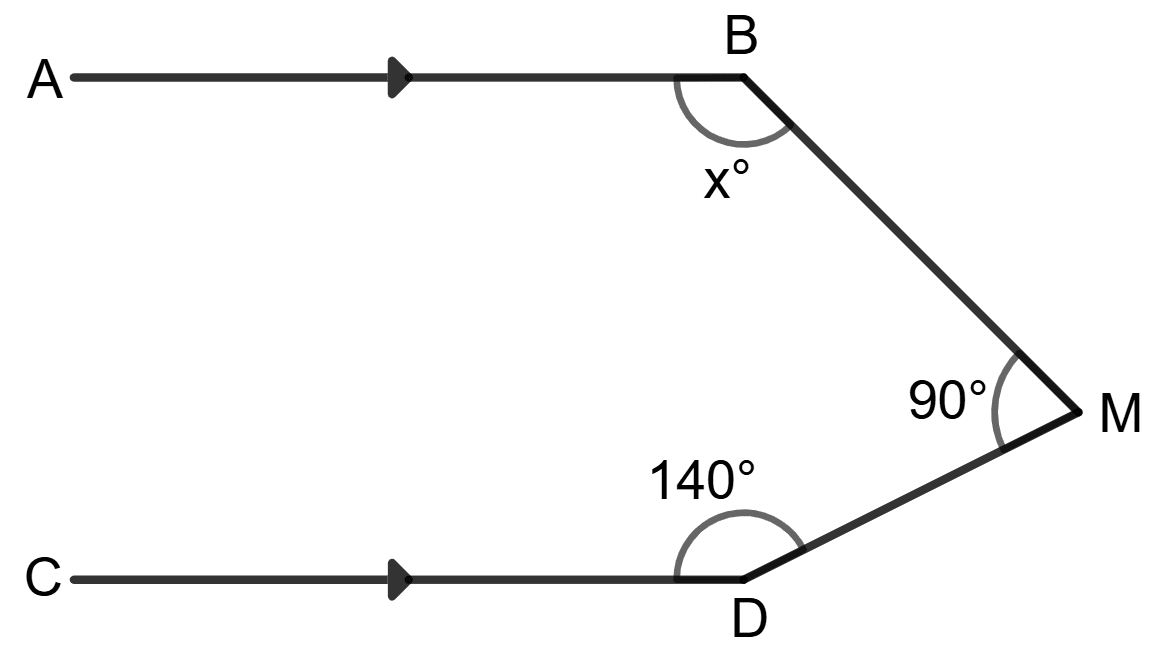
(vii)
Through M, draw a line EMF such that EF || AB || CD.
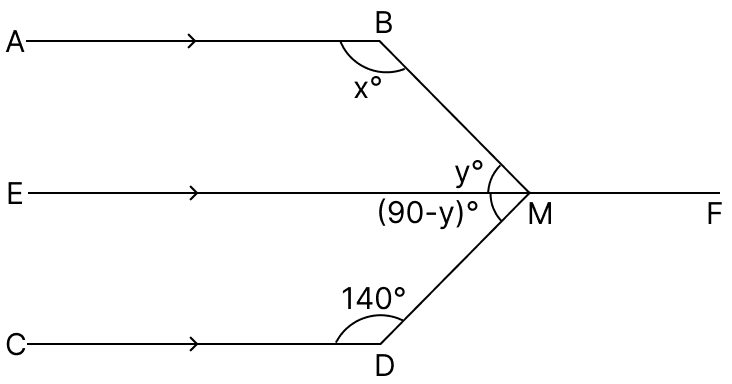
This line splits the angle at M into two parts:
Let ∠EMB = y° and ∠EMD = (90 - y)°
Now, EF || CD and MD is a transversal.
∴ The sum of co-interior angles is 180°.
∴ ∠CDM + ∠DME = 180°
⇒ 140° + (90 - y)° = 180°
⇒ 140° + 90° - y° = 180°
⇒ 230° - y° = 180°
⇒ y° = 230° - 180°
⇒ y° = 50°
Again, EF || AB and MB is a transversal.
∴ The sum of co-interior angles is 180°.
∴ ∠ABM + ∠BME = 180°
⇒ x° + y° = 180°
⇒ x° + 50° = 180°
⇒ x° = 180° - 50°
x° = 130°
(viii)
Through M, draw a line EMF such that EF || AB || CD.
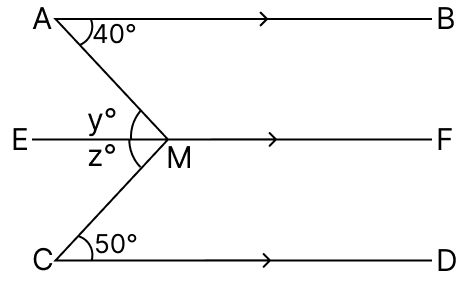
This line splits the angle at M into two parts:
Let ∠AME = y° and ∠CME = z°
Now, EF || AB and AM is a transversal.
∠AME = ∠BAM [Alternate angles]
∴ y° = 40°
Again, EF || CD and CM is a transversal.
∠CME = ∠MCD [Alternate angles]
∴ z° = 50°
x° = y° + z°
⇒ x° = 40° + 50°
x° = 90°
Answered By
1 Like